Showing posts with label permanent culture (permaculture). Show all posts

Saturday, July 18, 2009

Growing our own

It will astound most people to realise that a visit to the supermarket to buy food is a greater threat to our environment than all the pollution caused by coal fired power stations. Nearly 30% of the CO2 in our atmosphere is caused by us not growing our own food. Non-renewable energy is used to plough the fields, harvest and process the crop and take it to market. The fertilisers, pesticides and weed killers used to grow the crop are derived from oil. In fact 75% of the energy that is used to grow our food occurs once it has left the farm. The kitchen fridge uses more energy than the farm tractor. In some areas more energy is used to drive to the supermarket than is used on the farm. Up to 25% of the energy is consumed in wasteful packaging. Clive Blazey, Digger's Seeds

This week I planted 8 rhubarb shoots among indigenous grasses along the top of the dry-stone wall. You can't see them, their hiding in the mulch. Rhubarb likes well-drained soil and will grow in full-shade to full-sun conditions. Abundant for breakfasts or desserts for much of the year.

Also planted in aged, thick bush mulch are our broad beans. Frost hardy, their young leaves make a great winter salad. We collected our broad bean seeds from our brilliant crop last year. No money spent, just working within a system of cyclical regeneration, rather than linear death – supermarkets, wage-slavery, et al.

You can never go back to supermarket eggs after caring for your own chooks. They make great family friends. We free-range ours and pen in our vegies. Their shit is as golden as their eggs in a simple system of ecological-economics; circulatory reciprocity. No packaging -much goodness.

Digger's heirloom seeds are sowed tightly in this bed, and will be planted out later when the seedlings are bigger and our new raised beds are built. We typically get about 85-95% success rate with their seeds. A range of seeds including garlic, elephant leek, kale, snap peas, silverbeet, cos lettuce, spinach and broccoli.

The shed of interrelation, SOI (in progress). This will soon become our artist-in-residence shed for budding permies.

Tuesday, June 23, 2009

Chewers Borers Suckers

A friend of mine has some justifiable problems with the word 'permanent' and its use in the portmanteau 'permaculture' and in my portmanteaus 'permaplay' and 'permapoesis'. He writes:
I was reading Holmgren's 'Permaculture: Principles and Pathways Beyond Sustainability' last night and read a couple of passages which took me back to our brief exchange about the word permaplay, permaculture etc., and in particular to my mild general objection to the word 'permanent'. So I noted these passages when I read them: xxx "Even the idea of permanence at the heart of permaculture is problematic to say the least." And, xxvii 'The limitation of this concept of sustainable culture is that it suggests some stable state that we might arrive at sometime soon (by applying permaculture principles)".
It goes without saying that individual life is temporary. Cultures, however, are more ongoing. They are mutable and transforming, but ongoing. Some last longer than others, but of course no culture is totally permanent in a literal sense. The ones that last longer directly participate in, or mimic closely, natural systems. We can say these cultures are more permanent than others. The ones that die out more quickly have generally adopted linear, anti-ecological philosophies and economics based upon social divisiveness and relations of avoidance. As I've often quoted, the Dja Dja Wurrung lived in these parts for 40,000 years and aboriginal culture continues to survive in areas of Australia where their genocide was less fierce. Aboriginal culture is based on relations of common substance, they see themselves as contiguous with the world. If you compare continuous Aboriginal culture to our own, you can say it is permanent and ours is not, despite the fact that we have done everything in our power to make their culture impermanent like ours. We see ourselves as exclusive and separated, the corollaries of which (dioxins, warheads, plutonium, DDT) brand our culture abstract, fantastical and impermanent.

If you interpret the word 'permanent' in the above three portmanteaus as meaning 'static' or 'fixed' you've missed the point. Permanent here implies mutability. Nothing exists for very long in a rigid state. The most controlling regimes are generally the most vulnerable to collapse. Immutability equates to impermanency. The steady-state of a forest implies a forest in active, cyclical momentum, where everything is taken up by chewers, borers or suckers, used for life, excreted, only to be taken up and used again in a never ending cycle. The steady-state of a forest can only be mutable. Its health relies on constant change, active reciprocity and chance encounters. A natural ecology, operating within a non-hierarchical, closed-cycle where every organism is a participant, is what a modern permaculture mimics at a systems level. 

Our culture is currently predominated by post-structuralist philosophy: post-modernism. "Keep moving, even in place keep moving." (Gilles Deleuze). Post-moderns brought us some better thinking about race and gender and sexuality, and brilliantly critiqued the modernist male bully, but all this has done little to mitigate our abusive impermaculture. In fact our culture's aggression has only intensified over the past 30 years. Post-modernism coincided with psychopathic Neo-liberalism, as if they begat each other through oppositional warring. But by linear progression – pre-modernism, modernism, post-modernism – Po-mo is yet another urban-centric, ecologically disembodied school of philosophy that "rages against permanency." (Hamish Morgan). 

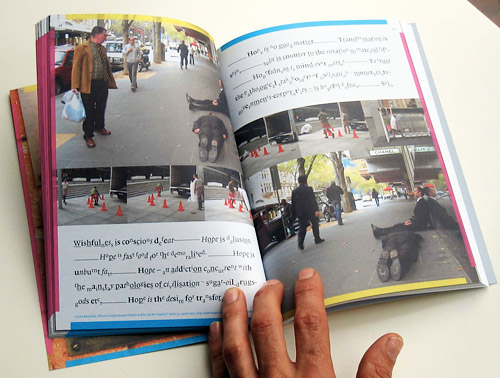
The sign below is representative of our culture. The three types of organisms found on Earth all coerced into being us, shooting off on their own singular path, everything operating autonomously, everything monological and separating out, everything getting closer to the end of their individual paths. Impermanence. Linear death. Chk chk boom.

Sunday, June 14, 2009

Waterless composting toilet

Since we started planning our permaculture garden two years ago we have given most of our energy to water conservation, renewable energy, heirloom food gardening, worm generation, composting, indigenous planting, companion planting and buying less and less items packaged in plastic. But we haven't yet got to black and grey water recycling and composting. So, after talking with a friend yesterday, who has just returned from a NZ permaculture farm where he saw a basic, home-made one in successful operation, I decided it's time to build a composting worm toilet in the guest shed. Any tips or good advice most welcome.
Design from here.

Friday, June 12, 2009

Steady-state for future growth

The word economics comes from the Greek ‘ta oikonomika’, which means the science of household management. It is how one takes care of one’s house. The word has suffered devaluation, and now means the management of money.

The word ecocide comes from Greek as well, ‘oikos’, meaning ‘house’, and ‘cidium’, meaning to ‘slay’ or ‘destroy’. Ecocide is the destruction of the house. Derrick Jensen
If you walk into a healthy forest it is brimming with life from deep down in the soil to the highest branch. If you walk into a paddock of industrialised agriculture there is only one or two species growing in dead soil, and there’s a heavy reliance on oil - tractors, pesticides, fertilisers – to keep these things alive. That is before anything is transported to our tables. Oil, of course, is running out. The forest provides our future model, the paddock represents the old school – John Howard, Milton Freidman, General Pinochet et al.

We have to get the carbon cycle back in balance and to do this, permaculture – based on steady-state economics – is the best ‘whole systems’ solution we have. Many will laugh now, but a gardeners’ revolution is the future; a return to localised, healthy food. Suits and hipsters will exchange briefcases, cafes and dark rimmed specs for pitchforks, raised beds and shovels. They’ll find a way to make them sexy, and good for them, while metrosexuals, the boys nature forgot, will actually grow muscle.

Wednesday, June 10, 2009

Shed of interrelation (in progress)

Click for bigger.

Tomorrow we start work on finishing the guest shed. The idea for this shed is to encourage artist and writer friends to come and stay and work on their various projects while contributing an hour or so a day to food gardening. Permapoesis is permanent meaning making. Sustainable food is central to sustainable arts practice. This guest shed will represent the coming together of these two things, the coming together of a modern permaculture.

Wednesday, May 27, 2009

Starting off

I first started gardening when I was in primary school. I watched my Dad striking Margarita daisies and asked him to show me how to do it. Several weeks later my first tray had struck more or less, and I had caught the propagating bug. Throughout high school I built up a collection of plants and designed and tended my own herb garden. I built a hot house and turned the old chicken run into a well ordered wholesale nursery. It was probably my nursery, writing, music, drawing, painting and first serious girlfriend that got me through my troubled high school years. 

Before I left home for art school I sold the nursery to pay for a 10 day white-water rafting trip down the Franklin River in Tasmania. This was my first excursion into the real wild. The interrelationship between mimicking ecology (permaculture gardening), creativity and wild nature forms my art practice today.

Monday, May 18, 2009

A steady-state crawl to self-sufficiency

It's been a year and a half since we started the garden. We began with a cleared block and one beautiful 30 year old oak tree. The soil we inherited was highly disturbed and compacted clay. Since we started we have brought in about 18 cubic metres of mulch, weekly collected green scraps from a local cafe, regularly gleaned brown biomass from the neighbourhood, occasionally bagged horse shit from the nearby horse farm, paid for mushroom compost, and free-ranged about 12 chickens. They're outside the window as I write. They bring us so much pleasure.

Here's what the garden looked like in November, 2007. The first thing I did was build a garden shed out of reclaimed materials and a dry stone wall to deal with the cut that our neighbours had created for their house site.


Over Summer this year we got up to about 25% self-sufficiency, while our indigenous grasses, banksias, wattles and sedges took root and began to grow. We failed dismally with both our sunflower and potato crops due to the lack of soil quality, but our leeks, corn, lettuce, garlic, tomatoes, broccoli, broad beans, snap peas, cucumber, onions, pumpkin, spinach, carrots, basil, strawberries, chillies, herbs and rhubarb were incredibly generous in what they provided for us.

So, this winter it's soil improvement time again. More raised beds are about to be built and I've just gleaned more top soil from local council works up the road, brought down by a friendly worker in his truck.

Here's what the garden looks like today.


With permaculture one mimics natural ecologies to grow food in healthy environments. In other words one establishes a significant connection between indigenous and exotic plants, microbes, insects, birds and animals. This constitutes a collective health based on diversity and relations of common substance. Hierarchy, or relations of avoidance, are not honoured here. That's why this garden is based on non-capitalist principals. It goes without saying we don't use anything synthetic on our land. We do, however, kill weeds on our drive by pouring boiling water onto them. This process kills microbes in the soil so we don't do it anywhere else in the garden. And there are many other ways we still behave like capitalists competing for dominance, and this is why our garden to date merely represents a steady crawl away from the dominant culture to a socio-ecological embedded life.

Friday, May 1, 2009

The level of denial


A number of years ago I was a participating artist at a land art event in Queensland. It was called The Floating Land 03. I installed three site-specific signs around Noosa. One along a bike path near to the regional gallery, one among the mangroves that you experienced by timber boardwalk, and one on Main beach.

The work on Main beach (pictured above and below) was gagged, or rather silenced for a short period during the event. Someone took offense and wrapped it up with fabric and gaffer tape. The reason I'm recalling this today is because I just read this quote by comedian Elayne Boosler:

"When women are depressed, they either eat or go shopping. Men invade another country".

The futility of this quote lies with the author's vision. She sees the two different responses to melancholy as being somehow unrelated. One is acceptable behaviour and one not. However the two responses are inextricably related. Man invades another country, justifies the destruction and theft of resources (by creating an enemy monster), makes more products with the resources to be consumed at home, which in turn fuels the illness of aggregate desire specific to modern capitalism. Both the consuming and the warring are acts of violence in modern life, only one is direct and one more mediated.

Unlike most of my friends I was sad to see John Howard go. Yes, I was. It meant an end to this horrible man's smug and mean spirited rule, but it also meant that we were heading back to the more indirect and veiled branch of the same party. As I expected, the Labor party has delivered almost the same government as Howard's, only with more fuzzy rhetoric and more sophisticated greenwash. Early in his office, after the Port Arthur massacre, Howard carried out his only good act as a politician, the disarmament of personal firearms. However, he made up for it later when he followed Bush's phony resource war to the Middle East. His logic: killing fellow Australians is inexcusable, however killing Muslims for fossil fuels is totally cool. Similarly, Rudd early in office, delivering his Sorry Day speech, brought us all to tears by 'fessing up to the brutality of white Australia; the genocides and repeated abuse of Aborigines by our very own colonising forces. The moral force of his words are still to this day just beautiful words, something educated people in positions of power are very good at displaying.

How many more years we have to wait for a politician to act morally is anyone's guess. Here, at the Garden of Self Defence, I generally don't dwell on what the Liberal-Labor party are up to. Many of the solutions to resource war, ecological destruction, male aggression, monotheistic colonisation, aggregate-growth capitalism, carbon emissions, genocide of indigenous cultures, pathologies of industrial agriculture, and abuse committed on non-human nature (by all of the above) can be found in community-based permaculture and heirloom seed gardening.


Photographs by Jonathan Sligh.

Monday, February 9, 2009

Street food: some minor alternatives to capitalism

Peter Tyndall opened my first (awarded) public work, Poemscape: a physical anthology, with a considerable talk critiquing the use of the word 'scape' and its problematic mediation of the natural world. We all baked facing west to a hot afternoon sun, listening to Peter outside the public library. The 18 Fujis that I planted, across the road from the town's supermarket, clung pathetically to sturdy timber plinths, each capped with a poem etched into a brass plaque. One of these poems was Michel Deguys' O great apposition of the world. I used three local poems, six Australian (from other parts) and twelve from other countries, each based environmental themes. Nearly ten years on, with various re-plantings due to drought and social idiocy, the trees struggle on. Each year I prune, water and feed them, and this is the first year the apples have coddling moth, which I'll need to treat over a period of time. 


This afternoon Maria, our neighbour, dropped over a large bag of green apples, produced by her trees. "No good for eating", she said, "but, OK for stewing". So I harvested what little rhubarb we had left and made a combined stew. For breakfast in summer we usually have organic rolled oats, that we buy in bulk, with stewed fruit or currants and local apple juice. In winter we make porridge and add local honey. The only time we have to visit a supermarket is when we have been disorganised, and missed the small produce shops or the Sunday market. Each time I walk into a supermarket I feel ambushed, and the more I learn about industrial agriculture and the plastics industry the more difficult it is to actually buy anything from these centers of mediated and fluorescent violence. 


Many people are talking about post-capitalist strategies. Here's a few of mine: If you are in the city join or start a permablitzing community, if you're in a rural area grow your own food and buy, swap and glean from local growers. If you're into graffiti, plant fruit trees – think espaliered tags – where council workers might ignore or not see them until they are established. Official public art, such as my Poemscape, seems passé today, but all of this thought and activity is in transition from a broken cycle toxicology to a closed-cycle ecology. We need to get incrementally better at the latter in order to mitigate the former.

Tuesday, January 27, 2009

Possibilities (or, this is what an anarchist government might look like)


OK, we've just stepped into office. We got there because we asked everyday Aussies to donate five bucks to our campaign (Obama style). We raised truck loads and while campaigning hard we used the excess money to implement 78 community permaculture gardens Australia-wide. We have another 221 ear-marked to start up in the next six months. We don't owe business one dollar, and like George Monbiot we refuse to dine with industry. As you can imagine they are shitting themselves.

The first 7 changes in this first week in office will include:

1. In consultation with indigenous Australia demolish the states and reform local governments based on traditional aboriginal tribal lands - the natural food and water bowls of Australia. Our federal government will merely oversee and encourage localised initiatives, education and activities based on indigenous knowledge and ecologically-sound economics.

2. An education programme to slow breeding. Indigenous Australia have practiced a highly successful 'biophysical economics' (Herman Daly) for over 40,000 years. Aboriginal culture is based on breeding only to numbers that the land can support. Infanticide was a strategy of their permanent sustainability. We would adapt this to a voluntary extinction gift, or a non-baby bonus (PO) in the form of heirloom vegetable seeds, recycled costumes (MU), spices wind-sailed from Asia (JW), the latest in recycled computer technology and traditional musical instruments. Breeding today is not a noble and selfless act, especially in large numbers, it's a religio-capitalist ploy to boost productivity-profit and therefore violate the landbase (just ask Peter Costello, who we've sent to work in one of the Djadja wurrung compost fields). Capitalism, based on dangling eternal fantasies in front of the dutiful consumer-parent, so as the idea of more consumerables is even more pleasurable than the products themselves (David Graeber), feeds directly into the fantasy of the ever-expanding family and therefore into baby production. Australians will be educated and rewarded to only have one or two children at most, preferably none - the most noblest act of all.

3. All rights relinquished (IR). A community-specific programme for the abolition of copyright and the advancing of the arts as a fully de-capitalised social gift ecology. Artists, writers, poets, filmmakers and musicians will gift their work to the communities that they themselves participate in. In return the community will support them in terms of shared resources. Celebrities and other toxicultural figures will join Peter Costello in the compost fields. More on this here.

4. Non-compostable waste producing industries (including the arts) will be cast adrift with no government backing or future support. The government will insist that local governments only back industries that use a 'biophysical economics' model. All previously government-supported private industry will be axed and industries that can not adapt ecologically will be bought by the government. Privatisation of public commons will become a thing of history. All other industries will be put on notice to change their operations within 12 months.

5. Aboriginal land tax for the sale of all private property (PO). Each time a piece of land is sold or resold revenue will be taken from the sale and go directly to the establishment of a local indigenous centre, or the maintaining and further developing of existing ones. These centers will foster indigenous culture - art and food covers all areas of life - and foster indigenous sustainability knowledges, which would feed directly back into the wider community. Private property owners who plant and maintain permaculture gardens will be exempt from paying tax or rates on the land, and will be given a permacultural allowance to provide food ethically - 'within walking distance' (RP) - grown for their families and friends. Private property owners who employ indigenous land consultants will be given further incentives (to be advised by the local indigenous communities at a later date).

6. The removal of all religious indoctrination and packaged-processed foods from schools. This hardly needs justification, but if you require more information please leave a comment below. Similarly, secular ignorance of religion will not be tolerated. All schools will teach the history of religions, focussing on religion's involvement in the establishment of private property and the tendency for religious supremacy to create resource wars. Food gardening will replace all religious indoctrination lessons.

7. Art auction houses (such as Christies and Sothebys) will turn all of their artifacts over to public cultural centers. Those works deemed to be not interesting or amusing enough will be garage-sold to the public. Each household can choose up to three works only, collectors will also be delegated to the compost fields. The proceeds from the art sales will go to detoxifying the arts industry with education programmes aimed at educating artists about food and survival in a post-capitalist world. The film and music industry will become heavily digitised and everything freely available online. Film projects that produce as much as one empty Mt Franklin plastic bottle (or equivalent) will be shut down.

After such a good start we're all going to celebrate with some Astrid Lorange home brew. Over to you comenteers for our next week in office.

Monday, January 19, 2009

All rights relinquished (or, 'Copyright Nothing' after The Fugs)

To get this post started, here is my 3-step, de-evolutionary path for a fully de-capitalised (and de-celebritised) culture - permanent culture (permaculture); culture of the mutable and unwashed.

1. All rights reserved - antiquated copyright and intellectual (private) property laws.
2. Some rights reserved - creative commons (transitional phase).
3. 'All rights relinquished' (Ian Robertson) – total abolition of the arts-as-capitalism's-slut.

Today I received a generous, although inflexible, comment from one of my favourite counter-culture bands of the sixties – The Fugs.
Hi Patrick. We, The Fugs, strongly recommend you delete your soundtrack from your film. We are honored that you have chosen us as a backing for your flicks, but unfortunately you are breaching copyright. We wanna keep the music bizo clean if you know what we mean. Musak is always a safe option. Love your blog btw. Fugz
What surprised me most was the language: "clean" and "safe". If you know The Fugs you'll know their music is neither clean nor safe, but very much unwashed and alive.

I chose to comply to the request for two reasons: Firstly, the bourgeois-training of my boyhood still responds well to politeness and good manners, and secondly, because I don't want to use music to accompany my (incidental and non-commercial) films by artist's who have contradictory values between what they make and how they act. My art and my values aim to 'bring down civilisation' (Derrick Jensen) and the culture of the 'Great Washed' (Alastair McIntosh), in small, everyday, bite-sized pieces. And besides, there are plenty of musicians who support this kind of de-capitalising anarchy. Artists and bands I have used for my films in the past, and who have not censored me (as yet), include:

Nightmares on Wax
Caribou
DJ Spooky
godspeedyou! blackemperor
esmerine
Aesop Rock
Howe Gelb
Justin Townes Earle

To name a few. Although once again, I have not sought approval to use their material as my work is strictly non-commercial and, in general, I do not acknowledge property rights for art. I do however take very seriously due acknowledgment of borrowed material, especially because it shows nothing is autonomous (and private) and everything is borrowed and shared.

Copyright is an embedded pathology of a civilised toxicology (impermanent culture) obsessed with transporting resources (mediated goods and food) and mediated celebrity. This toxiculture is an unstoppable fireball so ingrained in our skulls that even our beautiful (and dirty) old hippies buy into it. Who cares that artists are supported in the communties that they inspire (online and offline)? I do. Who cares that artists aren't paid for their goods? Not me. Who cares where artist's food comes from? I do! It comes from the soil that they help to improve and de-toxify, so as the vegetables, meat and fruit they eat and share no longer participate in a petroleum-based agriculture responsible for so much violence.

Yes, I acknowledge that my digital-anarcho-primitivism is problematic as the waste generated by the tools that make online art is unfathomable. My belief that 'progress is killing us as much as it is enabling us new possibilities' is, I admit, representative of my values in contradiction. However, the blogosphere has the potential to curb the secondary tier of art (the first being the conceptual) – the manufacturing of goods and other property including the intellectual. Online art also has the opportunity to take art back to its roots: to play in the space of the everyday. The film that The Fugs required I take down (I couldn't just delete the sound because I'd already deleted the master file from my ancient, overloaded laptop, and it only exists as an uneditable compressed Mpeg4), showed the flying fox I made for Zephyr and his friends. This 1.36 min film was called 'Permaplay' after 'permanent play', a fundamental of permaculture (Holmgren, Mollison), or permanent (sustainable) culture.

Impermanent culture is based on the immutable (the idea of universals such as copyright and God) – and on the toxicultural activity that springs from mediated life, removed from the landbase that supports us. On the other hand permanent culture (permaculture) is based on the mutable – the flux and chance of ecological life, where waste does not exist as everything is used and reused in a dynamic cycle of regeneration. Ironically, The Fugs' track that I used was their piss-take on the great immutable Ten Commandments.

W B Yeats' line from his poem Lapis Lazuli, 'all thing fall and are built again', is not a flawed generational hangup, and its timelessness doesn't make its very idea immutable, rather generationally adaptable. One of my favourite Fugs song is the 'Nothing' song, where everything is nothing, "Monday nothing... New Yorker nothing... Hanging out in Folkways nothing..."etc., including big Fug-fan Allen Ginsberg - "Nothing, nothing nothing!" This is the spirit in which the world becomes everything, where things' values aren't placed in an order of hierarchy or private property (David Graeber), but are shared monistly on ecologic grounds.

Wednesday, January 14, 2009

Consumption (or, it's Permablitzing time!)

So far I've been impressed with David Graeber's book, Possibilities. His first essay, "Manners, Deference, and Private Property: or Elements for a General theory of Hierarchy", has been used in various posts here over the past several weeks. His second essay concerns the very idea of consumption, and he naturally begins with some etymology.
The English "to consume" derives from the Latin verb consumere, meaning "to seize or take over completely," and hence, by extension, to "eat up, devour, waste, destroy, or spend". p.59
Graeber argues that if we were still speaking a fourteenth century dialectic a consumer society would mean 'a society of wastrels and destroyers'. 
...wasting diseases "consumed" their victims: a usage that according to the Oxford English Dictionary is already documented by 1395. This is why tuberculosis came to be known as "consumption". At first, the now-familiar sense of consumption as eating or drinking was very much a secondary meaning. Rather, when applied to material goods, consumption was almost always synonymous with waste: it meant destroying something that did not have to be (at least quite so thoroughly) destroyed. p59.
I fail to see how anything has changed since the fourteenth century. Waste and destruction have only intensified with population expansion placing greater and greater pressures on the Earth's ecologies. Graeber almost never writes using ecologic language, and I would guess he is an urban dweller who buys his food in from across the country and from overseas wrapped in plastic. However, his writing is nearly always suggesting an ecological revolution because he understands the toxic corollaries of twenty-first century capitalism, and where it has come from. Once we have a fair grasp of the pathologies of late-capitalism, it's time to turn to the solutions, as David Holmgren might say; it's time to permablitz the world.

Thursday, January 8, 2009

Tent city

Camping in a caravan park is essentially returning to social habits that are more welcoming and less gated. The thin sheets of canvas or tarpaulin that barely separate us all allow for greater spontaneous play and sharing of resources.

Where Permaculture is a blueprint for our species' survival in terms of food, tent cities are the future for sustainable shelter and social warming.

A permanent culture designs for constant flux. Flux and mutability is possible when land is made available for collective use, and not owned privately. Impermanent culture, or Judeo-Christian-capitalism, designs for dominance and permanency at the expense of the landbase, and thus the social base. Judeo-Christian-capitalism is the dominant hegemony responsible for global warming. No doubt the fine Jew, Jesus Christ, is deeply saddened by the 1600 years between St Augustine and George W Bush, that have paved the way for hierarchy and sociopathy to so blatantly lead the attack on the ecologies which support biodiverse life.


Zeph finishing breakfast, about to join the neighbouring kids for a hit of cricket at the council-run caravan park at Port Fairy.

Sunday, December 21, 2008

A de-civilising process

At this point, I can turn to Norbert Elias' argument about the civilizing process in Europe...essentially it came down to the attempt, largely on the part of middle class religious authorities, to improve the manners of those below: most of all by eliminating all traces of the carnivalesque from popular life. David Graeber, Possibilities, p31-32.
Earlier in his book David Graeber writes how gradually, from the twelfth century onwards, the social authorities imbibed a culture of shame and embarrassment for all things bodily – excrement, sex, etc.; things of common substance and their joking relations – think Rabelais’s dirty humour.

Property relations, not sacredness, was the rationale behind the church's enforcement of celibacy onto its priests. The eldest sons of priests were too often claiming church property as their inherited own, and the papacy cracked down on the loss of church property. If avoidance relations are so linked to property, as Graeber suggests, then it is little wonder that the ensuing culture of sex-secrecy – developed by so many priests struggling with celibacy, culminating in paedophilia and other abuses of power – has in turn led to the selling off of acquired properties to fund the thousands of law suites lodged by victims of their cause. It’s an interesting, sad and ironic several hundred-year cycle of avoidance, only checked due to recent demands of accountability on religious institutions by secular authority.

Every year in Daylesford there is a New Year’s Eve parade where various community groups and artists create themed floats or parade various skills, activities and crafts on foot. One year cartoonist, Michael Leunig, with some friends made a float using two inflatable sex dolls. It was called something like 'the garden of love'. The local authorities didn't share the humour and arrested them for public indecency, including the dolls. At the courthouse, while the trial was being heard, the male doll was brought into proceedings by a local cop who’d put a paper bag over his penis. A large group of locals, including kids, turned up to express their support for Leunig's float. I believe there was not a single local person against it. 

Last year, my own somewhat less contentious parade concept was in aid of my water activism; also using joking relations (based upon the behavioural relations between chance and cross-dressing). The purpose of this costume, after the joke for joke's sake, was to draw attention to a local thing of common substance – water, and its privatisation by Coca-Cola Amatil and Cadbury Schweppes for global profiteering. Meg handed out stickers that directed people to the justfreewater myspace page and over the next several days I watched my stats counter on the site grow measuredly. 


Photo: Peter O'Mara (as you can see he won't make Best Australian Photography, 2008, but he is included in this year's Best Australian Poems, UQP).

Zeph's mum, who was at the parade earlier on to drop Zeph off, made the joking remark, “no wonder we didn’t make it”, when she saw what I was wearing. Meg later jokingly said to me, “that’s why you're with me now”. Meg was dressed deliciously, as you’ll no doubt agree.

Photo: Peter O'Mara 

My ex-partner was raised in a Christian household. Her parents were missionaries, her dad become a scholar and translator, responsible for overseeing versions of the Bible into Chinese and other Asian languages. 

Sadly, his daughter and I now only have a relationship of avoidance based upon property rights, which regrettably over-rides a relation of common substance – our child. And it is tied up with the pressing issue of whether or not to sell the quarter acre, that constitutes the physical entity that partly feeds us and this blog: The Garden of Self Defence. 

Most people, most likely, relate with all three of the modes that Graeber and anthropologists before him have outlined: with avoidance, with jokes and with common substance. However, it remains to be seen whether the dominant culture, based on private property, waste and wealth generation – abstractions of avoidance in terms of the landbase that supports us – can ever close the broken cycle generated by capitalism's corollaries, and become a society more dominantly based on common substance again: children raised by whole communities; food not transported but grown within walking distance; natural resources not transported away from food and water bowls – in essence a permanent culture, based less on manners, restriction, hierarchy and capital growth, and more on an understanding of our place within a local ecology – where we consciously particpate in securing a sustainable and permanent future for those who come after us. A gift that has been provided by those who have come before.

Wednesday, December 3, 2008

The crow and the chook

The eagle, the crow and the bat are the three totems that belong to the local mob – the Loddon tribe of the Djadjawurrung people, a clan of the Kulin nation – local, at least, to where I live.
Aborigines saw man as sharing a common life-principal with animals, birds and plants. They embraced all these in human social and religious life by establishing totemic relationships between them and people. (A P Elkin, 1967, from The Loddon Aborigines, Edgar Morrison, p.17., private press booklet, 1971, from articles published in the Daylesford Advocate newspaper 1963-1971).
The Loddon Aborigines, as anthropologists like David Graeber might suggest, had relations of 'common substance' with the land – a closed-cycle, single-broken-line homeostasis, where the body (as tribe) is contiguous with everything else. Here, the closed-cycle represents the tribal land, a clearly delineated food and water bowl where nothing is wasted, and the single-broken-line represents the necessity for other relations outside of this land.
Within these clearly defined boundaries their hunting rights were ordinarily respected by their neighbours with whom they normally enjoyed friendly relations and a measure of collaboration and inter-marriage. (The Loddon Aborigines, Edgar Morrison, p16., private press booklet, 1971, from articles published in the Daylesford Advocate newspaper 1963-1971).
This kind of collaboration can occur because the line is permanently broken. By contrast, the gated-existence model of industrial civilisation – the privatisation, capitalisation and transportation of resources – is represented as a solid double=white=line; a line of brutally imposed impermanent or throwaway culture.

Last night at a meeting at the Daylesford Town Hall, David Holmgren, co-originator of Permaculture, spoke with climatologist Rob Gell, in relation to the funding of a community-owned wind farm, Hepburn Wind. After their presentations, I asked them whether 6-7 years was a realistic timeframe to make the transition from industrial civilisation to a zero emission, water, energy and food relocalisation system, such as what we are attempting, with permaculture principals, in the Garden of Self Defence. Gell said effectively that yes, 5-10 years is the timeframe for radical change and that runaway climate change will result if we don’t all act significantly within this period. Holmgren went on to add that those who make the transition earlier, especially from oil dependancy, will find it easier than others to adapt because in a culture of high waste there is still so much to glean and reuse when only a few are doing it. When he opened his address, Gell said that he had just met with Penny Wong, Minister for Climate Change and Water, which confirmed for him that those who place their trust in governments (to make the necessary changes) delude themselves.

Government, effectively, is in a war of contradictions with itself. The war goes something like this: good intentions plus millions of dollars of consultancy fees equates to greenwash, while old world industries pressure bureaucrats to retain business as usual in terms of consumption and waste. Last night’s sentiment and permaculture’s general call to arms since the early 1970s suggests that governments are sluggish beasts who cannot act as quickly as we can at a local level.

If we require a system to replace neoliberal capitalism, and I believe we do, then it is indeed Permaculture. Cuba has demonstrated this, albeit an easier task within a socialist country where there is little unburnt fat to start with. Which brings me to an issue that has been bugging me for a number of months, playing out in our garden as I write. Permaculture of course includes chooks as central to any design. Our two chooks are called Dirt and Cuba. Chooks give manure, eggs and companionship while we provide food, protection and a warm bed of straw reciprocally. A family of crows have come to enjoy the pleasures of gleaning the chook food and competing with them for local resources. Our natural inclination has been to frighten them off and protect our chooks' feed. Sound familiar? 

When German missionaries came to Central Australia they seduced the local tribes into following the teachings of Jesus Christ by offering white man’s food – mainly grain for bread – and when the cattlemen drove their cattle through tribal lands, polluting the water holes, the tribesmen couldn’t believe how easy (stationary) these beasts were to kill for food. As a result many indigenous hunters were rounded up and murdered by both white stockmen and police protecting privatised food sources. Until that time aboriginal men and women had observed public food laws in terms of tribal hunting grounds. After occupation black trackers also assisted in the killings of black people, they had been converted to the state of uniforms, surplus food and waste.

In order to understand the possibilities for our own localised, closed-cycle, single-broken-line ecological existence, we have come to realise we have to remain open to and not bully-away these potent black birds, whose environment we occupy. Indeed everything of our previous existence must be challenged, especially our double=white=line – the supermarket and the transportation of resources, and the interrelationship with the global market, conversion monotheism, profit-growth capitalism, our militarised and specialised education system, to name but a few of the most destructive hegemonies.

An ecological intelligence or permapoesis depends upon our sensitivity to indigenous intelligence. When our economists are equally our ecologists and our systems and resources are again shared, we will have reclaimed some of the intelligence for a permanent culture that the local mob fully possessed.

The crow shares a common substance relation to the land. Are we capable of this too; severing our relation to (private) property and therefore wealth, veiled violence and avoidance?

Thursday, November 27, 2008

Reaping that which is possible


Today's harvest: broad beans and snow peas.

When growing food ceases to become a lifestyle choice (a mediation), but a life conscious act – or, rather a collective act for community health and defiance against governments who support industrialised agriculture – our society will begin its slow walk away from a culture of abuse to one of sustainability; one that fixes carbon, not one which burns it; one that produces no waste because everything is used and re-used in a closed-cycle ecology. Until that time government proclamations about the environment are empty and off the mark.

The food needs to be walking distance (relocalisation) and human brutality direct and seen for what it is, not disguised on the shelves of supermarkets. Our council tips need to move from methane producing toxic dumps to aerobic compost heaps and community gardens.

All of this is possible if enough of us stop waiting for governments to act or watch them lead us in the opposite direction (John Brumby). Which leads me to my current read (a gift from Jason), which I highly recommend:


David Graeber, p23 –
Sexual relations, after all, need not be represented as a matter of one partner consuming the other; they can also be imagined as two people sharing food.
More on Possibilities later.

Wednesday, November 26, 2008

Nothing more, nothing less


There is nothing more self-determining, anarchical, pleasurable, poetic, subversive, exhilarating and intensely rewarding than growing your food. Today I planted 6 varieties of Banksia, two Blackwood wattles and about twenty stalks of sweet corn in the free soil, now weeded and mulched, that council dropped off last week.

Monday, November 24, 2008

Permapoesis

A well-composted soil fixes carbon in the earth where it’s needed most.

Permaculture bases its design principles on agro-ecology. A permaculturalist understands local ecology and applies this understanding to food production. This changes social, economic and cultural structures. If a poet’s food, which in part provides the material for poesis, is produced with her involvement, and within walking distance of her primary dwelling, her text is altered from one of capitalisation (reliance upon importation of resources) to one of ecology. The poet now participates actively within the environment that supports her, and the form and content of her life and work change accordingly.

The Readings Summer book catalogue arrived today which woke me from my slow text fantasy. I flicked through it in horror before heading back to my soil sifting. As I worked I imagined a publishing industry based on permaculture design and writers and poets stripped bare of their mediated existences; once dislocated, now active participants in the world that supports them.

Wednesday, November 19, 2008

Tagged Post (a response to Hamish Morgan)

The following writing is in response to Hamish Morgan's comment on Tag yesterday.

I don’t think Tag is ‘against the city’; at least it is not a negation in total. It is difficult for play to be against something when it is caught up in the surprise and the joy of the new.

We have made similar work in the country, and of course the environment alters the work we make wherever it is. A rule of our practice, set out by John Cage, is ‘a work of art should include its environment’.

So, I see this new work not so much a critique, nor a logical attack, rather states of permanent play (permaplay) in everyday space and poesis (meaning-making) through activity before langauge. Making art without producing anything consumable is an obvious eco-politic that is 'against' the city (civis, civilisation, centre, transportation of resources, capitalisation, etc), but the work overall, I think, is more than this.

We specifically chose non-heroic, non-spectacular outer parts of Melbourne for no other reason than CBDs (toxicities) are so last century.

In relation to tagging itself I have a developing interest in the urban phenomenon of self-determining font making, graffitists who through the act of generating their own personalised fonts decentralise and demiltarise the alphabet in public space. This is important and exciting territory, and the body as tag is an extension of this line of graffic thought.

To make Tag we caught a train down to Melbourne, thus burning carbon, so this is a negation of our own making. A zero carbon footprint comes in small gradual steps over the next 6-7 years. Just in terms of carbon, we have a very small distance to go compared with, say, Fox Studios.

Additionally this film is part of a gift-ecology, a concept I'm developing so as my overall practice continues to contribute to the global movement of decapitalised art. I use gift-ecology instead of 'gift-economy' (a term developed by capitalists), because art should produce no waste – hence permanent culture (permaculture) as antidote to toxiculture.

Again, all this is transitional thought, on the way to a post-industrial, post-consumerist modality.

Thanks to all the commenteers – such generosity!