Showing posts with label joking relations. Show all posts

Thursday, April 16, 2009

I think therefore I comment, I comment therefore I think

I regularly get stupid comments on my blog. I thought for a while I'd filter them, but went back to my original state of no border guard. The most stupid comments generally come from Anonymous, which I've discovered is a collective noun synonymous with gutless.

This morning I did some chance blog surfing and discovered this little line from a blog called Putting God First:
Delight yourself in the Lord, and he will give you the desires of your heart.
I thought about this for all of two minutes and left a comment (which of course can be tracked back to this site):
Delight yourself in the soil and it will give you unrelenting honesty about your Christian-capitalist carbon footprint.
But why is a C-c carbon footprint necessarily larger than my own? I'd like to get it measured to be sure, so I'm taking an educated guess that those who invest in desire, hope, fantasy and heaven aren't really thinking about microbial life, and therefore about carbon fixing. If only cops would breathalise us for greenhouse gas and humus depletion and leave drink driving to real chance encounters. 

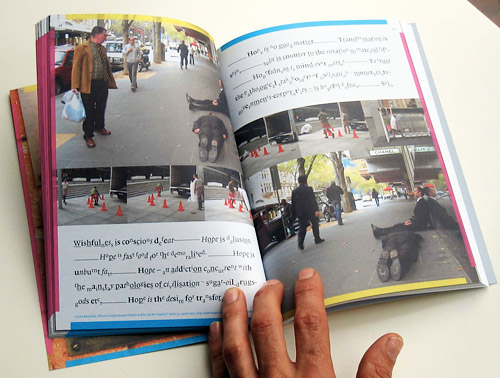
Regardless of where we each stand on the god front (or booze for that matter), sincerity comes from direct engagement, not cowardly, anonymous and indirect commenteering. Here's a comment, albeit analogue, that I posted several years ago in Melbourne on a real-live Christian site - a public footpath.
Click for bigger.

It says (in a slow text):
Christ is the only Christian, become your own Ian.
I have a friend called Ian whom I love to call Ianian, and he is the greatest Ianian of them all.

Tuesday, January 6, 2009

Beyond judgement, towards criticality

It's somewhere between 12am and sunrise and I'm listening to the drunks in the tent next door to ours. One guy is yelling, "me foreskin's wearing out" over and over until he invents another, "Julie, give me your finger, he's passed out, stick it up his arsehole". I consider getting up and asking him to lower the volume. Instead I lay there a little longer and eventually we all pass out.

Today I've been thinking about the drunk guy's graffic language, its volume and its incursion upon a sleeping campsite. And I've been thinking about my initial judgement (and avoidance) of these night raiders, or air graffitists, in light of my recent championing of both joking relations and relations of common substance.  

A few things come to mind. Firstly, it is clear that my immediate judgement stemmed from fear. As I lay in my tent I perceived a level of drunkeness in the loud guy's voice which I knew could quickly transmogrify into irritation, possibly even some level of violence. It seems to me that when a man is joking about sticking his finger up a mate's arse, he's either hanging for a fuck or looking for a fight. With extreme drunkenness either will suffice (in order to put the baby to sleep). The second judgement was based on community insensitivity. The four drunks had come back from a binge and loudly announced it to the sleeping world. The intervention was simply selfish in the quiet of the night.

Good manners are synomonous with the bourgeiose. In his book Possibilities, David Graeber tracks the course of manners through the Middle Ages and their correlation with relations of avoidance and property; most fiercly indoctrinated by the English puritans and the Scotsman Calvin.
...avoidance became generalized: in the sense that principals of behaviour which once applied mainly to relations of formal deference gradually came to set the terms for all social relations, until they became so thoroughly internalized they ended up transforming people's most basic relations with the world around them. David Graeber, p31.
My primary and secondary school education was Calvanist in flavour, or what I came to brand: Christian-capitalist. So my judgement, at an entrenched level, stems from the prejudices of prudishness and wealth generation (at the expense of the landbase) that Christian-based private schools promote.

In contrast my adult, self-formed self is more of the eco-anarchic-atheist, the frameworks within which I practice a critical life heavily reliant upon chance encounters, an attempt at permanent culture (permaculture) and a long standing admiration for common substance and indigenous intelligence.  

My two selves – a bourgeiose-Calvanist and a utopian embracing hopelessness – make up my whole, albeit unpopular, self. In this world it may seem far more simple to take a path of least resistance – join a proper club – and live supposedly free from judgement and critical thought, but I figure that eventually stupidity's dangerous side catches up with people, as it does with planets.


Sunday, December 21, 2008

A de-civilising process

At this point, I can turn to Norbert Elias' argument about the civilizing process in Europe...essentially it came down to the attempt, largely on the part of middle class religious authorities, to improve the manners of those below: most of all by eliminating all traces of the carnivalesque from popular life. David Graeber, Possibilities, p31-32.
Earlier in his book David Graeber writes how gradually, from the twelfth century onwards, the social authorities imbibed a culture of shame and embarrassment for all things bodily – excrement, sex, etc.; things of common substance and their joking relations – think Rabelais’s dirty humour.

Property relations, not sacredness, was the rationale behind the church's enforcement of celibacy onto its priests. The eldest sons of priests were too often claiming church property as their inherited own, and the papacy cracked down on the loss of church property. If avoidance relations are so linked to property, as Graeber suggests, then it is little wonder that the ensuing culture of sex-secrecy – developed by so many priests struggling with celibacy, culminating in paedophilia and other abuses of power – has in turn led to the selling off of acquired properties to fund the thousands of law suites lodged by victims of their cause. It’s an interesting, sad and ironic several hundred-year cycle of avoidance, only checked due to recent demands of accountability on religious institutions by secular authority.

Every year in Daylesford there is a New Year’s Eve parade where various community groups and artists create themed floats or parade various skills, activities and crafts on foot. One year cartoonist, Michael Leunig, with some friends made a float using two inflatable sex dolls. It was called something like 'the garden of love'. The local authorities didn't share the humour and arrested them for public indecency, including the dolls. At the courthouse, while the trial was being heard, the male doll was brought into proceedings by a local cop who’d put a paper bag over his penis. A large group of locals, including kids, turned up to express their support for Leunig's float. I believe there was not a single local person against it. 

Last year, my own somewhat less contentious parade concept was in aid of my water activism; also using joking relations (based upon the behavioural relations between chance and cross-dressing). The purpose of this costume, after the joke for joke's sake, was to draw attention to a local thing of common substance – water, and its privatisation by Coca-Cola Amatil and Cadbury Schweppes for global profiteering. Meg handed out stickers that directed people to the justfreewater myspace page and over the next several days I watched my stats counter on the site grow measuredly. 


Photo: Peter O'Mara (as you can see he won't make Best Australian Photography, 2008, but he is included in this year's Best Australian Poems, UQP).

Zeph's mum, who was at the parade earlier on to drop Zeph off, made the joking remark, “no wonder we didn’t make it”, when she saw what I was wearing. Meg later jokingly said to me, “that’s why you're with me now”. Meg was dressed deliciously, as you’ll no doubt agree.

Photo: Peter O'Mara 

My ex-partner was raised in a Christian household. Her parents were missionaries, her dad become a scholar and translator, responsible for overseeing versions of the Bible into Chinese and other Asian languages. 

Sadly, his daughter and I now only have a relationship of avoidance based upon property rights, which regrettably over-rides a relation of common substance – our child. And it is tied up with the pressing issue of whether or not to sell the quarter acre, that constitutes the physical entity that partly feeds us and this blog: The Garden of Self Defence. 

Most people, most likely, relate with all three of the modes that Graeber and anthropologists before him have outlined: with avoidance, with jokes and with common substance. However, it remains to be seen whether the dominant culture, based on private property, waste and wealth generation – abstractions of avoidance in terms of the landbase that supports us – can ever close the broken cycle generated by capitalism's corollaries, and become a society more dominantly based on common substance again: children raised by whole communities; food not transported but grown within walking distance; natural resources not transported away from food and water bowls – in essence a permanent culture, based less on manners, restriction, hierarchy and capital growth, and more on an understanding of our place within a local ecology – where we consciously particpate in securing a sustainable and permanent future for those who come after us. A gift that has been provided by those who have come before.
Saturday, December 20, 2008

Lousy at small talk

I'm now ready for the social season.

I mentioned yesterday that I'd have a t-shirt to give away. But I didn't have a spare one to print on. Instead, here's an old one of mine that fits a small person. Both are printed on American Apparel tops we found at the local op-shop. The first commenteer will have it posted to them on Monday.


Worship nothing not even Nietzsche! Now there's some small talk for the Christmas period.

Monday, December 1, 2008

On joking, avoidance and common substance

In David Graeber's book Possibilities: Essays on Hierarchy, Rebellion and Desire he redresses earlier anthropological social categories such as joking and avoidance relations.
The body in the domain of joking, one might say, is constituted mainly of substances – stuff flowing in or out. The same could hardly be true of the body in the domain of avoidance, which is set apart from the world... While joking bodies are necessarily apiece with the world (one is almost tempted to say "nature") and made up from the same sort of materials, the body in avoidance is constructed out of something completely different. It is constructed of property. p21.
Relations of 'common substance' are also recalled.
...where an entirely material idiom of bodily stuff and substances can be seen as the basis for bonds of caring and mutual responsibility between human beings. p23.
He goes on to talk about the possibility of sex between two people in terms of sharing food, not as one person consuming the other (as mentioned in an earlier post). Sharing, here, is experienced outside of an 'owning' relation (of avoidance). Graeber, like Hamish Morgan a few weeks ago in this garden, brings in Marcel Mauss.
Mauss has also argued that in giving a gift, one is giving a part of oneself. If a person is indeed made up of a collection of properties, this would certainly be true... Gift giving of the Maussian variety is never, to my knowledge, accompanied by the sort of behaviour typical of joking relations; but it often accompanies avoidance. p23.
A double white Australia line policy, an expression fixĂ© I have used in poems and other forms of thinking since 2001, is used to describe how colonialism (relations of avoidance) pierces and separates, disenfranchises and prepares Aboriginal land and resources for private use and sale. A double white Australia line is a policy of all governments since occupation. 

Colonialism also brought Christmas to the continent, imposing a gift-economy – guilt – on the people who had practiced (for 40,000 years) an extremely intelligent and sustainable gift-ecology.


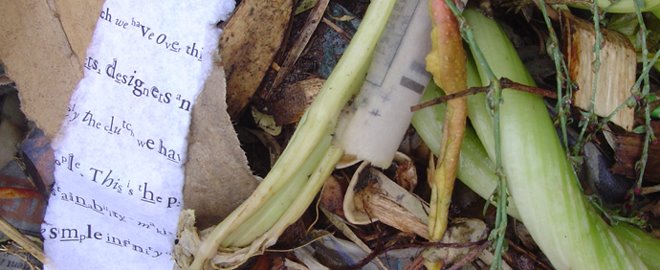
Another's Brilliance (1' concrete), Patrick Jones, Meanjin, Poetics, 2/2001