Showing posts with label hopelessness. Show all posts

Thursday, June 11, 2009

Give up hope on the environment


A wonderful thing happens when you give up on hope, which is that you realize you never needed it in the first place. Hope implies powerlessness, a lack of agency, and a reliance on forces beyond your control. To focus on an abstract sustainable future neglects the real-world actions that can be taken right now. When we realize the degree of agency we actually do have, we no longer have to ‘hope’ at all. We simply do the work. Derrick Jensen, 2006
More here.

Image by Brian Carlson, licensed under Creative Commons.

Wednesday, April 1, 2009

Father and son free-dragging

At the local Neighbourhood House there are many great courses you can enroll in, including courses on self-sufficiency, crochet, blogging (taken by my great girlfriend) and Laugh Club. So last night after walking home with cuts and bruises from free-dragging with Zeph I devised a possible course I could run at Neighbourhood House. The ad in the brochure would go something like this:
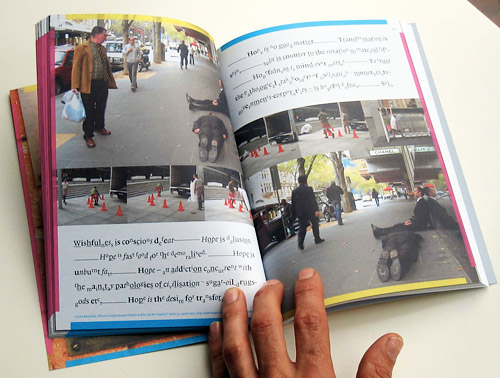
Laugh Club not working for you? Then wreck yourself in a crash course in Free-dragging. The course tutor is one of the co-originators of this mutant form of Parkour (sometimes carried out in drag). Learn the poetry of hopelessness and the art of physical graffiti from a master free-dragger. Come with your own liability insurance and self-liberty assurance. Guaranteed to make you sore.


Film still from forthcoming video.

Saturday, February 7, 2009

Possessions of the sun

We're at the local lake. Dogs, ducks, yabbies, redfin, swans, swamp hens, flies, wasps, bees, mosquitos, jumping jacks, bull-ants, foxes, snakes, swamp wallabies, children and adult human beings share the water. I swim, cool down, then sit on the bank and continue my slow read of David Graeber's Possibilities: Essays on Hierarchy, Rebellion, and Desire.
The ultimate proof that one has sovereign power over another human being is one's ability to have them executed. In a similar fashion, one might argue, the ultimate proof of possession, of one's personal dominium over a thing, is one's ability to destroy it – and indeed this remains one of the key legal ways of defining dominium, as a property right, to this day. p73
Zeph gets out of the water and comes over to us, his towel wraps his shivering body, "You are under a rest Dad!" Which is true, so I reply "Yes, I'm under a tree, resting". "No Dad! You're under arrest!" he shouts. 

Until this Summer the highest recorded local temperature was 39 degrees celsius. This area of south-east Australia is known for its high rainfall and cool highland climate. Things are rapidly changing. Today is the fourth day of 41 degrees this past fortnight, and it is the most brutal, wind-charged and apocalyptic of all of the 4928 days that I've been living here. We're all on a high fire alert.
When you eat something, you do indeed destroy it (as an autonomous entity), but at the same time, it remains "included in" you in the most material of senses. Eating food, then, became the perfect idiom for talking about desire and gratification in a world in which everything, all human relations, were being re-imagined as questions of property. p74
After today "sovereignty" over something in terms of social relations, say between parents and children, masters and slaves, private property and public lakes (to name a few) has changed. Today the unsinkable Murdoch media empire crumbles, while the sun takes up the heirarchical slack, as if the financial crash and the nature crunch are wholly linked organisms. Of course they are. We are standing on the bank looking out over a body of cool water. Nearby, Ballarat's majestic Lake Wendouree is barren. Runaway climate change is just over the horizon, and our politicians and our own comfortable incontestability have sentenced us to nature's complete rule and wrath.

David Holmgren, at a recent meeting in our town hall (with climatologist Rob Gell), stated that growing your own food by permaculture methods uses between a fifth and a tenth less water than supermarket food. Additionally, Gell stated that by 2013, according to the most recent science, the Arctic ice will be gone, and that the southern part of Australia will burn and the northern part will become much wetter.

So I return to all I know: making useless art, embracing hopelessness, growing what food is possible, living intensely and actively with few expectations and sharing what's possible to share. Astrid Lorange, in her review of my book, writes it this way –
By decentring the kind of symbolism we might attach to an artistic manifesto for a sustainable future–that is, that hope will manifest as change–Jones sets up a far more mobilising set of propositions. Rather than hope and desire, we need to practise free-dragging, where non-delusional play and civil disobedience are the productive ferment of critical and creative hopelessness.
Others call it excrement.

Tuesday, January 6, 2009

Beyond judgement, towards criticality

It's somewhere between 12am and sunrise and I'm listening to the drunks in the tent next door to ours. One guy is yelling, "me foreskin's wearing out" over and over until he invents another, "Julie, give me your finger, he's passed out, stick it up his arsehole". I consider getting up and asking him to lower the volume. Instead I lay there a little longer and eventually we all pass out.

Today I've been thinking about the drunk guy's graffic language, its volume and its incursion upon a sleeping campsite. And I've been thinking about my initial judgement (and avoidance) of these night raiders, or air graffitists, in light of my recent championing of both joking relations and relations of common substance.  

A few things come to mind. Firstly, it is clear that my immediate judgement stemmed from fear. As I lay in my tent I perceived a level of drunkeness in the loud guy's voice which I knew could quickly transmogrify into irritation, possibly even some level of violence. It seems to me that when a man is joking about sticking his finger up a mate's arse, he's either hanging for a fuck or looking for a fight. With extreme drunkenness either will suffice (in order to put the baby to sleep). The second judgement was based on community insensitivity. The four drunks had come back from a binge and loudly announced it to the sleeping world. The intervention was simply selfish in the quiet of the night.

Good manners are synomonous with the bourgeiose. In his book Possibilities, David Graeber tracks the course of manners through the Middle Ages and their correlation with relations of avoidance and property; most fiercly indoctrinated by the English puritans and the Scotsman Calvin.
...avoidance became generalized: in the sense that principals of behaviour which once applied mainly to relations of formal deference gradually came to set the terms for all social relations, until they became so thoroughly internalized they ended up transforming people's most basic relations with the world around them. David Graeber, p31.
My primary and secondary school education was Calvanist in flavour, or what I came to brand: Christian-capitalist. So my judgement, at an entrenched level, stems from the prejudices of prudishness and wealth generation (at the expense of the landbase) that Christian-based private schools promote.

In contrast my adult, self-formed self is more of the eco-anarchic-atheist, the frameworks within which I practice a critical life heavily reliant upon chance encounters, an attempt at permanent culture (permaculture) and a long standing admiration for common substance and indigenous intelligence.  

My two selves – a bourgeiose-Calvanist and a utopian embracing hopelessness – make up my whole, albeit unpopular, self. In this world it may seem far more simple to take a path of least resistance – join a proper club – and live supposedly free from judgement and critical thought, but I figure that eventually stupidity's dangerous side catches up with people, as it does with planets.