Showing posts with label climate change. Show all posts

Monday, June 22, 2009

From apocalypse to permapoesis

Our culture, in its dominant form, has an unstoppable death urge. Nice thought. Great way to start the week. Yum. Mass death. 

In a relatively straight line over six thousand years our efforts to wipe out every living thing including ourselves only intensify. Six thousand years of canonical philosophy has brought us merely doctrines for superior ecological disembodiment. Here, now, nearby, indigenous grasslands around outer Melbourne are next in line for the chop, to be replaced by a toxic sprawling development the size of Canberra. When it comes to the destruction of natural ecologies, Monsanto fan and state premier John Brumby would have to be the most extreme government we've seen in Victoria to date. As I said the death urge only intensifies, Brumby merely a wealthy (in relative terms) benefactor of its momentum. Be it grasslands, water systems, agriculture or energy consumption he is a major mass murderer of non-human life – life most of us don't even know exists.
Stasis. Death. The end of all life, if the dominant culture has its way. It's where we've been headed from the beginning of this several-thousand year journey. It is the only possible end for a culture of linear – as opposed to cyclical – progress. Beginning, middle, end. Self-extinguishment. The only solace and escape from separation: from ourselves, from each other, from the rest of the planet. Plutonium. DDT. Dioxin. Why else would we poison ourselves? No other explanation makes comprehensive sense. Apocalypse. Derrick Jensen p 227.
Put aside climate change and peak oil for a moment and think about how many other ways we can bring about mass destruction. The elimination of biodiverse systems; the collapse of insect populations causing widespread disease and pestilence to proliferate, in turn triggering a global chemical revolution that our governments will of course endorse. This will hand companies like Monsanto and Dow a license to stage more chemical warfare, causing further mass outbreaks of cancer, respiratory diseases and death to rich microbial life that does so much to keep us and our fellow organisms healthy. Apocalypse. The proliferation of factory farms; the growth of super viruses from live-stock antibiotic mutations and genetically modified grains; GM grains contaminating heirloom seeds that are generally hardier, more robust and more nutritious; dioxins and antibiotic pollutants (from paper mills and industrial farming) in our rivers and oceans killing biodiversity in our waters, triggering mass death of important ecologies which provide us and others health. More and more children raised in disembedded suburbs, completely unaware that their wage-slave parents, their toxic food, their creativity-destroying schooling – all constitute a dominant culture that is an unstoppable monster. Increases in self-harm, violence, anorexia, cancer, obesity, ADHD, mental illness, hatred, ecological ignorance, deafness to indigenous suffering, rape, warhead manufacturing, plutonium production, plastic waste dumping, and on and on it goes, an ever-expanding one-way road to annihilation. Why? Why do we agree to participate in a system so suicidal, so abusive, so destructive?

When you next read about a state or federal government making plans to wipe-out native grasslands, build new coal stations, mine wild mountains, ship soldiers, green-light GM crop trials, green-light businesses contributing to factory slave culture in poorer countries, throw millions at a Grand Prix, build new pulp mills, new airports, super farms, live-exporting, harvest old growth forests, dump toxic waste at sea, ask yourself what whole picture does this make. Is there anything sane about our culture? Do I have to participate? 

Imagine if there were no industrialised agricultures. No ADHD, obesity, cancer, tooth decay, violent mood disorders. Imagine most of us contributed a few days a week, from an early age, to localised food production. We only ate our own community's organic food in season. Children were given age-specific responsibilities within community food production that, in turn, gave them skills, bodily strength and healthy self-esteem. There was little mental illness as everyone had a place, a role. Our schooling was specific to our community's ecology and social wellness, and to online communities we developed as we got older. We rarely travel, import or export because we know that a system based upon transporting resources and human resources is suicidal to our species and to much of non-human life. Because we all share in food production there is much time to pursue creative interests. We have much free-time, and we have little money. We participate in a "free-poor" society where free time is valued as the greatest wealth. The cults of celebrity, anxiety and wishfulness have all died in the arse and are no longer valued because we once again like who we are. Dags are sexy and cool, we're all big cool dags now. There is no obesity nor anorexia but a great diversity of body shapes inbetween. The only mining that takes place is for the production of renewable energy technology. Technologies that fuel our low-energy houses and a few other essentials such as digital networking devices for global connectedness and creative purposes. This technology is given out in greater quantity to communities who actively show they are repairing their local wild ecologies. A federal government merely provides security from global corporate terrorism and oversees mediation for neighbouring communities who are in dispute. They do not interfere with or attempt to trade resources belonging to small local communities, or rather that small local communities belong to. People are encouraged to only breed to the capacity of their local landbase; to their local food and water bowls. All Monsanto, Coke, Halliburton, Walmart and Mcdonalds (a more extensive list will be drawn up in due course) chief executives and board directors will serve a minimum of 10 years in community compost fields, and be taught the proper treatment of humans and non-humans through social-ecology classes. On release they will be monitored and if they abuse again, they will be humanely destroyed and composted. Politicians known to have actively contributed to and were therefore abusers in the old system of pop-fascism, will be also encouraged to work in the compost fields and be monitored by the community in case they attempt to abuse again.

All this is highly possible. It is highly possible to participate in our culture while exorcising the dominant abusive traits – supermarket food, celebrity culture, two-party fraudulence, male-aggression, warring religions (monotheism), aggregate-growth economics. We can start now as individual households and build relations with others who share values based on permapoesis – permanent, cyclical meaning-making – not suicidal, linear apocalypse. It's time to ditch the old school.

Monday, May 11, 2009

I am, I think, I deny (Ian Plimer)

Clive Hamilton, in his feature, "Nature will deal with skeptics", critiques climate change denier, professor Ian Plimer's monological world-view. Hamilton describes Plimer's "reason" as coming from one whose ego has been bruised by a new era of ecologically embedded science. 

Read his article here.

While permacultural and biodynamic science are making inroads into modern existence methods (by recalling ancient methods), tech-driven science persists with its make-believe: we can invent our way out of ecological crisis with more product and more technology. The former system understands ecology and promotes steady-state economics, the latter persists with aggregate-growth economics and thus relies on continued resource wars.

Wednesday, March 25, 2009

Arnhem mob's songs of regeneration


Aboriginal elders, including medicine men, song men and traditional dancers, visited our area last weekend and conducted a series of dances relating to each aspect of the land. They were welcomed by local Djadjawurrung elder Aunty Carmel. The dances were conducted to heal the land after the bush-fires. A number of the local boys, including Zeph, were given instructions on how to perform some of the dances.

Saturday, February 7, 2009

Possessions of the sun

We're at the local lake. Dogs, ducks, yabbies, redfin, swans, swamp hens, flies, wasps, bees, mosquitos, jumping jacks, bull-ants, foxes, snakes, swamp wallabies, children and adult human beings share the water. I swim, cool down, then sit on the bank and continue my slow read of David Graeber's Possibilities: Essays on Hierarchy, Rebellion, and Desire.
The ultimate proof that one has sovereign power over another human being is one's ability to have them executed. In a similar fashion, one might argue, the ultimate proof of possession, of one's personal dominium over a thing, is one's ability to destroy it – and indeed this remains one of the key legal ways of defining dominium, as a property right, to this day. p73
Zeph gets out of the water and comes over to us, his towel wraps his shivering body, "You are under a rest Dad!" Which is true, so I reply "Yes, I'm under a tree, resting". "No Dad! You're under arrest!" he shouts. 

Until this Summer the highest recorded local temperature was 39 degrees celsius. This area of south-east Australia is known for its high rainfall and cool highland climate. Things are rapidly changing. Today is the fourth day of 41 degrees this past fortnight, and it is the most brutal, wind-charged and apocalyptic of all of the 4928 days that I've been living here. We're all on a high fire alert.
When you eat something, you do indeed destroy it (as an autonomous entity), but at the same time, it remains "included in" you in the most material of senses. Eating food, then, became the perfect idiom for talking about desire and gratification in a world in which everything, all human relations, were being re-imagined as questions of property. p74
After today "sovereignty" over something in terms of social relations, say between parents and children, masters and slaves, private property and public lakes (to name a few) has changed. Today the unsinkable Murdoch media empire crumbles, while the sun takes up the heirarchical slack, as if the financial crash and the nature crunch are wholly linked organisms. Of course they are. We are standing on the bank looking out over a body of cool water. Nearby, Ballarat's majestic Lake Wendouree is barren. Runaway climate change is just over the horizon, and our politicians and our own comfortable incontestability have sentenced us to nature's complete rule and wrath.

David Holmgren, at a recent meeting in our town hall (with climatologist Rob Gell), stated that growing your own food by permaculture methods uses between a fifth and a tenth less water than supermarket food. Additionally, Gell stated that by 2013, according to the most recent science, the Arctic ice will be gone, and that the southern part of Australia will burn and the northern part will become much wetter.

So I return to all I know: making useless art, embracing hopelessness, growing what food is possible, living intensely and actively with few expectations and sharing what's possible to share. Astrid Lorange, in her review of my book, writes it this way –
By decentring the kind of symbolism we might attach to an artistic manifesto for a sustainable future–that is, that hope will manifest as change–Jones sets up a far more mobilising set of propositions. Rather than hope and desire, we need to practise free-dragging, where non-delusional play and civil disobedience are the productive ferment of critical and creative hopelessness.
Others call it excrement.

Monday, February 2, 2009

The garden cops a beating


After a week of record breaking temperatures, some of our food supplies are being knocked around. Where are the wild chickpeas and ancient grains that can withstand extreme temperatures? They may be all we can grow in years to come.

Visit the Seed Hunter here to give you an idea of what's most likely to come.

Sunday, January 4, 2009

What we build

There are children swimming in the ocean. Many are what health specialists would, no doubt, call unhealthily overweight. Their parents have seen to it that they are covered up with sunscreen and that they wear long shorts, hats and arm length body tops to keep the harmful radiation off their skin. While most of us become increasingly aware of the science, we continue to burn our wages preparing the sun for its increasing assault on our skin and our soil. Our bodies are also products of industrialised agriculture – we eat food that is overly-refined, sugar rich and highly processed, we pass this on to our children. 

The interrelation between intensifying radiation from the sun on our skin and increased levels of unburnt fat in our bodies is obvious enough – oil-based economics based on profit growth. What is less discussed is that our society is an impermanent culture, not possible of ever being sustainable. We have lived a deluded, perma-boom existence, and our high levels of skin cancer and diabetes are the physical corollaries of this Australian life.

We have taught our children how to protect themselves from the sun (from nature), and how to eat (from supermarkets), we have introduced them to a global culture of progress. We have told our children that transporting resources, investing in economic growth and producing immeasurable waste is progressive. We have not told them that progress is killing us. We'd prefer to veil our kids from the inevitable horrors that await us, and the horrors that we've allowed to endorse our way of life.

Why is this? It is easy for us to attack nature – the sun is enemy, and therefore we can defend ourselves against enemies. But how do we defend ourselves from ourselves? How do we cease to participate in the great global toxiculture our elders have built for us?

Sunday, December 14, 2008

An angry post cheered up by a harvest of garlic, freshly washed

The one thing that everybody wants is to be free...not managed, threatened, directed, restrained, obliged, fearful, administered, they want none of these things they all want to feel free...they do not want to be afraid not more than is necessary in the ordinary business of living... Gertrude Stein, 1943
The daughter of the businessman, the income to write, the ordinary business of privilege; ever expanding post-war growth, ever expanding freedoms: cars, white-goods, confectionary, packaging, holidays; ever expanding art and art memorials; ever-expanding construction of culture well beyond the capacity of the landbase. Impermanent toxiculture; the mass market, the small secondary markets of the bourgeoisie: the snobs, the aspirants, the collectors, the publishers, the biography factory; ever-expanding obsessions of the civilised; utterly pre-tending to life.

"The world is round", Stein tells us, "and you can go on it round and round", she adds, as she did, as we do now, up and up, down and down, around and around, adding and expanding, unchecked and ill-managed, unbridled freedom, unlimited population, unleashed psychosis.

We have had 65 years of run-away capitalism, and here awaits us the blurred edge of run-away climate change: gas chambers lit for a new era holocaust by industry's furnaces and our desires.

Tuesday, November 11, 2008

Excerpt (Garden as Collective Offensive)

In less than a generation we have used half the world’s oil supply and are rapidly depleting other fossil fuels. Cheap food and cheap energy are becoming things of the past. The machinations of growth-obsessed industrial civilisation result in the continual transfer of carbon from the ground, where it is good, to the atmosphere, in ever-increasing quantities that make it toxic. Despite all the evidence demonstrating this, the governing corporations remain committed to the growth model - acting as though the environment has an infinite capacity to absorb the relentless production of toxicological wastes.

Wednesday, November 5, 2008

Out of print

I've thought for a long time about how to make publishing books more a part of a closed-cycle ecology.

As the wireless reading device is still relatively non-existent, we really only have an industrial model of publishing: thousands of tonnes of books and draft manuscripts annually depopulating forests and by extension, releasing carbon into the atmosphere as greenhouse gas. It's a pretty fucked-up industry, like water bottled in plastic, that few seem to be critiquing.

Books I've published in the past use materials such as vegetable-based inks and recycled and chlorine-free pulp, however, production is still industrialised. Finsbury Green is the printery Ian and I generally use, and while they are leading the transition in cleaner technologies, I'm not convinced this will make all that much difference to the mammoth task we have of dismantling our toxiculture.

I think that change has to come from writers, who now have to decide their level of output, material use and distribution method – especially if we consider that transportation is an assault on the landbase that supports us. It helps when writers are also the publishers and distributors, like David Prater, a poet and early advocate of online publishing. He edits Cordite and knows first hand how much paper and ink has not passed through his office in the past ten years.

However, where the digital age has the potential to reduce pulp consumption on the planet, there's still the problem of digital hardware and the capitalisation (toxicology) of new technology – new equipment is upgraded while old equipment is offloaded as non-compostable waste.

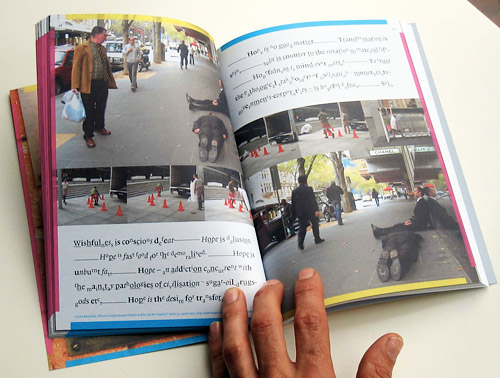
Then there's the materiality of books – their objecthoodness. Words and Things (2004) is an anthology of chance, concrete poetics and mutable literatures I edited, contributed to and co-produced with Ian Robertson. It includes Richard Tipping, Peter Tyndall, Peter O'Mara, Marie Sierra, Jeff Stewart, Aleks Danko, Alex Selenitsch and Geoffrey Baxter. It's now out of print and the 600 copies we manufactured are out in the world ready for some sort of decomposition.

Tuesday, October 28, 2008

Donovan Hohn does plastics

"Never mind that only 5 percent of plastics actually end up getting recycled. Never mind that the plastics industry stamps those little triangles of chasing arrows into plastics for which no viable recycling method exists. Never mind that plastics consume about 400 million tons of oil and gas every year and that oil and gas may very well run out in the not too distant future. Never mind that so-called green plastics made of biochemicals require fossil fuels to produce and release greenhouse gases when they break down. What’s most nefarious about plastic, however, is the way it invites fantasy, the way it pretends to deny the laws of matter, as if something—anything—could be made from nothing; the way it is intended to be thrown away but chemically engineered to last. By offering the false promise of disposability, of consumption without cost, it has helped create a culture of wasteful make-believe, an economy of forgetting."

This thing on the other hand is 100% compostable, printed with vegetable based inks.

Thursday, October 16, 2008

To what end?


"The economic crisis is petty by comparison to the nature crunch. But they have the same cause... As we goggle at the fluttering financial figures, a different set of numbers passes us by. On Friday, Pavan Sukhdev, the Deutsche Bank economist leading a European study on ecosystems, reported that we are losing natural capital worth between $2 trillion and $5 trillion every year, as a result of deforestation alone(1). The losses incurred so far by the financial sector amount to between $1 trillion and $1.5 trillion. Sukhdev arrived at his figure by estimating the value of the services - such as locking up carbon and providing freshwater - that forests perform, and calculating the cost of either replacing them or living without them. The credit crunch is petty when compared to the nature crunch." Read more Monbiot here.