
Showing posts with label Patrick Jones graffiti. Show all posts
Showing posts with label Patrick Jones graffiti. Show all posts
Friday, June 19, 2009


Monday, June 8, 2009
Slow text (towards a definition)
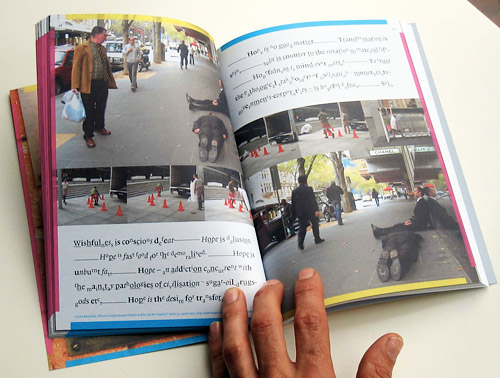
Here's another excerpt from Free-dragging, Slow Text and Permapoesis: towards a biophysical poetry, recently completed for a forthcoming Angelaki issue. To give some background I have just introduced the concept of hopelessness: By understanding that life is painful, unnecessarily destructive and generally hopeless, we have nothing to loose but to hop on it.

 A portrait of the artist as superscript type.
A portrait of the artist as superscript type.Tuesday, April 14, 2009

Monday, April 6, 2009

Sunday, February 1, 2009

Thursday, January 29, 2009
Old theories of love, today

Some Medieval and Renaissance thought pertaining to love, according to David Graeber, went like this:
...when a man fell in love with a woman, he was really in love not with the woman herself but with her image; one that once lodged in his pneumatic system, gradually came to hijack it, vampirizing his imagination...Medical writers tended to represent this as a disease that needed to be cured; poets and lovers, a heroic state that combined pleasures (in fantasy, but also, somewhat perversely in the very experience of frustration and denial) with an intrinsic spiritual or mystical value in itself.And the interrelations, between the Medieval medic and the spin-doctors of capitalism, continue in terms of how capitalism strives for the clean and the sanitised while beneath its images of wholesomeness and plastic patinas, ecologies are devastated and wasted. Language, it has been said by many, does play a big part in capitalism's veiling and mediation, it paves a civil way clear for the savagery. Think "clean coal" for example, or Coca-Cola's greenwashing in light of its production of bottled water and highly sugared, early-onset-diabetes-drinks for young people. Get 'em early says the church. Get 'em early says the corporation. Anyway, back to Graeber's Possibilities.
...lonely brooding is punctuated by frustrated urges to seize what cannot really be seized... A fair amount of "embracing" certainly did go on in Medieval Europe, as elsewhere. Still, this [lonely brooding] was the ideal, and critically, it became the model not just for sexual desire, but for desire in general.
In my early twenties, a country boy living in the city, I became obsessed with soft-porn advertising billboards, how corporate images promoting desire sanatised sex, and how graf artists played with or attacked these images. "Through her legs the tollways", was a line from a poem I later wrote called Billbored Sex when Australia's roads were beginning to be privatised and mega-billboards were popping up everywhere. Bugger-Up campaigners and graffitists were the local Oz wing of the global ad-busting movement. I was studying feminist art practices at the time and looking critically at gender representation in art and the media. And at the same time I was slavering over these images; broodingly, longingly.
Monday, November 24, 2008


Monday, November 17, 2008
Tag
Jason and I had a day making new work in Melbourne last Friday. On Saturday we put together this collage.
Sunday, November 16, 2008

Saturday, November 15, 2008
WorkmanJones tag Brunswick

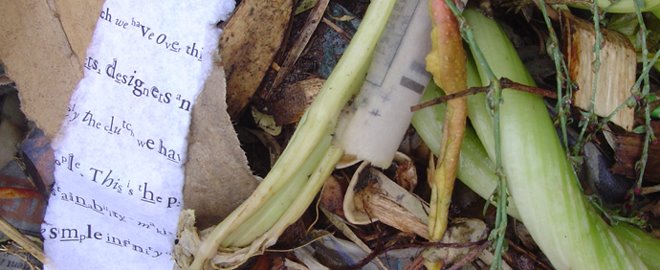
The printing of the poem appears as a tag on the retina of the passer-by – a poetry of memory, of a pure consumption of time and of a pure materialism – generated by chance, spitting everything back onto the street as a compost activator for culture.
Sunday, October 26, 2008

Thursday, October 16, 2008
To what end?

"The economic crisis is petty by comparison to the nature crunch. But they have the same cause... As we goggle at the fluttering financial figures, a different set of numbers passes us by. On Friday, Pavan Sukhdev, the Deutsche Bank economist leading a European study on ecosystems, reported that we are losing natural capital worth between $2 trillion and $5 trillion every year, as a result of deforestation alone(1). The losses incurred so far by the financial sector amount to between $1 trillion and $1.5 trillion. Sukhdev arrived at his figure by estimating the value of the services - such as locking up carbon and providing freshwater - that forests perform, and calculating the cost of either replacing them or living without them. The credit crunch is petty when compared to the nature crunch." Read more Monbiot here.
Subscribe to:
Posts (Atom)