Showing posts with label toxiculture. Show all posts

Thursday, January 29, 2009

Old theories of love, today


Some Medieval and Renaissance thought pertaining to love, according to David Graeber, went like this:
...when a man fell in love with a woman, he was really in love not with the woman herself but with her image; one that once lodged in his pneumatic system, gradually came to hijack it, vampirizing his imagination...Medical writers tended to represent this as a disease that needed to be cured; poets and lovers, a heroic state that combined pleasures (in fantasy, but also, somewhat perversely in the very experience of frustration and denial) with an intrinsic spiritual or mystical value in itself.
And the interrelations, between the Medieval medic and the spin-doctors of capitalism, continue in terms of how capitalism strives for the clean and the sanitised while beneath its images of wholesomeness and plastic patinas, ecologies are devastated and wasted. Language, it has been said by many, does play a big part in capitalism's veiling and mediation, it paves a civil way clear for the savagery. Think "clean coal" for example, or Coca-Cola's greenwashing in light of its production of bottled water and highly sugared, early-onset-diabetes-drinks for young people. Get 'em early says the church. Get 'em early says the corporation. Anyway, back to Graeber's Possibilities.
...lonely brooding is punctuated by frustrated urges to seize what cannot really be seized... A fair amount of "embracing" certainly did go on in Medieval Europe, as elsewhere. Still, this [lonely brooding] was the ideal, and critically, it became the model not just for sexual desire, but for desire in general.
In my early twenties, a country boy living in the city, I became obsessed with soft-porn advertising billboards, how corporate images promoting desire sanatised sex, and how graf artists played with or attacked these images. "Through her legs the tollways", was a line from a poem I later wrote called Billbored Sex when Australia's roads were beginning to be privatised and mega-billboards were popping up everywhere. Bugger-Up campaigners and graffitists were the local Oz wing of the global ad-busting movement. I was studying feminist art practices at the time and looking critically at gender representation in art and the media. And at the same time I was slavering over these images; broodingly, longingly.

Friday, January 9, 2009

The flux and detritus of the immutable

Every atheist must admit that God exists, because God exists in our minds, as an idea, a concept, a joke and as such God exists as an intellectual thing, a word made up of three letters.

I've been reading Why is there something rather than nothing, which is a kind of compendium of philosophical constructs from Socrates to Heidegger set out by Polish philosopher Leszek Kolakowski. His summary of St Augustine is alarming:
For Augustine there is only one historical process; here, contrary to the doctrines of some Greek philosophers, there are no cycles, regenerations or returns. And the things we consider to be the result of chance are all parts of the the wise plan of Providence, which is veiled from us. p.70
Wow! Judeo-Christian-capitalism is outlined in the 4th Century, which is essentially this: turn your back on ecology and chance by creating veils and mediations based on an idea of God; the desire for the immutable.

St Anselm, 600 years later, again summarised by Kolakowski, is similarly interesting:
...no experience is necessary to attain intellectual certainty of God's existence. p74
I wonder if no experience is necessary (of ecological life) to believe in the idea of cycles, regenerations or returns. On the way to the train and out of the city tonight we came across this Church of Returns; a Christian-based op shop had dumped its excess and some of us were skip-scabbing in celebration.

Sunday, January 4, 2009

What we build

There are children swimming in the ocean. Many are what health specialists would, no doubt, call unhealthily overweight. Their parents have seen to it that they are covered up with sunscreen and that they wear long shorts, hats and arm length body tops to keep the harmful radiation off their skin. While most of us become increasingly aware of the science, we continue to burn our wages preparing the sun for its increasing assault on our skin and our soil. Our bodies are also products of industrialised agriculture – we eat food that is overly-refined, sugar rich and highly processed, we pass this on to our children. 

The interrelation between intensifying radiation from the sun on our skin and increased levels of unburnt fat in our bodies is obvious enough – oil-based economics based on profit growth. What is less discussed is that our society is an impermanent culture, not possible of ever being sustainable. We have lived a deluded, perma-boom existence, and our high levels of skin cancer and diabetes are the physical corollaries of this Australian life.

We have taught our children how to protect themselves from the sun (from nature), and how to eat (from supermarkets), we have introduced them to a global culture of progress. We have told our children that transporting resources, investing in economic growth and producing immeasurable waste is progressive. We have not told them that progress is killing us. We'd prefer to veil our kids from the inevitable horrors that await us, and the horrors that we've allowed to endorse our way of life.

Why is this? It is easy for us to attack nature – the sun is enemy, and therefore we can defend ourselves against enemies. But how do we defend ourselves from ourselves? How do we cease to participate in the great global toxiculture our elders have built for us?

Saturday, January 3, 2009

Mashed (elegy for the city)

Our elders are sick. Written on the wall of a child's tree-house by a Scottish poet.
Since Plato we have been conscious of the ill-logic of our cities but struggled to do away with them. Now for the first time in human history there are more people in cities than in rural areas. It is no wonder, therefore, that human existence is at its most abstract, most violent, most 'civil', most veiled, most mediated, most toxic, most insane.

Jason Workman gave me permission to do a mashup of WorkmanJones city interventions between 2006 and 2008, which I've just finished. The main track is by Esmerine, who I think are a Canadian band that don members of godspeed you! black emperor.


Wednesday, December 17, 2008

Cities


After I posted the most recent WorkmanJones film, Tag, a friend of mine, Hamish Morgan, challenged me on why we chose to use the city as a site for our work. There are so many ways to think about and address this question. I initially gave some reasons in response, but having thought more about it lately, about impermanent culture (impermaculture), I thought I'd share some of this thinking.

Firstly, cities exist. Modern cities are toxicities, they rely on resources from elsewhere, they waste waste, they can (probably) never be sustainable, more people live in them than in rural areas (a recent global phenomenon), and cities are places of social invention and mutation. For all these reasons, critiquing, participating in and understanding the city is to understand the dominant psyche of modern humans and why centralised capitalism is killing us, and many other species, very rapidly and very cruelly.

Hamish has spent a few years living with an aboriginal community in remote WA, and I have spent the majority of my life living in occupied regional areas of Australia, namely the Wingecarribee district, Wagga Wagga and Djadjawurrung country for the past 13 years. Both Hamish and I have been educated in urban universities, where few questions are ever asked concerning urban impermaculture.

Recently, I voluntarily endured a paper given by a PhD candidate that cross-pollinated Situationist thought with her own desire to continue shopping. It was a seemingly clever paper using fashionable dérive poetics with individualist urbane desire. Michael Farrell brilliantly called it 'romantic shopping'. It simply repulsed me. She was a post-graduate student in sustainability and architecture. 

Her intellectual abstractions represented her mediated blindness. She told us that she drove her car into the city to carry out her shopping 'experiments', and that she had to consume things in order for her experiment to work. When I challenged her, pretty clumsily regrettably, on her work as capitalist embellishing, she exclaimed, "But what other system have we got?"

What was so offensive about this paper was that an architect working in the area of sustainability was not looking at urban permaculture in Havana as a model or focus point for her research, or any other transitional city. Havana is a living example that excitingly challenges my Jensenian belief that cities can never be sustainable (based on a reliance upon the importation of resources). Instead it was her own desire and its place in the world that was being indulgently understood. The other area this paper failed to investigate, regarding the question of future sustainability and urban psychogeography, was indigenous intelligence.

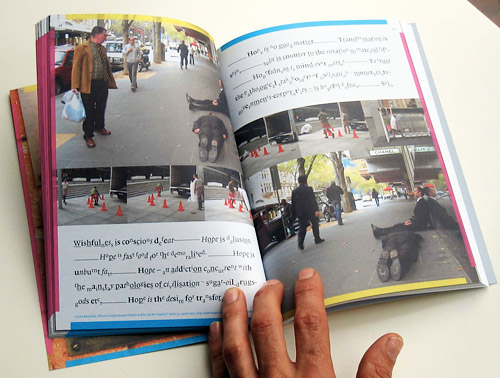
Our urban film, Tag, was never meant as a critique of the city, rather an example of using an impermacultural domain as a site for post-consumer play. A critique of the city occurs in other parts of my practice, as it does here. It was also made to demonstrate the body as common substance, devoid of shame and embarrassment, and directly influenced by the abstract and toxic environment in which we were courting chance behaviours. 


Photo: Kathryn McCool

Friday, November 21, 2008

The Australian


To the Letters Editor:

I bought your paper today for the first time in years. Reading it was like sneaking into a black tie dinner at a men's only club. Wow! I thought, people still think like this, but of course I was joking, you're just representing what we all think, right?

What I found since my last read (back in your glorious Howard years) was an even greater ramping up of heroic capitalist rhetoric, finer crafted greenwashing, and a border-line sociopathic hyper-mediated psyche, with the subtext embedded dispassionately: 'power invents a mask for powerlessness to wear' (TS). All this, despite the writing on the wall signaling the end, thank fuck, of capitalism.

Knowing a little of the territory marked by your bullish jock journos who champion pop-fascists like Rupert Murdoch – why wouldn't you, he's your boss right? – I should hardly have been surprised, but to witness again the dogmatic clutching on to an economics based upon profit growth and the refusal to advocate for a commerce that mimics ecological systems illustrates your bloody-minded stupidity and out-moded ideology.

Even after the nature crunch (which will make the sinking global-pool-of-money seem like just another family holiday spent at home), your paper (in the unlikely event that it survives) will no doubt once again twist the story of capitalism's failure to one of triumph. But capitalism's real triumph will be our extinction.

Your newspaper, to borrow McKenzie Wark's words, is a shopping guide where news breaks up the commercial page and filters the right stock advice throughout it. Your newspaper preaches the reliance upon the importation of resources when we know this to be our species' death wish. Therefore, your paper is illogical.

Luckily for me, my money is not totally wasted in buying today's, nor the material you print your capitalist propaganda on as it will go nicely in my compost, and feed the worms who enrich the soil to grow the food that is in walking distance to my home.

Wednesday, November 19, 2008

Tagged Post (a response to Hamish Morgan)

The following writing is in response to Hamish Morgan's comment on Tag yesterday.

I don’t think Tag is ‘against the city’; at least it is not a negation in total. It is difficult for play to be against something when it is caught up in the surprise and the joy of the new.

We have made similar work in the country, and of course the environment alters the work we make wherever it is. A rule of our practice, set out by John Cage, is ‘a work of art should include its environment’.

So, I see this new work not so much a critique, nor a logical attack, rather states of permanent play (permaplay) in everyday space and poesis (meaning-making) through activity before langauge. Making art without producing anything consumable is an obvious eco-politic that is 'against' the city (civis, civilisation, centre, transportation of resources, capitalisation, etc), but the work overall, I think, is more than this.

We specifically chose non-heroic, non-spectacular outer parts of Melbourne for no other reason than CBDs (toxicities) are so last century.

In relation to tagging itself I have a developing interest in the urban phenomenon of self-determining font making, graffitists who through the act of generating their own personalised fonts decentralise and demiltarise the alphabet in public space. This is important and exciting territory, and the body as tag is an extension of this line of graffic thought.

To make Tag we caught a train down to Melbourne, thus burning carbon, so this is a negation of our own making. A zero carbon footprint comes in small gradual steps over the next 6-7 years. Just in terms of carbon, we have a very small distance to go compared with, say, Fox Studios.

Additionally this film is part of a gift-ecology, a concept I'm developing so as my overall practice continues to contribute to the global movement of decapitalised art. I use gift-ecology instead of 'gift-economy' (a term developed by capitalists), because art should produce no waste – hence permanent culture (permaculture) as antidote to toxiculture.

Again, all this is transitional thought, on the way to a post-industrial, post-consumerist modality.

Thanks to all the commenteers – such generosity!

Tuesday, November 11, 2008

Excerpt (Garden as Collective Offensive)

In less than a generation we have used half the world’s oil supply and are rapidly depleting other fossil fuels. Cheap food and cheap energy are becoming things of the past. The machinations of growth-obsessed industrial civilisation result in the continual transfer of carbon from the ground, where it is good, to the atmosphere, in ever-increasing quantities that make it toxic. Despite all the evidence demonstrating this, the governing corporations remain committed to the growth model - acting as though the environment has an infinite capacity to absorb the relentless production of toxicological wastes.

Monday, November 3, 2008

The Blogatron


Derrick Jensen's core premise, that industrial civilisation is not and can never be sustainable, is central to my move towards a post-industrial poetry. Together with friends, neighbours, the garden and a four-year old, de-logoed blogatron on Wi-Fi (above), we move towards a digi-primitivism; de-industrialised and de-capitalised.

Industrial civilisation is a toxiculture – from every modernised (genetically vulnerable) wheat seed to the next (carbon dioxide producing) Man Booker Prize novel. Yes, the blogatron too!

Part of the solution is permaculture, an antidote to the toxiculture that is capitalism.

Sunday, November 2, 2008

Mashup with Ian Robertson

From The Garden as Collective Offensive: 
Industrial civilisation functions in a broken cycle: product is separated from process, production and consumption are geographically dislocated, cause is distanced from eventual (deferred) effect. The production of waste is unavoidable in this modality. There is no ecology of commerce in place, nor is capitalism capable of implementing one.

Tuesday, October 28, 2008

Donovan Hohn does plastics

"Never mind that only 5 percent of plastics actually end up getting recycled. Never mind that the plastics industry stamps those little triangles of chasing arrows into plastics for which no viable recycling method exists. Never mind that plastics consume about 400 million tons of oil and gas every year and that oil and gas may very well run out in the not too distant future. Never mind that so-called green plastics made of biochemicals require fossil fuels to produce and release greenhouse gases when they break down. What’s most nefarious about plastic, however, is the way it invites fantasy, the way it pretends to deny the laws of matter, as if something—anything—could be made from nothing; the way it is intended to be thrown away but chemically engineered to last. By offering the false promise of disposability, of consumption without cost, it has helped create a culture of wasteful make-believe, an economy of forgetting."

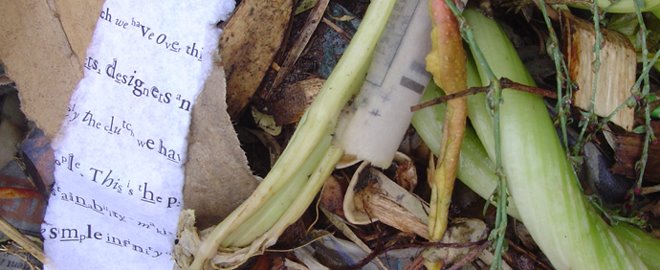
This thing on the other hand is 100% compostable, printed with vegetable based inks.

Monday, October 27, 2008

Zephyr carves up Swallow

A few years ago Zeph, Michael Farrell and I were walking from one room at the Ian Potter (NGV) – a gallery for non-compostable toxiculture specifically obsessed with Australian art – to another room where Ricky Swallow's dumb Vader object sat mutely on the floor. Zeph took one look at the dark ziggurat-like mask and launched himself at it, quickly mounting the top. At the time I expressed my delight to Micki Faz (as nicknamed by Nick Keys) that Zeph, at age 4, had out-done his dad in terms of cultural achievement. This little flick, taken a month or two ago, reminds me of that beautiful spirit at the Potty.