Showing posts with label indigenous intelligence. Show all posts

Monday, May 18, 2009

A steady-state crawl to self-sufficiency

It's been a year and a half since we started the garden. We began with a cleared block and one beautiful 30 year old oak tree. The soil we inherited was highly disturbed and compacted clay. Since we started we have brought in about 18 cubic metres of mulch, weekly collected green scraps from a local cafe, regularly gleaned brown biomass from the neighbourhood, occasionally bagged horse shit from the nearby horse farm, paid for mushroom compost, and free-ranged about 12 chickens. They're outside the window as I write. They bring us so much pleasure.

Here's what the garden looked like in November, 2007. The first thing I did was build a garden shed out of reclaimed materials and a dry stone wall to deal with the cut that our neighbours had created for their house site.


Over Summer this year we got up to about 25% self-sufficiency, while our indigenous grasses, banksias, wattles and sedges took root and began to grow. We failed dismally with both our sunflower and potato crops due to the lack of soil quality, but our leeks, corn, lettuce, garlic, tomatoes, broccoli, broad beans, snap peas, cucumber, onions, pumpkin, spinach, carrots, basil, strawberries, chillies, herbs and rhubarb were incredibly generous in what they provided for us.

So, this winter it's soil improvement time again. More raised beds are about to be built and I've just gleaned more top soil from local council works up the road, brought down by a friendly worker in his truck.

Here's what the garden looks like today.


With permaculture one mimics natural ecologies to grow food in healthy environments. In other words one establishes a significant connection between indigenous and exotic plants, microbes, insects, birds and animals. This constitutes a collective health based on diversity and relations of common substance. Hierarchy, or relations of avoidance, are not honoured here. That's why this garden is based on non-capitalist principals. It goes without saying we don't use anything synthetic on our land. We do, however, kill weeds on our drive by pouring boiling water onto them. This process kills microbes in the soil so we don't do it anywhere else in the garden. And there are many other ways we still behave like capitalists competing for dominance, and this is why our garden to date merely represents a steady crawl away from the dominant culture to a socio-ecological embedded life.

Thursday, April 30, 2009

Future social and ecological systems

Hamish Morgan, who works with various community groups in Western Australia, and I are writing a paper on future socio-ecological systems. Here is the first draft abstract:
The Internet and globalisation have created a virtual compression of time-space; networks of interrelation have spread across any possible boundary creating diverse points of connection. The net is expanding from one site of intensity to another, creating webs of interrelation upon which economic, environmental and social survival depends. The extension we want to make in this paper is that this modern digital experience is one that shares its model, at least at a ‘systems’ or epistemological level, with both traditional and contemporary cultural practices from the Central and Western Deserts in Australia.

Far from being ‘primitive’ or ‘no longer possible’ the Aboriginal model is the future. It is a map or blueprint for future social, economic and ecological relations that are taking place now, as they have for thousands of years. The modernisation of Australia can be seen as beginning from the desert out.

European modernisation in Australia is predominantly ecologically disembodied, and in recent times we have experienced further ramifications of this dominant cultural intervention, especially in terms of social and environmental disquietude. In Australia’s urban centres increases in self-harm, mood disorders, chronic illness, violence and obesity proliferate among young people, while their social network systems have never been more advanced. The concentration of populations in cities, and the reliance upon the importation of resources, has placed an unprecedented strain upon the landbase. The generation of heavily processed and synthetic food, derived from a developing culture of “super-farms”, coincide with a digital ecology model for social health and diversity; where the former (industrial agricultures) negates the latter (digital ecologies).

In this paper we will develop these theses and show which models already exist for a future beyond a disembodied aggregate-growth society. We will discuss Aboriginal social networking modalities in light of online community making; discuss Aboriginal rotational agricultural practices and compare them to modern permacultural practices; and discuss how the disembodied urban experience can be re-embedded into socio-ecological systems.


Monday, March 30, 2009

Two Fires festival of art and activism


Uncle Max Harrison lights the fire at the opening ceremony of the Two Fires festival in Braidwood that took place over the weekend. Uncle Max is an elder of the Yuin people, who are the traditional people of the area. Other highlights included a wide ranging discussion concerning the work of Val Plumwood and Judith Wright, exchanging our presentations on "social warming" for hearty response, as well as hanging out with friends.

One thing that struck me while there concerned the design of the Aboriginal flag. Designed by Harold Thomas, a Luritja man from Central Australia, it has an immensely clear symbolism relating to land. And here I would suggest that Aboriginal culture participates in how it represents itself. In contrast the Australian flag is both skywards (Southern Cross) and across the seas (Union Jack), with no clear symbolic relation to land. Here, I would suggest, that Euro-Australian culture participates in how it represents itself. However a dislocated relationship to land is more broadly a corollary of industrial civilisation and is not only prejudiced to young colonies like Australia. In my paper for our Social Warming panel I posited this:
Perhaps why we know so much less about the trillions of microbes in the soil below our feet than we do about the stars and solar systems above our heads is because the "civilised world" is obsessed with transcendence, grandeur, spectacle and escape. And it seems apparent that art and literature are specifically implicated in this skywards obsession, which also concerns the cult of celebrity – a culture of anxiety and hypermediation directly related to food disorders and substance abuse.

Tuesday, January 27, 2009

Possibilities (or, this is what an anarchist government might look like)


OK, we've just stepped into office. We got there because we asked everyday Aussies to donate five bucks to our campaign (Obama style). We raised truck loads and while campaigning hard we used the excess money to implement 78 community permaculture gardens Australia-wide. We have another 221 ear-marked to start up in the next six months. We don't owe business one dollar, and like George Monbiot we refuse to dine with industry. As you can imagine they are shitting themselves.

The first 7 changes in this first week in office will include:

1. In consultation with indigenous Australia demolish the states and reform local governments based on traditional aboriginal tribal lands - the natural food and water bowls of Australia. Our federal government will merely oversee and encourage localised initiatives, education and activities based on indigenous knowledge and ecologically-sound economics.

2. An education programme to slow breeding. Indigenous Australia have practiced a highly successful 'biophysical economics' (Herman Daly) for over 40,000 years. Aboriginal culture is based on breeding only to numbers that the land can support. Infanticide was a strategy of their permanent sustainability. We would adapt this to a voluntary extinction gift, or a non-baby bonus (PO) in the form of heirloom vegetable seeds, recycled costumes (MU), spices wind-sailed from Asia (JW), the latest in recycled computer technology and traditional musical instruments. Breeding today is not a noble and selfless act, especially in large numbers, it's a religio-capitalist ploy to boost productivity-profit and therefore violate the landbase (just ask Peter Costello, who we've sent to work in one of the Djadja wurrung compost fields). Capitalism, based on dangling eternal fantasies in front of the dutiful consumer-parent, so as the idea of more consumerables is even more pleasurable than the products themselves (David Graeber), feeds directly into the fantasy of the ever-expanding family and therefore into baby production. Australians will be educated and rewarded to only have one or two children at most, preferably none - the most noblest act of all.

3. All rights relinquished (IR). A community-specific programme for the abolition of copyright and the advancing of the arts as a fully de-capitalised social gift ecology. Artists, writers, poets, filmmakers and musicians will gift their work to the communities that they themselves participate in. In return the community will support them in terms of shared resources. Celebrities and other toxicultural figures will join Peter Costello in the compost fields. More on this here.

4. Non-compostable waste producing industries (including the arts) will be cast adrift with no government backing or future support. The government will insist that local governments only back industries that use a 'biophysical economics' model. All previously government-supported private industry will be axed and industries that can not adapt ecologically will be bought by the government. Privatisation of public commons will become a thing of history. All other industries will be put on notice to change their operations within 12 months.

5. Aboriginal land tax for the sale of all private property (PO). Each time a piece of land is sold or resold revenue will be taken from the sale and go directly to the establishment of a local indigenous centre, or the maintaining and further developing of existing ones. These centers will foster indigenous culture - art and food covers all areas of life - and foster indigenous sustainability knowledges, which would feed directly back into the wider community. Private property owners who plant and maintain permaculture gardens will be exempt from paying tax or rates on the land, and will be given a permacultural allowance to provide food ethically - 'within walking distance' (RP) - grown for their families and friends. Private property owners who employ indigenous land consultants will be given further incentives (to be advised by the local indigenous communities at a later date).

6. The removal of all religious indoctrination and packaged-processed foods from schools. This hardly needs justification, but if you require more information please leave a comment below. Similarly, secular ignorance of religion will not be tolerated. All schools will teach the history of religions, focussing on religion's involvement in the establishment of private property and the tendency for religious supremacy to create resource wars. Food gardening will replace all religious indoctrination lessons.

7. Art auction houses (such as Christies and Sothebys) will turn all of their artifacts over to public cultural centers. Those works deemed to be not interesting or amusing enough will be garage-sold to the public. Each household can choose up to three works only, collectors will also be delegated to the compost fields. The proceeds from the art sales will go to detoxifying the arts industry with education programmes aimed at educating artists about food and survival in a post-capitalist world. The film and music industry will become heavily digitised and everything freely available online. Film projects that produce as much as one empty Mt Franklin plastic bottle (or equivalent) will be shut down.

After such a good start we're all going to celebrate with some Astrid Lorange home brew. Over to you comenteers for our next week in office.
Monday, January 5, 2009

We breed the pathologies

Today I stumbled across a small booklet published in 1945 called We breed the Platypus written by local naturalist David Fleay. The introduction was written by Alec H Chisholm, F.R.Z.S., who refers to Fleay as the 'god-father' to the first platypus born in captivity.

The language of Chisholm is what is most interesting about this introduction. Chisholm obsesses with Fleay's noteriety as he does with a shy Australian mammal's global image.
Fame, of course, usually selects her subjects in more or less orthodox fashion, but occassionally she indulges a whimsy and makes her choice on novel lines.
Chisholm introduces to us the platypus in terms of her gradual shift from monist indigenous being, to invader's hoax, to spectacular zoological curiosity and worthy of civilised scholary investigation. 
Aborigines had stated that the animal actually burrowed into the ground for breeding purposes and laid soft-shelled eggs, and a number of white men had made the same claim. But no definitive evidence on the point was forth-coming until as late as 1884.
Chisholm notes that English zoologist, W H Caldwell's "...hard work in the bush" to make the discovery that the platypus actually lays eggs "...caused a major scientific sensation". Then he gets to the crux of what this post is about:
As the years rolled on the platypus continued with persistence worthy of a film star, to keep itself in the news.
In 1927 the first book about the platypus was written by actor turned naturalist Harry Burrell. Earlier Burrell took five 'water-moles' to America, and for the one that survived the voyage, for a mere forty-nine days in the New York Zoo, the authorities declared that the $1400 it cost and the interest it aroused was "fully justified".

Chisholm's invader's voice speaks for itself. A voice we have inherited without acknowledging the subtext. Today academics speak of post-industrialism and post-colonialism but the attitudes that exploit and colonise go on unchecked, as if celebrity culture has delivered us from the cult of the aristocrat.

I can't get out of my mind the poet's words: "Our elders are sick". It seems to say everything about how white Australia has, for the most part, ignored Aboriginal eldership and replaced it with abstraction and mediation.

Wednesday, December 17, 2008

Cities


After I posted the most recent WorkmanJones film, Tag, a friend of mine, Hamish Morgan, challenged me on why we chose to use the city as a site for our work. There are so many ways to think about and address this question. I initially gave some reasons in response, but having thought more about it lately, about impermanent culture (impermaculture), I thought I'd share some of this thinking.

Firstly, cities exist. Modern cities are toxicities, they rely on resources from elsewhere, they waste waste, they can (probably) never be sustainable, more people live in them than in rural areas (a recent global phenomenon), and cities are places of social invention and mutation. For all these reasons, critiquing, participating in and understanding the city is to understand the dominant psyche of modern humans and why centralised capitalism is killing us, and many other species, very rapidly and very cruelly.

Hamish has spent a few years living with an aboriginal community in remote WA, and I have spent the majority of my life living in occupied regional areas of Australia, namely the Wingecarribee district, Wagga Wagga and Djadjawurrung country for the past 13 years. Both Hamish and I have been educated in urban universities, where few questions are ever asked concerning urban impermaculture.

Recently, I voluntarily endured a paper given by a PhD candidate that cross-pollinated Situationist thought with her own desire to continue shopping. It was a seemingly clever paper using fashionable dérive poetics with individualist urbane desire. Michael Farrell brilliantly called it 'romantic shopping'. It simply repulsed me. She was a post-graduate student in sustainability and architecture. 

Her intellectual abstractions represented her mediated blindness. She told us that she drove her car into the city to carry out her shopping 'experiments', and that she had to consume things in order for her experiment to work. When I challenged her, pretty clumsily regrettably, on her work as capitalist embellishing, she exclaimed, "But what other system have we got?"

What was so offensive about this paper was that an architect working in the area of sustainability was not looking at urban permaculture in Havana as a model or focus point for her research, or any other transitional city. Havana is a living example that excitingly challenges my Jensenian belief that cities can never be sustainable (based on a reliance upon the importation of resources). Instead it was her own desire and its place in the world that was being indulgently understood. The other area this paper failed to investigate, regarding the question of future sustainability and urban psychogeography, was indigenous intelligence.

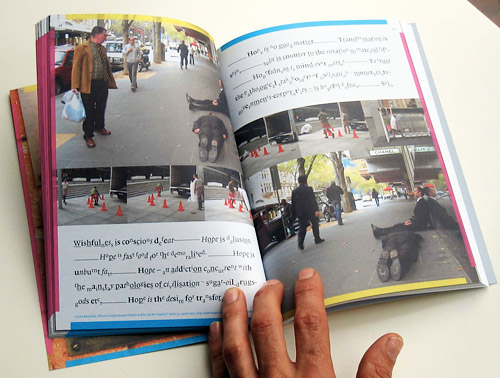
Our urban film, Tag, was never meant as a critique of the city, rather an example of using an impermacultural domain as a site for post-consumer play. A critique of the city occurs in other parts of my practice, as it does here. It was also made to demonstrate the body as common substance, devoid of shame and embarrassment, and directly influenced by the abstract and toxic environment in which we were courting chance behaviours. 


Photo: Kathryn McCool