Showing posts with label industrial agriculture. Show all posts

Wednesday, June 3, 2009

Desperate stuff

The Victorian government has recently formed an alliance with US chemical and plastics giant Dow Chemical. Here's what Dow states on its website:
The new $230 million Biosciences Research Centre, a joint venture between the Victorian Government and La Trobe University, will boost Victoria’s ability to make these important scientific discoveries. To be located in Bundoora, Melbourne, the facility will be a world-class centre for agricultural biosciences research and development. Other agencies and organisations with complementary science objectives are invited to partner or link in to the new Centre. (GOSD added the bold)
Government backed commercialised science is based on profits at the expense of natural ecologies. There is no longer an independent CSIRO. Contrary to what it says about averting a potential food supply crisis, CSIRO, like the other hijacked departments, is part of the problem. Science has been bought by chemical companies. University scientists are paid to deliver the science that best reflects the products of large corporations, which of course isn't science at all but at a systems level, a monumental ecological travesty. Chemical agriculture can never enhance the complexities of complex microbial life in the soil, can never mimic the complexities of natural systems, and therefore can never produce sustainable agriculture. Governments who support chemical companies such as Dow and Monsanto, support the abuse of the landbase and the abuse of those that eat their food.

As people, we have to move beyond desperate monological AgriBusiness and start to once again feed ourselves in healthy ecologies. Governments think the future of agriculture is with super farms that rely on broad acre chemicalisation, but the future lies with community food sovereignty. AgriBusiness will never protect diverse life with its single focussed aggregate-growth world view.

Friday, May 15, 2009

Don't buy any food you've ever seen advertised

Michael Pollan is one of America’s leading writers and thinkers in the country on the issue of food. He is author of several books about food, including The Botany of Desire, The Omnivore’s Dilemma and his latest, In Defense of Food: An Eater’s Manifesto. In light of what he calls the processed food industry’s co-option of “sustainability” and its vast spending on marketing, Pollan advises to be wary of any food that’s advertised.
Watch here.

Friday, May 1, 2009

The level of denial


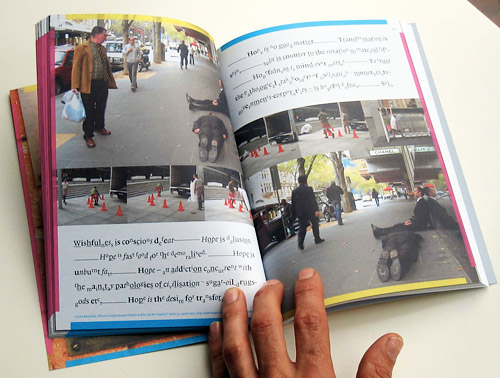
A number of years ago I was a participating artist at a land art event in Queensland. It was called The Floating Land 03. I installed three site-specific signs around Noosa. One along a bike path near to the regional gallery, one among the mangroves that you experienced by timber boardwalk, and one on Main beach.

The work on Main beach (pictured above and below) was gagged, or rather silenced for a short period during the event. Someone took offense and wrapped it up with fabric and gaffer tape. The reason I'm recalling this today is because I just read this quote by comedian Elayne Boosler:

"When women are depressed, they either eat or go shopping. Men invade another country".

The futility of this quote lies with the author's vision. She sees the two different responses to melancholy as being somehow unrelated. One is acceptable behaviour and one not. However the two responses are inextricably related. Man invades another country, justifies the destruction and theft of resources (by creating an enemy monster), makes more products with the resources to be consumed at home, which in turn fuels the illness of aggregate desire specific to modern capitalism. Both the consuming and the warring are acts of violence in modern life, only one is direct and one more mediated.

Unlike most of my friends I was sad to see John Howard go. Yes, I was. It meant an end to this horrible man's smug and mean spirited rule, but it also meant that we were heading back to the more indirect and veiled branch of the same party. As I expected, the Labor party has delivered almost the same government as Howard's, only with more fuzzy rhetoric and more sophisticated greenwash. Early in his office, after the Port Arthur massacre, Howard carried out his only good act as a politician, the disarmament of personal firearms. However, he made up for it later when he followed Bush's phony resource war to the Middle East. His logic: killing fellow Australians is inexcusable, however killing Muslims for fossil fuels is totally cool. Similarly, Rudd early in office, delivering his Sorry Day speech, brought us all to tears by 'fessing up to the brutality of white Australia; the genocides and repeated abuse of Aborigines by our very own colonising forces. The moral force of his words are still to this day just beautiful words, something educated people in positions of power are very good at displaying.

How many more years we have to wait for a politician to act morally is anyone's guess. Here, at the Garden of Self Defence, I generally don't dwell on what the Liberal-Labor party are up to. Many of the solutions to resource war, ecological destruction, male aggression, monotheistic colonisation, aggregate-growth capitalism, carbon emissions, genocide of indigenous cultures, pathologies of industrial agriculture, and abuse committed on non-human nature (by all of the above) can be found in community-based permaculture and heirloom seed gardening.


Photographs by Jonathan Sligh.

Thursday, April 30, 2009

Future social and ecological systems

Hamish Morgan, who works with various community groups in Western Australia, and I are writing a paper on future socio-ecological systems. Here is the first draft abstract:
The Internet and globalisation have created a virtual compression of time-space; networks of interrelation have spread across any possible boundary creating diverse points of connection. The net is expanding from one site of intensity to another, creating webs of interrelation upon which economic, environmental and social survival depends. The extension we want to make in this paper is that this modern digital experience is one that shares its model, at least at a ‘systems’ or epistemological level, with both traditional and contemporary cultural practices from the Central and Western Deserts in Australia.

Far from being ‘primitive’ or ‘no longer possible’ the Aboriginal model is the future. It is a map or blueprint for future social, economic and ecological relations that are taking place now, as they have for thousands of years. The modernisation of Australia can be seen as beginning from the desert out.

European modernisation in Australia is predominantly ecologically disembodied, and in recent times we have experienced further ramifications of this dominant cultural intervention, especially in terms of social and environmental disquietude. In Australia’s urban centres increases in self-harm, mood disorders, chronic illness, violence and obesity proliferate among young people, while their social network systems have never been more advanced. The concentration of populations in cities, and the reliance upon the importation of resources, has placed an unprecedented strain upon the landbase. The generation of heavily processed and synthetic food, derived from a developing culture of “super-farms”, coincide with a digital ecology model for social health and diversity; where the former (industrial agricultures) negates the latter (digital ecologies).

In this paper we will develop these theses and show which models already exist for a future beyond a disembodied aggregate-growth society. We will discuss Aboriginal social networking modalities in light of online community making; discuss Aboriginal rotational agricultural practices and compare them to modern permacultural practices; and discuss how the disembodied urban experience can be re-embedded into socio-ecological systems.


Monday, February 9, 2009

Street food: some minor alternatives to capitalism

Peter Tyndall opened my first (awarded) public work, Poemscape: a physical anthology, with a considerable talk critiquing the use of the word 'scape' and its problematic mediation of the natural world. We all baked facing west to a hot afternoon sun, listening to Peter outside the public library. The 18 Fujis that I planted, across the road from the town's supermarket, clung pathetically to sturdy timber plinths, each capped with a poem etched into a brass plaque. One of these poems was Michel Deguys' O great apposition of the world. I used three local poems, six Australian (from other parts) and twelve from other countries, each based environmental themes. Nearly ten years on, with various re-plantings due to drought and social idiocy, the trees struggle on. Each year I prune, water and feed them, and this is the first year the apples have coddling moth, which I'll need to treat over a period of time. 


This afternoon Maria, our neighbour, dropped over a large bag of green apples, produced by her trees. "No good for eating", she said, "but, OK for stewing". So I harvested what little rhubarb we had left and made a combined stew. For breakfast in summer we usually have organic rolled oats, that we buy in bulk, with stewed fruit or currants and local apple juice. In winter we make porridge and add local honey. The only time we have to visit a supermarket is when we have been disorganised, and missed the small produce shops or the Sunday market. Each time I walk into a supermarket I feel ambushed, and the more I learn about industrial agriculture and the plastics industry the more difficult it is to actually buy anything from these centers of mediated and fluorescent violence. 


Many people are talking about post-capitalist strategies. Here's a few of mine: If you are in the city join or start a permablitzing community, if you're in a rural area grow your own food and buy, swap and glean from local growers. If you're into graffiti, plant fruit trees – think espaliered tags – where council workers might ignore or not see them until they are established. Official public art, such as my Poemscape, seems passé today, but all of this thought and activity is in transition from a broken cycle toxicology to a closed-cycle ecology. We need to get incrementally better at the latter in order to mitigate the former.

Sunday, January 4, 2009

What we build

There are children swimming in the ocean. Many are what health specialists would, no doubt, call unhealthily overweight. Their parents have seen to it that they are covered up with sunscreen and that they wear long shorts, hats and arm length body tops to keep the harmful radiation off their skin. While most of us become increasingly aware of the science, we continue to burn our wages preparing the sun for its increasing assault on our skin and our soil. Our bodies are also products of industrialised agriculture – we eat food that is overly-refined, sugar rich and highly processed, we pass this on to our children. 

The interrelation between intensifying radiation from the sun on our skin and increased levels of unburnt fat in our bodies is obvious enough – oil-based economics based on profit growth. What is less discussed is that our society is an impermanent culture, not possible of ever being sustainable. We have lived a deluded, perma-boom existence, and our high levels of skin cancer and diabetes are the physical corollaries of this Australian life.

We have taught our children how to protect themselves from the sun (from nature), and how to eat (from supermarkets), we have introduced them to a global culture of progress. We have told our children that transporting resources, investing in economic growth and producing immeasurable waste is progressive. We have not told them that progress is killing us. We'd prefer to veil our kids from the inevitable horrors that await us, and the horrors that we've allowed to endorse our way of life.

Why is this? It is easy for us to attack nature – the sun is enemy, and therefore we can defend ourselves against enemies. But how do we defend ourselves from ourselves? How do we cease to participate in the great global toxiculture our elders have built for us?

Thursday, November 27, 2008

Reaping that which is possible


Today's harvest: broad beans and snow peas.

When growing food ceases to become a lifestyle choice (a mediation), but a life conscious act – or, rather a collective act for community health and defiance against governments who support industrialised agriculture – our society will begin its slow walk away from a culture of abuse to one of sustainability; one that fixes carbon, not one which burns it; one that produces no waste because everything is used and re-used in a closed-cycle ecology. Until that time government proclamations about the environment are empty and off the mark.

The food needs to be walking distance (relocalisation) and human brutality direct and seen for what it is, not disguised on the shelves of supermarkets. Our council tips need to move from methane producing toxic dumps to aerobic compost heaps and community gardens.

All of this is possible if enough of us stop waiting for governments to act or watch them lead us in the opposite direction (John Brumby). Which leads me to my current read (a gift from Jason), which I highly recommend:


David Graeber, p23 –
Sexual relations, after all, need not be represented as a matter of one partner consuming the other; they can also be imagined as two people sharing food.
More on Possibilities later.

Monday, November 24, 2008

Permapoesis

A well-composted soil fixes carbon in the earth where it’s needed most.

Permaculture bases its design principles on agro-ecology. A permaculturalist understands local ecology and applies this understanding to food production. This changes social, economic and cultural structures. If a poet’s food, which in part provides the material for poesis, is produced with her involvement, and within walking distance of her primary dwelling, her text is altered from one of capitalisation (reliance upon importation of resources) to one of ecology. The poet now participates actively within the environment that supports her, and the form and content of her life and work change accordingly.

The Readings Summer book catalogue arrived today which woke me from my slow text fantasy. I flicked through it in horror before heading back to my soil sifting. As I worked I imagined a publishing industry based on permaculture design and writers and poets stripped bare of their mediated existences; once dislocated, now active participants in the world that supports them.

Tuesday, November 11, 2008

Excerpt (Garden as Collective Offensive)

In less than a generation we have used half the world’s oil supply and are rapidly depleting other fossil fuels. Cheap food and cheap energy are becoming things of the past. The machinations of growth-obsessed industrial civilisation result in the continual transfer of carbon from the ground, where it is good, to the atmosphere, in ever-increasing quantities that make it toxic. Despite all the evidence demonstrating this, the governing corporations remain committed to the growth model - acting as though the environment has an infinite capacity to absorb the relentless production of toxicological wastes.

Saturday, November 8, 2008

Best Sellers

The Centre for Collective Wealth is a project-based initiative founded by Jason Workman and Larisa Marossine in Brooklyn, NY. The centre facilitates online projects, discussions, events, public works and shows.

For its inaugural project, the Center for Collective Wealth presents Best Sellers, a new video work by Patrick Jones. 

Sunday, November 2, 2008

Mashup with Ian Robertson

From The Garden as Collective Offensive: 
Industrial civilisation functions in a broken cycle: product is separated from process, production and consumption are geographically dislocated, cause is distanced from eventual (deferred) effect. The production of waste is unavoidable in this modality. There is no ecology of commerce in place, nor is capitalism capable of implementing one.