Showing posts with label toxicology. Show all posts

Monday, February 9, 2009

Street food: some minor alternatives to capitalism

Peter Tyndall opened my first (awarded) public work, Poemscape: a physical anthology, with a considerable talk critiquing the use of the word 'scape' and its problematic mediation of the natural world. We all baked facing west to a hot afternoon sun, listening to Peter outside the public library. The 18 Fujis that I planted, across the road from the town's supermarket, clung pathetically to sturdy timber plinths, each capped with a poem etched into a brass plaque. One of these poems was Michel Deguys' O great apposition of the world. I used three local poems, six Australian (from other parts) and twelve from other countries, each based environmental themes. Nearly ten years on, with various re-plantings due to drought and social idiocy, the trees struggle on. Each year I prune, water and feed them, and this is the first year the apples have coddling moth, which I'll need to treat over a period of time. 


This afternoon Maria, our neighbour, dropped over a large bag of green apples, produced by her trees. "No good for eating", she said, "but, OK for stewing". So I harvested what little rhubarb we had left and made a combined stew. For breakfast in summer we usually have organic rolled oats, that we buy in bulk, with stewed fruit or currants and local apple juice. In winter we make porridge and add local honey. The only time we have to visit a supermarket is when we have been disorganised, and missed the small produce shops or the Sunday market. Each time I walk into a supermarket I feel ambushed, and the more I learn about industrial agriculture and the plastics industry the more difficult it is to actually buy anything from these centers of mediated and fluorescent violence. 


Many people are talking about post-capitalist strategies. Here's a few of mine: If you are in the city join or start a permablitzing community, if you're in a rural area grow your own food and buy, swap and glean from local growers. If you're into graffiti, plant fruit trees – think espaliered tags – where council workers might ignore or not see them until they are established. Official public art, such as my Poemscape, seems passé today, but all of this thought and activity is in transition from a broken cycle toxicology to a closed-cycle ecology. We need to get incrementally better at the latter in order to mitigate the former.

Monday, January 19, 2009

All rights relinquished (or, 'Copyright Nothing' after The Fugs)

To get this post started, here is my 3-step, de-evolutionary path for a fully de-capitalised (and de-celebritised) culture - permanent culture (permaculture); culture of the mutable and unwashed.

1. All rights reserved - antiquated copyright and intellectual (private) property laws.
2. Some rights reserved - creative commons (transitional phase).
3. 'All rights relinquished' (Ian Robertson) – total abolition of the arts-as-capitalism's-slut.

Today I received a generous, although inflexible, comment from one of my favourite counter-culture bands of the sixties – The Fugs.
Hi Patrick. We, The Fugs, strongly recommend you delete your soundtrack from your film. We are honored that you have chosen us as a backing for your flicks, but unfortunately you are breaching copyright. We wanna keep the music bizo clean if you know what we mean. Musak is always a safe option. Love your blog btw. Fugz
What surprised me most was the language: "clean" and "safe". If you know The Fugs you'll know their music is neither clean nor safe, but very much unwashed and alive.

I chose to comply to the request for two reasons: Firstly, the bourgeois-training of my boyhood still responds well to politeness and good manners, and secondly, because I don't want to use music to accompany my (incidental and non-commercial) films by artist's who have contradictory values between what they make and how they act. My art and my values aim to 'bring down civilisation' (Derrick Jensen) and the culture of the 'Great Washed' (Alastair McIntosh), in small, everyday, bite-sized pieces. And besides, there are plenty of musicians who support this kind of de-capitalising anarchy. Artists and bands I have used for my films in the past, and who have not censored me (as yet), include:

Nightmares on Wax
Caribou
DJ Spooky
godspeedyou! blackemperor
esmerine
Aesop Rock
Howe Gelb
Justin Townes Earle

To name a few. Although once again, I have not sought approval to use their material as my work is strictly non-commercial and, in general, I do not acknowledge property rights for art. I do however take very seriously due acknowledgment of borrowed material, especially because it shows nothing is autonomous (and private) and everything is borrowed and shared.

Copyright is an embedded pathology of a civilised toxicology (impermanent culture) obsessed with transporting resources (mediated goods and food) and mediated celebrity. This toxiculture is an unstoppable fireball so ingrained in our skulls that even our beautiful (and dirty) old hippies buy into it. Who cares that artists are supported in the communties that they inspire (online and offline)? I do. Who cares that artists aren't paid for their goods? Not me. Who cares where artist's food comes from? I do! It comes from the soil that they help to improve and de-toxify, so as the vegetables, meat and fruit they eat and share no longer participate in a petroleum-based agriculture responsible for so much violence.

Yes, I acknowledge that my digital-anarcho-primitivism is problematic as the waste generated by the tools that make online art is unfathomable. My belief that 'progress is killing us as much as it is enabling us new possibilities' is, I admit, representative of my values in contradiction. However, the blogosphere has the potential to curb the secondary tier of art (the first being the conceptual) – the manufacturing of goods and other property including the intellectual. Online art also has the opportunity to take art back to its roots: to play in the space of the everyday. The film that The Fugs required I take down (I couldn't just delete the sound because I'd already deleted the master file from my ancient, overloaded laptop, and it only exists as an uneditable compressed Mpeg4), showed the flying fox I made for Zephyr and his friends. This 1.36 min film was called 'Permaplay' after 'permanent play', a fundamental of permaculture (Holmgren, Mollison), or permanent (sustainable) culture.

Impermanent culture is based on the immutable (the idea of universals such as copyright and God) – and on the toxicultural activity that springs from mediated life, removed from the landbase that supports us. On the other hand permanent culture (permaculture) is based on the mutable – the flux and chance of ecological life, where waste does not exist as everything is used and reused in a dynamic cycle of regeneration. Ironically, The Fugs' track that I used was their piss-take on the great immutable Ten Commandments.

W B Yeats' line from his poem Lapis Lazuli, 'all thing fall and are built again', is not a flawed generational hangup, and its timelessness doesn't make its very idea immutable, rather generationally adaptable. One of my favourite Fugs song is the 'Nothing' song, where everything is nothing, "Monday nothing... New Yorker nothing... Hanging out in Folkways nothing..."etc., including big Fug-fan Allen Ginsberg - "Nothing, nothing nothing!" This is the spirit in which the world becomes everything, where things' values aren't placed in an order of hierarchy or private property (David Graeber), but are shared monistly on ecologic grounds.

Sunday, January 4, 2009

What we build

There are children swimming in the ocean. Many are what health specialists would, no doubt, call unhealthily overweight. Their parents have seen to it that they are covered up with sunscreen and that they wear long shorts, hats and arm length body tops to keep the harmful radiation off their skin. While most of us become increasingly aware of the science, we continue to burn our wages preparing the sun for its increasing assault on our skin and our soil. Our bodies are also products of industrialised agriculture – we eat food that is overly-refined, sugar rich and highly processed, we pass this on to our children. 

The interrelation between intensifying radiation from the sun on our skin and increased levels of unburnt fat in our bodies is obvious enough – oil-based economics based on profit growth. What is less discussed is that our society is an impermanent culture, not possible of ever being sustainable. We have lived a deluded, perma-boom existence, and our high levels of skin cancer and diabetes are the physical corollaries of this Australian life.

We have taught our children how to protect themselves from the sun (from nature), and how to eat (from supermarkets), we have introduced them to a global culture of progress. We have told our children that transporting resources, investing in economic growth and producing immeasurable waste is progressive. We have not told them that progress is killing us. We'd prefer to veil our kids from the inevitable horrors that await us, and the horrors that we've allowed to endorse our way of life.

Why is this? It is easy for us to attack nature – the sun is enemy, and therefore we can defend ourselves against enemies. But how do we defend ourselves from ourselves? How do we cease to participate in the great global toxiculture our elders have built for us?

Tuesday, November 11, 2008

Excerpt (Garden as Collective Offensive)

In less than a generation we have used half the world’s oil supply and are rapidly depleting other fossil fuels. Cheap food and cheap energy are becoming things of the past. The machinations of growth-obsessed industrial civilisation result in the continual transfer of carbon from the ground, where it is good, to the atmosphere, in ever-increasing quantities that make it toxic. Despite all the evidence demonstrating this, the governing corporations remain committed to the growth model - acting as though the environment has an infinite capacity to absorb the relentless production of toxicological wastes.

Wednesday, November 5, 2008

Out of print

I've thought for a long time about how to make publishing books more a part of a closed-cycle ecology.

As the wireless reading device is still relatively non-existent, we really only have an industrial model of publishing: thousands of tonnes of books and draft manuscripts annually depopulating forests and by extension, releasing carbon into the atmosphere as greenhouse gas. It's a pretty fucked-up industry, like water bottled in plastic, that few seem to be critiquing.

Books I've published in the past use materials such as vegetable-based inks and recycled and chlorine-free pulp, however, production is still industrialised. Finsbury Green is the printery Ian and I generally use, and while they are leading the transition in cleaner technologies, I'm not convinced this will make all that much difference to the mammoth task we have of dismantling our toxiculture.

I think that change has to come from writers, who now have to decide their level of output, material use and distribution method – especially if we consider that transportation is an assault on the landbase that supports us. It helps when writers are also the publishers and distributors, like David Prater, a poet and early advocate of online publishing. He edits Cordite and knows first hand how much paper and ink has not passed through his office in the past ten years.

However, where the digital age has the potential to reduce pulp consumption on the planet, there's still the problem of digital hardware and the capitalisation (toxicology) of new technology – new equipment is upgraded while old equipment is offloaded as non-compostable waste.

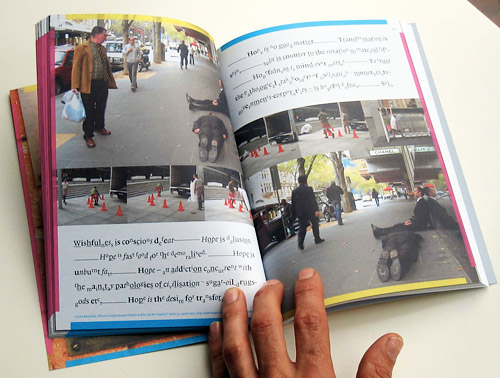
Then there's the materiality of books – their objecthoodness. Words and Things (2004) is an anthology of chance, concrete poetics and mutable literatures I edited, contributed to and co-produced with Ian Robertson. It includes Richard Tipping, Peter Tyndall, Peter O'Mara, Marie Sierra, Jeff Stewart, Aleks Danko, Alex Selenitsch and Geoffrey Baxter. It's now out of print and the 600 copies we manufactured are out in the world ready for some sort of decomposition.