
Showing posts with label C02. Show all posts
Showing posts with label C02. Show all posts
Tuesday, May 19, 2009


Saturday, May 16, 2009
If it's advertised it's probably toxic
A follow on from Pollan's thoughts...
If you join the dots between a thing advertised and the materials, environments, humans and non-humans used in the process of making that thing, you'll see what I mean.
Take this example:
I walk up to the shops in my town... a massive water tanker passes me by... they advertise their phone number on the side of the truck... I call them up... I'm told they cart bore water for bottled water companies such as Big Wet and Coca-Cola... I then call those companies... they confirm that they exploit this public resource... once public to the Djadjawurrung before their genocide... I start to think about the water being taken from an ecosystem and wonder what large scale, long term water mining will do to it... I start to think about how much carbon pollution the bottled water industry generates by trucking its product around the country... and about the amount of oil required to make the plastic and therefore the landfill of toxic waste...I find out, in Australia alone, nearly 500,000 barrels per year, and for what? Because everyday people like us, just trying to earn a living, conned us into believing that bottled water is cleaner and healthier? My body, my temple – fuck the rest of everything else.
 Conned by religious nuts, conned by business creeps, conned by dodgy politicians? Or do we just con ourselves by falling for the comforting lies of madmen? Why do we pay them attention, why do we pay them our wages?
Take this example:
I walk up to the shops in my town... a massive water tanker passes me by... they advertise their phone number on the side of the truck... I call them up... I'm told they cart bore water for bottled water companies such as Big Wet and Coca-Cola... I then call those companies... they confirm that they exploit this public resource... once public to the Djadjawurrung before their genocide... I start to think about the water being taken from an ecosystem and wonder what large scale, long term water mining will do to it... I start to think about how much carbon pollution the bottled water industry generates by trucking its product around the country... and about the amount of oil required to make the plastic and therefore the landfill of toxic waste...I find out, in Australia alone, nearly 500,000 barrels per year, and for what? Because everyday people like us, just trying to earn a living, conned us into believing that bottled water is cleaner and healthier? My body, my temple – fuck the rest of everything else.
Conned by religious nuts, conned by business creeps, conned by dodgy politicians? Or do we just con ourselves by falling for the comforting lies of madmen? Why do we pay them attention, why do we pay them our wages?Here, in my hand is one dot (a discarded water bottle thrown from a car window), and over there is another dot (the ecological sources of that waste). It's up to us to join the dots, for they represent industrial civilisation; they represent our modes of production; they represent us – ecophobic, disembodied and ignorantly abusive.
Take any advertised product, spend a day online researching who's behind that product and where the materials used for it come from, make numerous calls, join the dots, factor in the transportation costs to the environment, and I guarantee you'll find what I have found. Welcome to capitalism!
It's now time to "grow your own food, catch your own water [and energy], and say hello to your neighbour" – Roberto Perez, Cuban permaculturalist, Daylesford Town Hall, 2008.
Thursday, April 16, 2009
I think therefore I comment, I comment therefore I think
I regularly get stupid comments on my blog. I thought for a while I'd filter them, but went back to my original state of no border guard. The most stupid comments generally come from Anonymous, which I've discovered is a collective noun synonymous with gutless.
This morning I did some chance blog surfing and discovered this little line from a blog called Putting God First:
Delight yourself in the Lord, and he will give you the desires of your heart.
I thought about this for all of two minutes and left a comment (which of course can be tracked back to this site):
Delight yourself in the soil and it will give you unrelenting honesty about your Christian-capitalist carbon footprint.But why is a C-c carbon footprint necessarily larger than my own? I'd like to get it measured to be sure, so I'm taking an educated guess that those who invest in desire, hope, fantasy and heaven aren't really thinking about microbial life, and therefore about carbon fixing. If only cops would breathalise us for greenhouse gas and humus depletion and leave drink driving to real chance encounters.
Regardless of where we each stand on the god front (or booze for that matter), sincerity comes from direct engagement, not cowardly, anonymous and indirect commenteering. Here's a comment, albeit analogue, that I posted several years ago in Melbourne on a real-live Christian site - a public footpath.

Click for bigger.
It says (in a slow text):
Christ is the only Christian, become your own Ian.I have a friend called Ian whom I love to call Ianian, and he is the greatest Ianian of them all.
Sunday, January 4, 2009
What we build
There are children swimming in the ocean. Many are what health specialists would, no doubt, call unhealthily overweight. Their parents have seen to it that they are covered up with sunscreen and that they wear long shorts, hats and arm length body tops to keep the harmful radiation off their skin. While most of us become increasingly aware of the science, we continue to burn our wages preparing the sun for its increasing assault on our skin and our soil. Our bodies are also products of industrialised agriculture – we eat food that is overly-refined, sugar rich and highly processed, we pass this on to our children.
The interrelation between intensifying radiation from the sun on our skin and increased levels of unburnt fat in our bodies is obvious enough – oil-based economics based on profit growth. What is less discussed is that our society is an impermanent culture, not possible of ever being sustainable. We have lived a deluded, perma-boom existence, and our high levels of skin cancer and diabetes are the physical corollaries of this Australian life.
We have taught our children how to protect themselves from the sun (from nature), and how to eat (from supermarkets), we have introduced them to a global culture of progress. We have told our children that transporting resources, investing in economic growth and producing immeasurable waste is progressive. We have not told them that progress is killing us. We'd prefer to veil our kids from the inevitable horrors that await us, and the horrors that we've allowed to endorse our way of life.
Why is this? It is easy for us to attack nature – the sun is enemy, and therefore we can defend ourselves against enemies. But how do we defend ourselves from ourselves? How do we cease to participate in the great global toxiculture our elders have built for us?
We have taught our children how to protect themselves from the sun (from nature), and how to eat (from supermarkets), we have introduced them to a global culture of progress. We have told our children that transporting resources, investing in economic growth and producing immeasurable waste is progressive. We have not told them that progress is killing us. We'd prefer to veil our kids from the inevitable horrors that await us, and the horrors that we've allowed to endorse our way of life.
Why is this? It is easy for us to attack nature – the sun is enemy, and therefore we can defend ourselves against enemies. But how do we defend ourselves from ourselves? How do we cease to participate in the great global toxiculture our elders have built for us?
Tuesday, November 11, 2008
Excerpt (Garden as Collective Offensive)
In less than a generation we have used half the world’s oil supply and are rapidly depleting other fossil fuels. Cheap food and cheap energy are becoming things of the past. The machinations of growth-obsessed industrial civilisation result in the continual transfer of carbon from the ground, where it is good, to the atmosphere, in ever-increasing quantities that make it toxic. Despite all the evidence demonstrating this, the governing corporations remain committed to the growth model - acting as though the environment has an infinite capacity to absorb the relentless production of toxicological wastes.
Sunday, October 26, 2008

Friday, October 17, 2008
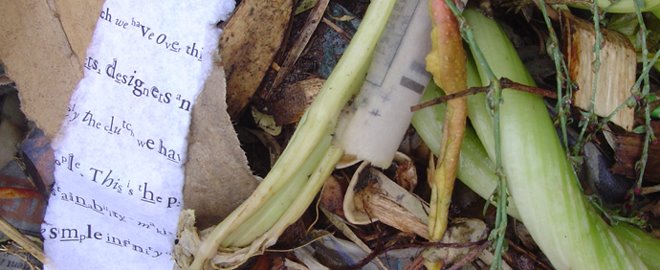
Composting as collective offensive (for Hamish Morgan)
The following flick is an eyepiece for aerobic composting, where the aeration of the body is contiguous with the world. It's a short flick cut to a short track called Fall by the band called The Thing (now Dirtbird). It's a how-to-do-words-with-things film that emits little methane, recalling "All things fall and are built again" (W B Yeats, 1939), together with "Once upon a time the world was round, and you could go on it round and round" (Gertrude Stein, also 1939).
Carbon is fixed in the soil if the compost is damp and aerated. If the compost is too wet and not turned (not aerated), the organic matter rots, giving off methane. Carbon is the gaseous nutrient. It's transformation, into a greenhouse gas, is CO2. But carbon is organic matter in the soil, if treated well there is less gaseous transformation, less reduction of humus and therefore less carbon dioxide in the atmosphere.
All things fall and are built again in a closed-cycle ecology – NO WASTE – and those that build them again are microbial and joyous. Our economics and our ecology can now come home – Oikos – together. To give up on gaseous transformation – aspiration/celebrity – is to act as a collective offensive, or in mutual self defence.
Carbon is fixed in the soil if the compost is damp and aerated. If the compost is too wet and not turned (not aerated), the organic matter rots, giving off methane. Carbon is the gaseous nutrient. It's transformation, into a greenhouse gas, is CO2. But carbon is organic matter in the soil, if treated well there is less gaseous transformation, less reduction of humus and therefore less carbon dioxide in the atmosphere.
All things fall and are built again in a closed-cycle ecology – NO WASTE – and those that build them again are microbial and joyous. Our economics and our ecology can now come home – Oikos – together. To give up on gaseous transformation – aspiration/celebrity – is to act as a collective offensive, or in mutual self defence.
Thursday, October 16, 2008
To what end?

"The economic crisis is petty by comparison to the nature crunch. But they have the same cause... As we goggle at the fluttering financial figures, a different set of numbers passes us by. On Friday, Pavan Sukhdev, the Deutsche Bank economist leading a European study on ecosystems, reported that we are losing natural capital worth between $2 trillion and $5 trillion every year, as a result of deforestation alone(1). The losses incurred so far by the financial sector amount to between $1 trillion and $1.5 trillion. Sukhdev arrived at his figure by estimating the value of the services - such as locking up carbon and providing freshwater - that forests perform, and calculating the cost of either replacing them or living without them. The credit crunch is petty when compared to the nature crunch." Read more Monbiot here.
Subscribe to:
Posts (Atom)