Showing posts with label common substance. Show all posts

Saturday, May 2, 2009

On death, sex and compost


One of the fantasies my girlfriend and I share in bed is our compost fantasy. It's one where we become part of a whole underground domain; our bed wriggling with a world of re-embodying substances, de-centered egos, legs and limbs akimbo, rolling and turning in a field of damp, warm loving life.

What is so inextricably sexy about taking a heap of gleaned organic biomass, fetid kitchen scraps, sweet smelling forest mulch, and chicken, horse and cow shit, and turning it into dark chocolate compost, rich in microbial life? Well for me, apart from the material goodness it provides for the garden, it also means I don't have to visit supermarkets and other centres of abuse, denial, silencing and avoidance.

It's International Compost Awareness Week this week. So, here at The Garden there'll be a number of compost related posts. But first, a picture of one of mine cooking beneath one of my "prohibition" signs (related to yesterday's post).


Thursday, April 16, 2009

I think therefore I comment, I comment therefore I think

I regularly get stupid comments on my blog. I thought for a while I'd filter them, but went back to my original state of no border guard. The most stupid comments generally come from Anonymous, which I've discovered is a collective noun synonymous with gutless.

This morning I did some chance blog surfing and discovered this little line from a blog called Putting God First:
Delight yourself in the Lord, and he will give you the desires of your heart.
I thought about this for all of two minutes and left a comment (which of course can be tracked back to this site):
Delight yourself in the soil and it will give you unrelenting honesty about your Christian-capitalist carbon footprint.
But why is a C-c carbon footprint necessarily larger than my own? I'd like to get it measured to be sure, so I'm taking an educated guess that those who invest in desire, hope, fantasy and heaven aren't really thinking about microbial life, and therefore about carbon fixing. If only cops would breathalise us for greenhouse gas and humus depletion and leave drink driving to real chance encounters. 

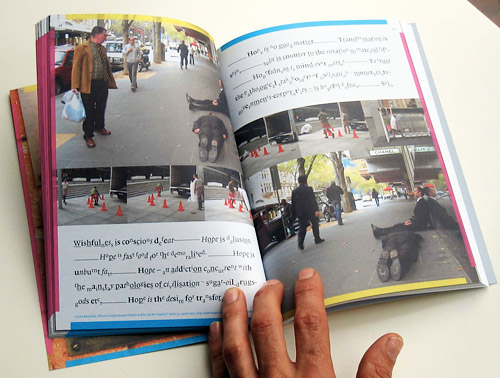
Regardless of where we each stand on the god front (or booze for that matter), sincerity comes from direct engagement, not cowardly, anonymous and indirect commenteering. Here's a comment, albeit analogue, that I posted several years ago in Melbourne on a real-live Christian site - a public footpath.
Click for bigger.

It says (in a slow text):
Christ is the only Christian, become your own Ian.
I have a friend called Ian whom I love to call Ianian, and he is the greatest Ianian of them all.

Wednesday, April 1, 2009

Father and son free-dragging

At the local Neighbourhood House there are many great courses you can enroll in, including courses on self-sufficiency, crochet, blogging (taken by my great girlfriend) and Laugh Club. So last night after walking home with cuts and bruises from free-dragging with Zeph I devised a possible course I could run at Neighbourhood House. The ad in the brochure would go something like this:
Laugh Club not working for you? Then wreck yourself in a crash course in Free-dragging. The course tutor is one of the co-originators of this mutant form of Parkour (sometimes carried out in drag). Learn the poetry of hopelessness and the art of physical graffiti from a master free-dragger. Come with your own liability insurance and self-liberty assurance. Guaranteed to make you sore.


Film still from forthcoming video.

Wednesday, February 18, 2009

3g

  1. gathering
  2. gleaning
  3. growing

What else is intelligence but adapting to one's continuously changing environment? And when environments change, no longer providing the conditions for life as we know it, new life, new thought and new activity flourish; remixing ancient modes of survival with new social and technological phenomena.

A young boy is alone in his room, feeding himself industrialised chips, drinking plastic-coated junk, playing with his Xbox. He represents an old dying world.
 
The technologies that fail us are the one's that help construct relations of avoidance, wholly attached to capitalism's cult of the individual. The technologies for a new world are those that will help us remain connected and supported as collectives of common substance.


Saturday, February 7, 2009

Possessions of the sun

We're at the local lake. Dogs, ducks, yabbies, redfin, swans, swamp hens, flies, wasps, bees, mosquitos, jumping jacks, bull-ants, foxes, snakes, swamp wallabies, children and adult human beings share the water. I swim, cool down, then sit on the bank and continue my slow read of David Graeber's Possibilities: Essays on Hierarchy, Rebellion, and Desire.
The ultimate proof that one has sovereign power over another human being is one's ability to have them executed. In a similar fashion, one might argue, the ultimate proof of possession, of one's personal dominium over a thing, is one's ability to destroy it – and indeed this remains one of the key legal ways of defining dominium, as a property right, to this day. p73
Zeph gets out of the water and comes over to us, his towel wraps his shivering body, "You are under a rest Dad!" Which is true, so I reply "Yes, I'm under a tree, resting". "No Dad! You're under arrest!" he shouts. 

Until this Summer the highest recorded local temperature was 39 degrees celsius. This area of south-east Australia is known for its high rainfall and cool highland climate. Things are rapidly changing. Today is the fourth day of 41 degrees this past fortnight, and it is the most brutal, wind-charged and apocalyptic of all of the 4928 days that I've been living here. We're all on a high fire alert.
When you eat something, you do indeed destroy it (as an autonomous entity), but at the same time, it remains "included in" you in the most material of senses. Eating food, then, became the perfect idiom for talking about desire and gratification in a world in which everything, all human relations, were being re-imagined as questions of property. p74
After today "sovereignty" over something in terms of social relations, say between parents and children, masters and slaves, private property and public lakes (to name a few) has changed. Today the unsinkable Murdoch media empire crumbles, while the sun takes up the heirarchical slack, as if the financial crash and the nature crunch are wholly linked organisms. Of course they are. We are standing on the bank looking out over a body of cool water. Nearby, Ballarat's majestic Lake Wendouree is barren. Runaway climate change is just over the horizon, and our politicians and our own comfortable incontestability have sentenced us to nature's complete rule and wrath.

David Holmgren, at a recent meeting in our town hall (with climatologist Rob Gell), stated that growing your own food by permaculture methods uses between a fifth and a tenth less water than supermarket food. Additionally, Gell stated that by 2013, according to the most recent science, the Arctic ice will be gone, and that the southern part of Australia will burn and the northern part will become much wetter.

So I return to all I know: making useless art, embracing hopelessness, growing what food is possible, living intensely and actively with few expectations and sharing what's possible to share. Astrid Lorange, in her review of my book, writes it this way –
By decentring the kind of symbolism we might attach to an artistic manifesto for a sustainable future–that is, that hope will manifest as change–Jones sets up a far more mobilising set of propositions. Rather than hope and desire, we need to practise free-dragging, where non-delusional play and civil disobedience are the productive ferment of critical and creative hopelessness.
Others call it excrement.

Saturday, January 17, 2009

Stateless Gestures

And from public fruit (yesterday's post) to another form of self-pollination – Jason Workman and Ian Gamble in North Carolina.

Tuesday, January 6, 2009

Beyond judgement, towards criticality

It's somewhere between 12am and sunrise and I'm listening to the drunks in the tent next door to ours. One guy is yelling, "me foreskin's wearing out" over and over until he invents another, "Julie, give me your finger, he's passed out, stick it up his arsehole". I consider getting up and asking him to lower the volume. Instead I lay there a little longer and eventually we all pass out.

Today I've been thinking about the drunk guy's graffic language, its volume and its incursion upon a sleeping campsite. And I've been thinking about my initial judgement (and avoidance) of these night raiders, or air graffitists, in light of my recent championing of both joking relations and relations of common substance.  

A few things come to mind. Firstly, it is clear that my immediate judgement stemmed from fear. As I lay in my tent I perceived a level of drunkeness in the loud guy's voice which I knew could quickly transmogrify into irritation, possibly even some level of violence. It seems to me that when a man is joking about sticking his finger up a mate's arse, he's either hanging for a fuck or looking for a fight. With extreme drunkenness either will suffice (in order to put the baby to sleep). The second judgement was based on community insensitivity. The four drunks had come back from a binge and loudly announced it to the sleeping world. The intervention was simply selfish in the quiet of the night.

Good manners are synomonous with the bourgeiose. In his book Possibilities, David Graeber tracks the course of manners through the Middle Ages and their correlation with relations of avoidance and property; most fiercly indoctrinated by the English puritans and the Scotsman Calvin.
...avoidance became generalized: in the sense that principals of behaviour which once applied mainly to relations of formal deference gradually came to set the terms for all social relations, until they became so thoroughly internalized they ended up transforming people's most basic relations with the world around them. David Graeber, p31.
My primary and secondary school education was Calvanist in flavour, or what I came to brand: Christian-capitalist. So my judgement, at an entrenched level, stems from the prejudices of prudishness and wealth generation (at the expense of the landbase) that Christian-based private schools promote.

In contrast my adult, self-formed self is more of the eco-anarchic-atheist, the frameworks within which I practice a critical life heavily reliant upon chance encounters, an attempt at permanent culture (permaculture) and a long standing admiration for common substance and indigenous intelligence.  

My two selves – a bourgeiose-Calvanist and a utopian embracing hopelessness – make up my whole, albeit unpopular, self. In this world it may seem far more simple to take a path of least resistance – join a proper club – and live supposedly free from judgement and critical thought, but I figure that eventually stupidity's dangerous side catches up with people, as it does with planets.


Saturday, January 3, 2009

The great unwashed


Supermarkets represent society's woeful handling of death. Like the city, the supermarket is a petroleum-based assualt on the earth by the Great Washed – the civilised; the centralised. When all our vegetables once again look like these dirty irregular carrots (top right), grown locally, we will have given up the dependance upon credit, veils, abstractions and mediations that constitute a woeful and disconnected relation to death.

For a more succinct and inspirational version of this rant check out Alastair McIntosh's Do Lecture.

Sunday, December 21, 2008

A de-civilising process

At this point, I can turn to Norbert Elias' argument about the civilizing process in Europe...essentially it came down to the attempt, largely on the part of middle class religious authorities, to improve the manners of those below: most of all by eliminating all traces of the carnivalesque from popular life. David Graeber, Possibilities, p31-32.
Earlier in his book David Graeber writes how gradually, from the twelfth century onwards, the social authorities imbibed a culture of shame and embarrassment for all things bodily – excrement, sex, etc.; things of common substance and their joking relations – think Rabelais’s dirty humour.

Property relations, not sacredness, was the rationale behind the church's enforcement of celibacy onto its priests. The eldest sons of priests were too often claiming church property as their inherited own, and the papacy cracked down on the loss of church property. If avoidance relations are so linked to property, as Graeber suggests, then it is little wonder that the ensuing culture of sex-secrecy – developed by so many priests struggling with celibacy, culminating in paedophilia and other abuses of power – has in turn led to the selling off of acquired properties to fund the thousands of law suites lodged by victims of their cause. It’s an interesting, sad and ironic several hundred-year cycle of avoidance, only checked due to recent demands of accountability on religious institutions by secular authority.

Every year in Daylesford there is a New Year’s Eve parade where various community groups and artists create themed floats or parade various skills, activities and crafts on foot. One year cartoonist, Michael Leunig, with some friends made a float using two inflatable sex dolls. It was called something like 'the garden of love'. The local authorities didn't share the humour and arrested them for public indecency, including the dolls. At the courthouse, while the trial was being heard, the male doll was brought into proceedings by a local cop who’d put a paper bag over his penis. A large group of locals, including kids, turned up to express their support for Leunig's float. I believe there was not a single local person against it. 

Last year, my own somewhat less contentious parade concept was in aid of my water activism; also using joking relations (based upon the behavioural relations between chance and cross-dressing). The purpose of this costume, after the joke for joke's sake, was to draw attention to a local thing of common substance – water, and its privatisation by Coca-Cola Amatil and Cadbury Schweppes for global profiteering. Meg handed out stickers that directed people to the justfreewater myspace page and over the next several days I watched my stats counter on the site grow measuredly. 


Photo: Peter O'Mara (as you can see he won't make Best Australian Photography, 2008, but he is included in this year's Best Australian Poems, UQP).

Zeph's mum, who was at the parade earlier on to drop Zeph off, made the joking remark, “no wonder we didn’t make it”, when she saw what I was wearing. Meg later jokingly said to me, “that’s why you're with me now”. Meg was dressed deliciously, as you’ll no doubt agree.

Photo: Peter O'Mara 

My ex-partner was raised in a Christian household. Her parents were missionaries, her dad become a scholar and translator, responsible for overseeing versions of the Bible into Chinese and other Asian languages. 

Sadly, his daughter and I now only have a relationship of avoidance based upon property rights, which regrettably over-rides a relation of common substance – our child. And it is tied up with the pressing issue of whether or not to sell the quarter acre, that constitutes the physical entity that partly feeds us and this blog: The Garden of Self Defence. 

Most people, most likely, relate with all three of the modes that Graeber and anthropologists before him have outlined: with avoidance, with jokes and with common substance. However, it remains to be seen whether the dominant culture, based on private property, waste and wealth generation – abstractions of avoidance in terms of the landbase that supports us – can ever close the broken cycle generated by capitalism's corollaries, and become a society more dominantly based on common substance again: children raised by whole communities; food not transported but grown within walking distance; natural resources not transported away from food and water bowls – in essence a permanent culture, based less on manners, restriction, hierarchy and capital growth, and more on an understanding of our place within a local ecology – where we consciously particpate in securing a sustainable and permanent future for those who come after us. A gift that has been provided by those who have come before.

Friday, December 19, 2008

Immutable fashion – notes on small talk

I have an idea for a t-shirt that says: 'Lousy at small talk', something I can wear to parties. I'll probably make one in the next few weeks, perhaps two, one for you dear reader, if you're inclined. 

Is small talk a thing of common substance or of avoidance?

1. Small talk as common substance: To speak small talk with others is to build relations based on a mutual lightness of spirit. Although I'm empathetic to this notion in terms of 'social warming', small talk functions best as an ancillary to something else, such as dancing or disruption: lobbing a boot at a psychopathic politician and calling him a dog after he has fucked your country.

The Dancers Inherit the party

When I have talked for an hour I feel lousy –
Not so when I have danced for an hour:
The dancers inherit the party
While the talkers wear themselves out and
            sit in corners alone, and glower.

2. Small talk as avoidance. The natural territory of small talk resides within the localities inhabited by the bourgeoise and petit bourgeoise. It is here that small talk is rarely allowed to become 'big'. It can be cut off with eye rolling, polite refrain or bodily squeamishness that breaks the social engagement. Small talk as a natural language modality of the middle classes is predicated on older religious boundaries of shame and embarrassment developed since the twelfth and thirteenth centuries. This is when art, incidentally, turned from a practice of everyday social activity, practiced by numerous, to one where the artist became sublime and individualistic – the development of the capitalist construct of the genius; worthy of marketing and cultural exploitation. The cult of the nice is society's modern, secular equivalent – here the genius has a happy disposition (see the likes of John Cage), or for an alternative, winter baby's view:

On middle class poverty 

The poet's teeth are rotten.
The poet doesn't drive.
The poet has an empire in the mind.
The poet writes the god.
The poet is assassinated.
The poet's unAustralian.

Patrick Jones (listen to this poem here)
NB. I'm writing this post after coming home from a party where I engaged in mid-sized talk and ate beautiful food and drank local plonk, all for which I'm passingly grateful. 

Wednesday, December 17, 2008

Cities


After I posted the most recent WorkmanJones film, Tag, a friend of mine, Hamish Morgan, challenged me on why we chose to use the city as a site for our work. There are so many ways to think about and address this question. I initially gave some reasons in response, but having thought more about it lately, about impermanent culture (impermaculture), I thought I'd share some of this thinking.

Firstly, cities exist. Modern cities are toxicities, they rely on resources from elsewhere, they waste waste, they can (probably) never be sustainable, more people live in them than in rural areas (a recent global phenomenon), and cities are places of social invention and mutation. For all these reasons, critiquing, participating in and understanding the city is to understand the dominant psyche of modern humans and why centralised capitalism is killing us, and many other species, very rapidly and very cruelly.

Hamish has spent a few years living with an aboriginal community in remote WA, and I have spent the majority of my life living in occupied regional areas of Australia, namely the Wingecarribee district, Wagga Wagga and Djadjawurrung country for the past 13 years. Both Hamish and I have been educated in urban universities, where few questions are ever asked concerning urban impermaculture.

Recently, I voluntarily endured a paper given by a PhD candidate that cross-pollinated Situationist thought with her own desire to continue shopping. It was a seemingly clever paper using fashionable dérive poetics with individualist urbane desire. Michael Farrell brilliantly called it 'romantic shopping'. It simply repulsed me. She was a post-graduate student in sustainability and architecture. 

Her intellectual abstractions represented her mediated blindness. She told us that she drove her car into the city to carry out her shopping 'experiments', and that she had to consume things in order for her experiment to work. When I challenged her, pretty clumsily regrettably, on her work as capitalist embellishing, she exclaimed, "But what other system have we got?"

What was so offensive about this paper was that an architect working in the area of sustainability was not looking at urban permaculture in Havana as a model or focus point for her research, or any other transitional city. Havana is a living example that excitingly challenges my Jensenian belief that cities can never be sustainable (based on a reliance upon the importation of resources). Instead it was her own desire and its place in the world that was being indulgently understood. The other area this paper failed to investigate, regarding the question of future sustainability and urban psychogeography, was indigenous intelligence.

Our urban film, Tag, was never meant as a critique of the city, rather an example of using an impermacultural domain as a site for post-consumer play. A critique of the city occurs in other parts of my practice, as it does here. It was also made to demonstrate the body as common substance, devoid of shame and embarrassment, and directly influenced by the abstract and toxic environment in which we were courting chance behaviours. 


Photo: Kathryn McCool

Monday, December 15, 2008

Property relations


Photo: Kathryn McCool
If property is so closely related to avoidance, and if these two principals of identification and exclusion really are so consistently at play (and I think they are), then is it really so daring to suggest that the person, in the domain of avoidance, is constructed out of property? David Graeber, Possibilities, p22.

Saturday, December 13, 2008

Ashes and boxes (some notes on death)

I'm thinking of Alice B Toklas in her seventies, and similarly an old friend, Val Herbst, trudging damply around her dry garden, fat fag smoking from her lips, high cloud drizzle falling on dying perennials, drought around, drinking coffee through unwashed glass alive with unnameable film, Alice, tasting her oldness in everything, listening to her thongs slapping the peddles of the baby harpsichord, punching out Scarlatti, lionising him while attacking the polite memorials, her mind that brave, her bed dank, a cat's bed under the Murrumbeena bowls and foxing shelves of printed thought. A lifetime corroding in full view of my early twenties, drawing her pictures; her decomposition a gift reversed.

Instead we burn our dead or box them tight from soil in coffins – the pollutions of avoidance. Val insisted on the right to be buried in her half dead garden and years later the same spirit home-birthed Zeph; the stuff of common substance becomes an argument with the fearful. 
The one thing that everybody wants is to be free...not managed, threatened, directed, restrained, obliged, fearful, administered, they want none of these things they all want to feel free...they do not want to be afraid not more than is necessary in the ordinary business of living... Gertrude Stein, 1943

Friday, December 5, 2008

Shredding, gleaning, piling and heaping

Currently I glean most of the material for my composts. Neighbours recently saved a trip to the tip because I pulled up with my wheelbarrow and asked to take the loads away. I often take my wheelbarrow for a walk scavenging for material. Peter O has been getting into the habit of dropping off shredded paper from school (if only I could get hold of the White House's pile right now). We collect horse poo from the nearby horse riding ranch and, as I've mentioned before, we weekly collect the food scrap bins from a nearby cafe. As we have now started to harvest food, we have increased our green waste which, in a closed-cycle ecology, is not really waste at all. 

As you can see in the below picture our soil is highly disturbed, largely compacted clay. Intensive mulching, to keep moisture in the soil (which attracts worms who break down the clay), together with intensive composting over the next several years should see a dramatic decrease in water usage.


Wednesday, December 3, 2008

The crow and the chook

The eagle, the crow and the bat are the three totems that belong to the local mob – the Loddon tribe of the Djadjawurrung people, a clan of the Kulin nation – local, at least, to where I live.
Aborigines saw man as sharing a common life-principal with animals, birds and plants. They embraced all these in human social and religious life by establishing totemic relationships between them and people. (A P Elkin, 1967, from The Loddon Aborigines, Edgar Morrison, p.17., private press booklet, 1971, from articles published in the Daylesford Advocate newspaper 1963-1971).
The Loddon Aborigines, as anthropologists like David Graeber might suggest, had relations of 'common substance' with the land – a closed-cycle, single-broken-line homeostasis, where the body (as tribe) is contiguous with everything else. Here, the closed-cycle represents the tribal land, a clearly delineated food and water bowl where nothing is wasted, and the single-broken-line represents the necessity for other relations outside of this land.
Within these clearly defined boundaries their hunting rights were ordinarily respected by their neighbours with whom they normally enjoyed friendly relations and a measure of collaboration and inter-marriage. (The Loddon Aborigines, Edgar Morrison, p16., private press booklet, 1971, from articles published in the Daylesford Advocate newspaper 1963-1971).
This kind of collaboration can occur because the line is permanently broken. By contrast, the gated-existence model of industrial civilisation – the privatisation, capitalisation and transportation of resources – is represented as a solid double=white=line; a line of brutally imposed impermanent or throwaway culture.

Last night at a meeting at the Daylesford Town Hall, David Holmgren, co-originator of Permaculture, spoke with climatologist Rob Gell, in relation to the funding of a community-owned wind farm, Hepburn Wind. After their presentations, I asked them whether 6-7 years was a realistic timeframe to make the transition from industrial civilisation to a zero emission, water, energy and food relocalisation system, such as what we are attempting, with permaculture principals, in the Garden of Self Defence. Gell said effectively that yes, 5-10 years is the timeframe for radical change and that runaway climate change will result if we don’t all act significantly within this period. Holmgren went on to add that those who make the transition earlier, especially from oil dependancy, will find it easier than others to adapt because in a culture of high waste there is still so much to glean and reuse when only a few are doing it. When he opened his address, Gell said that he had just met with Penny Wong, Minister for Climate Change and Water, which confirmed for him that those who place their trust in governments (to make the necessary changes) delude themselves.

Government, effectively, is in a war of contradictions with itself. The war goes something like this: good intentions plus millions of dollars of consultancy fees equates to greenwash, while old world industries pressure bureaucrats to retain business as usual in terms of consumption and waste. Last night’s sentiment and permaculture’s general call to arms since the early 1970s suggests that governments are sluggish beasts who cannot act as quickly as we can at a local level.

If we require a system to replace neoliberal capitalism, and I believe we do, then it is indeed Permaculture. Cuba has demonstrated this, albeit an easier task within a socialist country where there is little unburnt fat to start with. Which brings me to an issue that has been bugging me for a number of months, playing out in our garden as I write. Permaculture of course includes chooks as central to any design. Our two chooks are called Dirt and Cuba. Chooks give manure, eggs and companionship while we provide food, protection and a warm bed of straw reciprocally. A family of crows have come to enjoy the pleasures of gleaning the chook food and competing with them for local resources. Our natural inclination has been to frighten them off and protect our chooks' feed. Sound familiar? 

When German missionaries came to Central Australia they seduced the local tribes into following the teachings of Jesus Christ by offering white man’s food – mainly grain for bread – and when the cattlemen drove their cattle through tribal lands, polluting the water holes, the tribesmen couldn’t believe how easy (stationary) these beasts were to kill for food. As a result many indigenous hunters were rounded up and murdered by both white stockmen and police protecting privatised food sources. Until that time aboriginal men and women had observed public food laws in terms of tribal hunting grounds. After occupation black trackers also assisted in the killings of black people, they had been converted to the state of uniforms, surplus food and waste.

In order to understand the possibilities for our own localised, closed-cycle, single-broken-line ecological existence, we have come to realise we have to remain open to and not bully-away these potent black birds, whose environment we occupy. Indeed everything of our previous existence must be challenged, especially our double=white=line – the supermarket and the transportation of resources, and the interrelationship with the global market, conversion monotheism, profit-growth capitalism, our militarised and specialised education system, to name but a few of the most destructive hegemonies.

An ecological intelligence or permapoesis depends upon our sensitivity to indigenous intelligence. When our economists are equally our ecologists and our systems and resources are again shared, we will have reclaimed some of the intelligence for a permanent culture that the local mob fully possessed.

The crow shares a common substance relation to the land. Are we capable of this too; severing our relation to (private) property and therefore wealth, veiled violence and avoidance?

Monday, December 1, 2008

On joking, avoidance and common substance

In David Graeber's book Possibilities: Essays on Hierarchy, Rebellion and Desire he redresses earlier anthropological social categories such as joking and avoidance relations.
The body in the domain of joking, one might say, is constituted mainly of substances – stuff flowing in or out. The same could hardly be true of the body in the domain of avoidance, which is set apart from the world... While joking bodies are necessarily apiece with the world (one is almost tempted to say "nature") and made up from the same sort of materials, the body in avoidance is constructed out of something completely different. It is constructed of property. p21.
Relations of 'common substance' are also recalled.
...where an entirely material idiom of bodily stuff and substances can be seen as the basis for bonds of caring and mutual responsibility between human beings. p23.
He goes on to talk about the possibility of sex between two people in terms of sharing food, not as one person consuming the other (as mentioned in an earlier post). Sharing, here, is experienced outside of an 'owning' relation (of avoidance). Graeber, like Hamish Morgan a few weeks ago in this garden, brings in Marcel Mauss.
Mauss has also argued that in giving a gift, one is giving a part of oneself. If a person is indeed made up of a collection of properties, this would certainly be true... Gift giving of the Maussian variety is never, to my knowledge, accompanied by the sort of behaviour typical of joking relations; but it often accompanies avoidance. p23.
A double white Australia line policy, an expression fixé I have used in poems and other forms of thinking since 2001, is used to describe how colonialism (relations of avoidance) pierces and separates, disenfranchises and prepares Aboriginal land and resources for private use and sale. A double white Australia line is a policy of all governments since occupation. 

Colonialism also brought Christmas to the continent, imposing a gift-economy – guilt – on the people who had practiced (for 40,000 years) an extremely intelligent and sustainable gift-ecology.


Another's Brilliance (1' concrete), Patrick Jones, Meanjin, Poetics, 2/2001

Sunday, November 30, 2008

Closed-cycle (single-broken-line) ecology

When I first got this tattoo I was in the early stages of developing a personal methodology for a closed-cycle ecology where the world is allowed to come in, pass through, participate and leave at will.