Showing posts with label Hamish Morgan. Show all posts

Thursday, April 30, 2009

Future social and ecological systems

Hamish Morgan, who works with various community groups in Western Australia, and I are writing a paper on future socio-ecological systems. Here is the first draft abstract:
The Internet and globalisation have created a virtual compression of time-space; networks of interrelation have spread across any possible boundary creating diverse points of connection. The net is expanding from one site of intensity to another, creating webs of interrelation upon which economic, environmental and social survival depends. The extension we want to make in this paper is that this modern digital experience is one that shares its model, at least at a ‘systems’ or epistemological level, with both traditional and contemporary cultural practices from the Central and Western Deserts in Australia.

Far from being ‘primitive’ or ‘no longer possible’ the Aboriginal model is the future. It is a map or blueprint for future social, economic and ecological relations that are taking place now, as they have for thousands of years. The modernisation of Australia can be seen as beginning from the desert out.

European modernisation in Australia is predominantly ecologically disembodied, and in recent times we have experienced further ramifications of this dominant cultural intervention, especially in terms of social and environmental disquietude. In Australia’s urban centres increases in self-harm, mood disorders, chronic illness, violence and obesity proliferate among young people, while their social network systems have never been more advanced. The concentration of populations in cities, and the reliance upon the importation of resources, has placed an unprecedented strain upon the landbase. The generation of heavily processed and synthetic food, derived from a developing culture of “super-farms”, coincide with a digital ecology model for social health and diversity; where the former (industrial agricultures) negates the latter (digital ecologies).

In this paper we will develop these theses and show which models already exist for a future beyond a disembodied aggregate-growth society. We will discuss Aboriginal social networking modalities in light of online community making; discuss Aboriginal rotational agricultural practices and compare them to modern permacultural practices; and discuss how the disembodied urban experience can be re-embedded into socio-ecological systems.


Thursday, January 29, 2009

Hamish's second gift

A very low-fi song to go with your low-end art; I made it a few years ago when we were looking for a house in Northcote. 
Hamish Morgan

Wednesday, December 17, 2008

Cities


After I posted the most recent WorkmanJones film, Tag, a friend of mine, Hamish Morgan, challenged me on why we chose to use the city as a site for our work. There are so many ways to think about and address this question. I initially gave some reasons in response, but having thought more about it lately, about impermanent culture (impermaculture), I thought I'd share some of this thinking.

Firstly, cities exist. Modern cities are toxicities, they rely on resources from elsewhere, they waste waste, they can (probably) never be sustainable, more people live in them than in rural areas (a recent global phenomenon), and cities are places of social invention and mutation. For all these reasons, critiquing, participating in and understanding the city is to understand the dominant psyche of modern humans and why centralised capitalism is killing us, and many other species, very rapidly and very cruelly.

Hamish has spent a few years living with an aboriginal community in remote WA, and I have spent the majority of my life living in occupied regional areas of Australia, namely the Wingecarribee district, Wagga Wagga and Djadjawurrung country for the past 13 years. Both Hamish and I have been educated in urban universities, where few questions are ever asked concerning urban impermaculture.

Recently, I voluntarily endured a paper given by a PhD candidate that cross-pollinated Situationist thought with her own desire to continue shopping. It was a seemingly clever paper using fashionable dérive poetics with individualist urbane desire. Michael Farrell brilliantly called it 'romantic shopping'. It simply repulsed me. She was a post-graduate student in sustainability and architecture. 

Her intellectual abstractions represented her mediated blindness. She told us that she drove her car into the city to carry out her shopping 'experiments', and that she had to consume things in order for her experiment to work. When I challenged her, pretty clumsily regrettably, on her work as capitalist embellishing, she exclaimed, "But what other system have we got?"

What was so offensive about this paper was that an architect working in the area of sustainability was not looking at urban permaculture in Havana as a model or focus point for her research, or any other transitional city. Havana is a living example that excitingly challenges my Jensenian belief that cities can never be sustainable (based on a reliance upon the importation of resources). Instead it was her own desire and its place in the world that was being indulgently understood. The other area this paper failed to investigate, regarding the question of future sustainability and urban psychogeography, was indigenous intelligence.

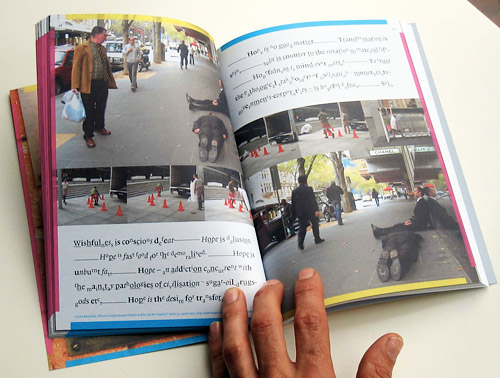
Our urban film, Tag, was never meant as a critique of the city, rather an example of using an impermacultural domain as a site for post-consumer play. A critique of the city occurs in other parts of my practice, as it does here. It was also made to demonstrate the body as common substance, devoid of shame and embarrassment, and directly influenced by the abstract and toxic environment in which we were courting chance behaviours. 


Photo: Kathryn McCool

Monday, December 1, 2008

On joking, avoidance and common substance

In David Graeber's book Possibilities: Essays on Hierarchy, Rebellion and Desire he redresses earlier anthropological social categories such as joking and avoidance relations.
The body in the domain of joking, one might say, is constituted mainly of substances – stuff flowing in or out. The same could hardly be true of the body in the domain of avoidance, which is set apart from the world... While joking bodies are necessarily apiece with the world (one is almost tempted to say "nature") and made up from the same sort of materials, the body in avoidance is constructed out of something completely different. It is constructed of property. p21.
Relations of 'common substance' are also recalled.
...where an entirely material idiom of bodily stuff and substances can be seen as the basis for bonds of caring and mutual responsibility between human beings. p23.
He goes on to talk about the possibility of sex between two people in terms of sharing food, not as one person consuming the other (as mentioned in an earlier post). Sharing, here, is experienced outside of an 'owning' relation (of avoidance). Graeber, like Hamish Morgan a few weeks ago in this garden, brings in Marcel Mauss.
Mauss has also argued that in giving a gift, one is giving a part of oneself. If a person is indeed made up of a collection of properties, this would certainly be true... Gift giving of the Maussian variety is never, to my knowledge, accompanied by the sort of behaviour typical of joking relations; but it often accompanies avoidance. p23.
A double white Australia line policy, an expression fixé I have used in poems and other forms of thinking since 2001, is used to describe how colonialism (relations of avoidance) pierces and separates, disenfranchises and prepares Aboriginal land and resources for private use and sale. A double white Australia line is a policy of all governments since occupation. 

Colonialism also brought Christmas to the continent, imposing a gift-economy – guilt – on the people who had practiced (for 40,000 years) an extremely intelligent and sustainable gift-ecology.


Another's Brilliance (1' concrete), Patrick Jones, Meanjin, Poetics, 2/2001

Thursday, November 20, 2008

Hamish's gift

Response to my Tagged post by Hamish Morgan. 

You talk about in your 'How to do Words with Things' about city based artists feeding off their own disconnection/abstraction in order to do their art (I would have to check up on that); their angst becomes generative of the work itself, and because everyone in the city has this disconnection there is a good market for this kind of work. Consumers buy the art in order to express their solidarity with disconnection and consumption. Your play in the city (along with an interest in graffiti, tagging, fonting!), to me, expresses a critique of those kind of artistic practices. That is, an art practice not built around consumption, one that is decapitalised. You propose an exchange, or gift-ecology. (The idea of a gift-economy began with Marcel Mauss, an anthropologist writing in the late 1920s after the destruction of Europe – through war and the industrial revolution – and wanting to rediscover a point of human connection without economic and industrial subterfuge. His book, 'The Gift', is a rather interesting critique of capitalism). I digress, back to my long-winded point. So you are interested in an art practice that generates responsibilities, obligations, debts, counter-gifts that keep a cycle of exchange going, that connects and keeps us in play with each other. (Another side point, the word for gift in German 'Gib' is the same word as poison - i.e. the gift is not 'free' but indebts us to give back, which is not necessarily a bad thing. The gift; antidote and poison! Also the English derivative of gift comes from the same word as 'take': the gift economy is one where we give and take; by giving we take something from the other - we take their sense of debt so that they give back!).

Perhaps all I want to say is that a truly decapitalised practice would have nothing to do with the city; would have no play with its structures, because this is what gives and takes our (creative) energy. I love a good ideas stoush; this shows my terrible reliance on critique (this is what the university teaches). I retreat from creativity through the self-defense of critique - now there is another provocation... PJ, I might add, I find your work terribly hopeful and evocative of a post-industrial future. Please keep sharing and indebting us all in a gift-ecology.

Wednesday, November 19, 2008

Tagged Post (a response to Hamish Morgan)

The following writing is in response to Hamish Morgan's comment on Tag yesterday.

I don’t think Tag is ‘against the city’; at least it is not a negation in total. It is difficult for play to be against something when it is caught up in the surprise and the joy of the new.

We have made similar work in the country, and of course the environment alters the work we make wherever it is. A rule of our practice, set out by John Cage, is ‘a work of art should include its environment’.

So, I see this new work not so much a critique, nor a logical attack, rather states of permanent play (permaplay) in everyday space and poesis (meaning-making) through activity before langauge. Making art without producing anything consumable is an obvious eco-politic that is 'against' the city (civis, civilisation, centre, transportation of resources, capitalisation, etc), but the work overall, I think, is more than this.

We specifically chose non-heroic, non-spectacular outer parts of Melbourne for no other reason than CBDs (toxicities) are so last century.

In relation to tagging itself I have a developing interest in the urban phenomenon of self-determining font making, graffitists who through the act of generating their own personalised fonts decentralise and demiltarise the alphabet in public space. This is important and exciting territory, and the body as tag is an extension of this line of graffic thought.

To make Tag we caught a train down to Melbourne, thus burning carbon, so this is a negation of our own making. A zero carbon footprint comes in small gradual steps over the next 6-7 years. Just in terms of carbon, we have a very small distance to go compared with, say, Fox Studios.

Additionally this film is part of a gift-ecology, a concept I'm developing so as my overall practice continues to contribute to the global movement of decapitalised art. I use gift-ecology instead of 'gift-economy' (a term developed by capitalists), because art should produce no waste – hence permanent culture (permaculture) as antidote to toxiculture.

Again, all this is transitional thought, on the way to a post-industrial, post-consumerist modality.

Thanks to all the commenteers – such generosity!

Wednesday, November 12, 2008

Compost & Cos


Today I killed Bill. She wasn't getting better with the garlic water and we couldn't justify the expense of a vet, nor the fantasy of industrial pharmaceuticals. I killed her as part of redressing the compost area, which looked like this at about 5pm. 


At 4.30pm I brought the black and white bins, full of kitchen scraps, back from Ben's cafe, laid Billy to rest at the base of the right-hand bay, tore up several cardboard boxes and placed them over her. I then wet down this elegiac layer and heaped on Ben's scraps, straw from the coup and Meg's day's weeding material, before covering up both bays to cook the compost.


The bay on the left (above), that I last turned here for Hamish Morgan – who today sent more reference humus: Katherine Gibson's 'The End of Capitalism' – is almost ready for use on the garden.


I picked our finest cos lettuce (above right) and returned Ben's bins, proudly presenting the first exchange of our casual gift-ecology.

Friday, October 17, 2008

Composting as collective offensive (for Hamish Morgan)

The following flick is an eyepiece for aerobic composting, where the aeration of the body is contiguous with the world. It's a short flick cut to a short track called Fall by the band called The Thing (now Dirtbird). It's a how-to-do-words-with-things film that emits little methane, recalling "All things fall and are built again" (W B Yeats, 1939), together with "Once upon a time the world was round, and you could go on it round and round" (Gertrude Stein, also 1939).

Carbon is fixed in the soil if the compost is damp and aerated. If the compost is too wet and not turned (not aerated), the organic matter rots, giving off methane. Carbon is the gaseous nutrient. It's transformation, into a greenhouse gas, is CO2. But carbon is organic matter in the soil, if treated well there is less gaseous transformation, less reduction of humus and therefore less carbon dioxide in the atmosphere.

All things fall and are built again in a closed-cycle ecology – NO WASTE – and those that build them again are microbial and joyous. Our economics and our ecology can now come home – Oikos – together. To give up on gaseous transformation – aspiration/celebrity – is to act as a collective offensive, or in mutual self defence.

So take your pitchfork and give some air to your body. The movement exclusive of industrial agriculture – supermarkets, refrigerants and Monsanto – is in full swing!