Showing posts with label how to do words with things. Show all posts

Saturday, January 10, 2009

Ockham's Razor (or, man on a) wire

What we know is based on direct experience, and the things we experience are twofold: the things we can see and touch, and our own mental activity... p.105
Leszek Kolakowski suggests Ockham's philosophy "opens up a deep rift, an unbridgeable chasm, between natural knowledge and faith"; the physical and the abstract, at least in the thirteenth century.

War generally is the result of unbridgeable chasms between the physical and the mental; of resource and land sovereingty and ideological or religious superiority. There is generally the oppressor (who's in expansion mode) and the oppressed (who's in resistance mode). 

When wars are fought Ockham's Razor goes out the window, and therefore multiplicity is posited beyond necessity. I used the following Orwell quote in my last book to begin a chapter titled The problem of civilisation.
Actions are held to be good or bad, not on their own merits, but according to who does them, and there is almost no kind of moral outrage – torture, the use of hostages, forced labour, mass deportations, imprisonment without trial, forgery, assassination, the bombing of civilians – which does not change its moral colour when it is committed by "our" side. George Orwell, Notes on Nationalism, 1945
Anthony Loewenstein's Zionism is a clear-eyed practice of Ockham's Razor; in other words, 'all other things being equal, the simplest solution is the best' – two states, no greed, permanent peace, checked superiority. Or, as my friends Peter O'Mara and Jeff Stewart have posited among the gum trees –

Saturday, December 20, 2008

Lousy at small talk

I'm now ready for the social season.

I mentioned yesterday that I'd have a t-shirt to give away. But I didn't have a spare one to print on. Instead, here's an old one of mine that fits a small person. Both are printed on American Apparel tops we found at the local op-shop. The first commenteer will have it posted to them on Monday.


Worship nothing not even Nietzsche! Now there's some small talk for the Christmas period.

Thursday, November 20, 2008

Hamish's gift

Response to my Tagged post by Hamish Morgan. 

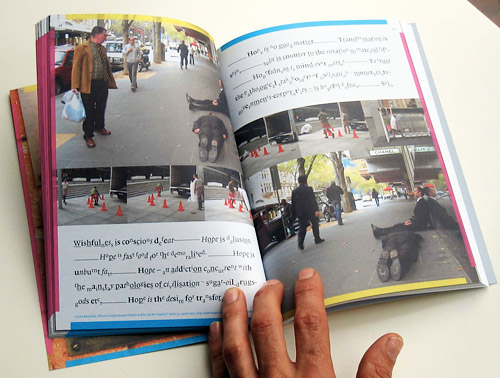
You talk about in your 'How to do Words with Things' about city based artists feeding off their own disconnection/abstraction in order to do their art (I would have to check up on that); their angst becomes generative of the work itself, and because everyone in the city has this disconnection there is a good market for this kind of work. Consumers buy the art in order to express their solidarity with disconnection and consumption. Your play in the city (along with an interest in graffiti, tagging, fonting!), to me, expresses a critique of those kind of artistic practices. That is, an art practice not built around consumption, one that is decapitalised. You propose an exchange, or gift-ecology. (The idea of a gift-economy began with Marcel Mauss, an anthropologist writing in the late 1920s after the destruction of Europe – through war and the industrial revolution – and wanting to rediscover a point of human connection without economic and industrial subterfuge. His book, 'The Gift', is a rather interesting critique of capitalism). I digress, back to my long-winded point. So you are interested in an art practice that generates responsibilities, obligations, debts, counter-gifts that keep a cycle of exchange going, that connects and keeps us in play with each other. (Another side point, the word for gift in German 'Gib' is the same word as poison - i.e. the gift is not 'free' but indebts us to give back, which is not necessarily a bad thing. The gift; antidote and poison! Also the English derivative of gift comes from the same word as 'take': the gift economy is one where we give and take; by giving we take something from the other - we take their sense of debt so that they give back!).

Perhaps all I want to say is that a truly decapitalised practice would have nothing to do with the city; would have no play with its structures, because this is what gives and takes our (creative) energy. I love a good ideas stoush; this shows my terrible reliance on critique (this is what the university teaches). I retreat from creativity through the self-defense of critique - now there is another provocation... PJ, I might add, I find your work terribly hopeful and evocative of a post-industrial future. Please keep sharing and indebting us all in a gift-ecology.

Wednesday, November 19, 2008

Calvanism

The great social and ecological perversion that became Christian-capitalism.