Showing posts with label social warming. Show all posts

Thursday, March 26, 2009

Free-dragging, slow text and permapoesis: towards a biophysical poetry (an excerpt)


The following is the final paragraph of a paper I finished today for UK journal Angelaki, which I am presenting at Two Fires festival this weekend on a panel called Social Warming. The festival's theme is "Coming Together".
Little by little the things that were once free and uncapitalised are increasingly legislated against, privatised or both – seed, birth, milk, school, water, art, death, etc. While free-dragging on road signs in country Victoria a few years ago Jason Workman and I were booked for “abstracting traffic”, and after challenging the police officer as to why we were being booked he told us “people have concerns when they see people doing things”. The fine was manageable at $120, however it was 100% of the budget for our day of practice. I managed to record the whole conversation I had with him, and have played it back many times to hear those words: “abstracting traffic”. But we were neither abstracting nor obstructing, which is no doubt what the country cop meant to say. Free-dragging developed for both Workman and I out of our own imprisonments. Free-dragging is thus a response to feeling enslaved. Free-dragging is a biophysics for self-liberty, a poetry form synonymous with composting where abstractions do not dominate but rather play their part in a material world. In coming out of these self-imposed sentences we began to understand that to hope was to project something abstract and unreachable upon the future and this caused considerable anxiety. We quickly came to reacquaint ourselves with joy and post-utopian play – non-deluded – our blood oxygenated with the liberty of hopelessness; endorphins as air in an aerobic compost. By becoming unstuck and uprooted we took greater refuge in ourselves as contiguous beings with everything else. Therefore our poetry/graffiti had to become public and participate in social space. We pulled down our garrets and with the materials reclaimed from an age of isolation and anxiety built raised beds for vegetables, chook houses, compost bays and are planning future alehouses based on steady state economics. Food sovereignty has become central to our work, which has developed as part of a broader permaculture community, a community of intensifying "poeverty" (post H D Thoreau and D T Suzuki), and through the development of a personal permapoesis. Thanks to Ian, Meg, Kate F, Jeff, Hamish, Jason and Pete O for your help with this work.
The title of the panel came from this drawing I did a few years ago and was first published in Going Down Swinging No.26 last year.


Click for bigger.

Wednesday, March 25, 2009

Arnhem mob's songs of regeneration


Aboriginal elders, including medicine men, song men and traditional dancers, visited our area last weekend and conducted a series of dances relating to each aspect of the land. They were welcomed by local Djadjawurrung elder Aunty Carmel. The dances were conducted to heal the land after the bush-fires. A number of the local boys, including Zeph, were given instructions on how to perform some of the dances.

Tuesday, March 24, 2009

Making meaning (or, Alan Watts lives)

I've put together a few words, terms and their (in-progress) meanings here, which I've been developing over the past few years. But first a reminder:

Only words and conventions can isolate us from the entirely undefinable something which is everything. Alan Watts, The Wisdom of Insecurity (1951)

Social warming – A social by-product of global warming, where good things come from horror and tragedy.
Permaplay – Non-delusional play invented by both children and adults within a permaculture.
Pop-fascism – Self-enslavement through debt as a result of aggregate desire and participation in capitalism’s slavery/destruction model. A Pop-fascist state is the private control of trade and industry in collusion with the state to the detriment of the environment and society at large.
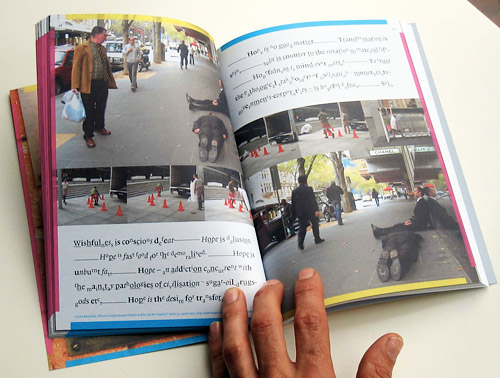
Free-dragging – Street art. A mutant form of parkour or free-running (often practiced in drag). Physical graffiti tagged on the retina of the passer-by.
Permapoesis – Permanent meaning-making through active participation with one’s ecology and hence the localising of one's resources.

Saturday, March 14, 2009

Harvest Swap Meet


If we must stop aggregate growth because it is uneconomic, then how do we deal with poverty in the SSE? The simple answer is by redistribution—by limits to the range of permissible inequality, by a minimum income and a maximum income. What is the proper range of inequality—one that rewards real differences and contributions rather than just multiplying privilege? Plato thought it was a factor of four. Universities, civil services and the military seem to manage with a factor of ten to twenty. In the US corporate sector it is over 500. As a first step could we not try to lower the overall range to a factor of, say, one hundred? Remember, we are no longer trying to provide massive incentives to stimulate (uneconomic) growth! Also, since we are not trying to stimulate aggregate growth, we no longer need to spend billions on advertising. Instead of treating advertising as a tax-deductible cost of production we should tax it heavily as a public nuisance. If economistsreally believe that the consumer is sovereign then she should be obeyed rather than manipulated, cajoled, badgered, and lied to. Herman Daly, A Steady-State Economy

Tuesday, January 27, 2009

Possibilities (or, this is what an anarchist government might look like)


OK, we've just stepped into office. We got there because we asked everyday Aussies to donate five bucks to our campaign (Obama style). We raised truck loads and while campaigning hard we used the excess money to implement 78 community permaculture gardens Australia-wide. We have another 221 ear-marked to start up in the next six months. We don't owe business one dollar, and like George Monbiot we refuse to dine with industry. As you can imagine they are shitting themselves.

The first 7 changes in this first week in office will include:

1. In consultation with indigenous Australia demolish the states and reform local governments based on traditional aboriginal tribal lands - the natural food and water bowls of Australia. Our federal government will merely oversee and encourage localised initiatives, education and activities based on indigenous knowledge and ecologically-sound economics.

2. An education programme to slow breeding. Indigenous Australia have practiced a highly successful 'biophysical economics' (Herman Daly) for over 40,000 years. Aboriginal culture is based on breeding only to numbers that the land can support. Infanticide was a strategy of their permanent sustainability. We would adapt this to a voluntary extinction gift, or a non-baby bonus (PO) in the form of heirloom vegetable seeds, recycled costumes (MU), spices wind-sailed from Asia (JW), the latest in recycled computer technology and traditional musical instruments. Breeding today is not a noble and selfless act, especially in large numbers, it's a religio-capitalist ploy to boost productivity-profit and therefore violate the landbase (just ask Peter Costello, who we've sent to work in one of the Djadja wurrung compost fields). Capitalism, based on dangling eternal fantasies in front of the dutiful consumer-parent, so as the idea of more consumerables is even more pleasurable than the products themselves (David Graeber), feeds directly into the fantasy of the ever-expanding family and therefore into baby production. Australians will be educated and rewarded to only have one or two children at most, preferably none - the most noblest act of all.

3. All rights relinquished (IR). A community-specific programme for the abolition of copyright and the advancing of the arts as a fully de-capitalised social gift ecology. Artists, writers, poets, filmmakers and musicians will gift their work to the communities that they themselves participate in. In return the community will support them in terms of shared resources. Celebrities and other toxicultural figures will join Peter Costello in the compost fields. More on this here.

4. Non-compostable waste producing industries (including the arts) will be cast adrift with no government backing or future support. The government will insist that local governments only back industries that use a 'biophysical economics' model. All previously government-supported private industry will be axed and industries that can not adapt ecologically will be bought by the government. Privatisation of public commons will become a thing of history. All other industries will be put on notice to change their operations within 12 months.

5. Aboriginal land tax for the sale of all private property (PO). Each time a piece of land is sold or resold revenue will be taken from the sale and go directly to the establishment of a local indigenous centre, or the maintaining and further developing of existing ones. These centers will foster indigenous culture - art and food covers all areas of life - and foster indigenous sustainability knowledges, which would feed directly back into the wider community. Private property owners who plant and maintain permaculture gardens will be exempt from paying tax or rates on the land, and will be given a permacultural allowance to provide food ethically - 'within walking distance' (RP) - grown for their families and friends. Private property owners who employ indigenous land consultants will be given further incentives (to be advised by the local indigenous communities at a later date).

6. The removal of all religious indoctrination and packaged-processed foods from schools. This hardly needs justification, but if you require more information please leave a comment below. Similarly, secular ignorance of religion will not be tolerated. All schools will teach the history of religions, focussing on religion's involvement in the establishment of private property and the tendency for religious supremacy to create resource wars. Food gardening will replace all religious indoctrination lessons.

7. Art auction houses (such as Christies and Sothebys) will turn all of their artifacts over to public cultural centers. Those works deemed to be not interesting or amusing enough will be garage-sold to the public. Each household can choose up to three works only, collectors will also be delegated to the compost fields. The proceeds from the art sales will go to detoxifying the arts industry with education programmes aimed at educating artists about food and survival in a post-capitalist world. The film and music industry will become heavily digitised and everything freely available online. Film projects that produce as much as one empty Mt Franklin plastic bottle (or equivalent) will be shut down.

After such a good start we're all going to celebrate with some Astrid Lorange home brew. Over to you comenteers for our next week in office.
Thursday, January 8, 2009

Tent city

Camping in a caravan park is essentially returning to social habits that are more welcoming and less gated. The thin sheets of canvas or tarpaulin that barely separate us all allow for greater spontaneous play and sharing of resources.

Where Permaculture is a blueprint for our species' survival in terms of food, tent cities are the future for sustainable shelter and social warming.

A permanent culture designs for constant flux. Flux and mutability is possible when land is made available for collective use, and not owned privately. Impermanent culture, or Judeo-Christian-capitalism, designs for dominance and permanency at the expense of the landbase, and thus the social base. Judeo-Christian-capitalism is the dominant hegemony responsible for global warming. No doubt the fine Jew, Jesus Christ, is deeply saddened by the 1600 years between St Augustine and George W Bush, that have paved the way for hierarchy and sociopathy to so blatantly lead the attack on the ecologies which support biodiverse life.


Zeph finishing breakfast, about to join the neighbouring kids for a hit of cricket at the council-run caravan park at Port Fairy.

Saturday, December 20, 2008

Lousy at small talk

I'm now ready for the social season.

I mentioned yesterday that I'd have a t-shirt to give away. But I didn't have a spare one to print on. Instead, here's an old one of mine that fits a small person. Both are printed on American Apparel tops we found at the local op-shop. The first commenteer will have it posted to them on Monday.


Worship nothing not even Nietzsche! Now there's some small talk for the Christmas period.

Friday, December 19, 2008

Immutable fashion – notes on small talk

I have an idea for a t-shirt that says: 'Lousy at small talk', something I can wear to parties. I'll probably make one in the next few weeks, perhaps two, one for you dear reader, if you're inclined. 

Is small talk a thing of common substance or of avoidance?

1. Small talk as common substance: To speak small talk with others is to build relations based on a mutual lightness of spirit. Although I'm empathetic to this notion in terms of 'social warming', small talk functions best as an ancillary to something else, such as dancing or disruption: lobbing a boot at a psychopathic politician and calling him a dog after he has fucked your country.

The Dancers Inherit the party

When I have talked for an hour I feel lousy –
Not so when I have danced for an hour:
The dancers inherit the party
While the talkers wear themselves out and
            sit in corners alone, and glower.

2. Small talk as avoidance. The natural territory of small talk resides within the localities inhabited by the bourgeoise and petit bourgeoise. It is here that small talk is rarely allowed to become 'big'. It can be cut off with eye rolling, polite refrain or bodily squeamishness that breaks the social engagement. Small talk as a natural language modality of the middle classes is predicated on older religious boundaries of shame and embarrassment developed since the twelfth and thirteenth centuries. This is when art, incidentally, turned from a practice of everyday social activity, practiced by numerous, to one where the artist became sublime and individualistic – the development of the capitalist construct of the genius; worthy of marketing and cultural exploitation. The cult of the nice is society's modern, secular equivalent – here the genius has a happy disposition (see the likes of John Cage), or for an alternative, winter baby's view:

On middle class poverty 

The poet's teeth are rotten.
The poet doesn't drive.
The poet has an empire in the mind.
The poet writes the god.
The poet is assassinated.
The poet's unAustralian.

Patrick Jones (listen to this poem here)
NB. I'm writing this post after coming home from a party where I engaged in mid-sized talk and ate beautiful food and drank local plonk, all for which I'm passingly grateful. 

Saturday, December 6, 2008

Young people and the Yam daisy

This morning Barry Golding, from the University of Ballarat, led a group of us on a walk from inside the crater at Lalgambook (Mt Franklin) to Larnebarramul (Franklinford). Barry is a font of anthropological, geographical and archeological information dating from the earliest volcanic activity 20 million years ago, to more recent history, specifically that of the Djadjawurrung.


The other half of the day I spent at the senior citizens rooms behind Daylesford Town Hall with another group of people. The issue of heritage was a major sticking point with us, some people thinking that social heritage begins with Cornish miners. We were attempting to agree on a way forward for the contentious community reserve which adjoins the equally contentious youth (skate) park. On my agenda was public food, and I was sucessful in having fruit and nut trees (20-30%) considered as a recommendation for the final planting scheme.


Among the day's highlights was learning about the murnyong (Yam daisy). The murnyong was a major staple tuber that the Djadjawurrung lived off for tens of thousands of years, and which still grows wild in the area and across central Victoria. Barry had collected seed earlier in the morning and gave some out. I'm looking forward to propagating our five seeds. Another highlight was working with others of wide-ranging opinions to develop a common objective, and potentially the beginnings of a food relocalisation mind-shift, that local council backs on behalf of the community.

Wednesday, November 12, 2008

Compost & Cos


Today I killed Bill. She wasn't getting better with the garlic water and we couldn't justify the expense of a vet, nor the fantasy of industrial pharmaceuticals. I killed her as part of redressing the compost area, which looked like this at about 5pm. 


At 4.30pm I brought the black and white bins, full of kitchen scraps, back from Ben's cafe, laid Billy to rest at the base of the right-hand bay, tore up several cardboard boxes and placed them over her. I then wet down this elegiac layer and heaped on Ben's scraps, straw from the coup and Meg's day's weeding material, before covering up both bays to cook the compost.


The bay on the left (above), that I last turned here for Hamish Morgan – who today sent more reference humus: Katherine Gibson's 'The End of Capitalism' – is almost ready for use on the garden.


I picked our finest cos lettuce (above right) and returned Ben's bins, proudly presenting the first exchange of our casual gift-ecology.

Thursday, October 30, 2008

Social Warming

Until today we have managed to live on our 1/4 acre without one single fence, with the exception of temporary guards around our vegetables to keep the chooks from helping themselves.


However our neighbour to the North has insisted we build one because he doesn't like looking at our water tank and 'unsightly' produce area. We agreed as long as we could design and build it and not have to pay for it, so this is the beginnings of our social warming fence.


The Cuban says, "grow your own food, catch your water, say hello to your neighbour" – a reachable suburban anarchy.

Wednesday, October 22, 2008

How to Do Things With Friends (2005)

Several years ago, inspired by reading John Cage, I asked Michael Farrell and Toby Sime to join me in a day's adventure with big dice in Melbourne. I made the dice with off-cuts of plywood and painted them with fast drying acrylic – my work tends to be compulsive; no rehearsal, little planning, loads of opportunity for de-authorisation. I asked a filmmaker friend, Ivor Bowen, to document the day as a surveiller, or as a jaw-agape tourist. Michael, Toby and I just hung around the city inventing games, sitting around, talking to people, walking aimlessly and throwing the dice. A few years later another friend of mine's band, The Haints of Dean Hall, put out an album and I choose the following, completely unrelated country soundtrack to accompany the activities we had previously invented in the city, and spun the two together into the following flick.

In short, Cage's writings on chance and the Situationists' manifesta on 'experimental behaviour' and 'drifting' cumulate into three poets fucking around the city writing poems with big die.

Monday, October 13, 2008

How to Do Words With Friends

Public necessity


Everything we buy is likely to be unsustainable 
and/or abusive in terms of its production and 
transportation. Water bottled in plastic is both. 
Read more here and here.