Showing posts with label heirloom seeds. Show all posts

Wednesday, June 24, 2009

Shed of Interrelation (part three)

Meg and I insulated and plastered the ceiling of the Shed of Interrelation (SoI) today. You're looking at the small bathroom where a bath and composting toilet will go. The shed is for artists/writers-cum-woofers to take short residencies and rest, make art and work a little in the garden. The shed is a place to encourage transitional thinking in the arts, to encourage permapoesis where art and organic food generation are embedded activities.

In the meantime our winter seeds are rocking. Heirloom elephant leek, garlic, silverbeet fordhook, pak choy, sweet pea, broad beans, broccoli, carrots, black kale, spinach, spring onions, beetroot, baby cos lettuce and cabbage mini. Meg and I were discussing today how many families could potentially be living on this quarter acre in 10-20 years. I think it could feed about 15-18 people in the Summer months and maybe 10-12 in Winter. 

I'm looking down on young banksias and heavily mulched areas with lomandras, poa tussocks, broad beans, almonds, olives, peaches and my chain-sawed eucalyptus balls. The dry stone HaHa wall back-filled with rubble allows for water to pass through it without disturbing the integrity of the wall. You can also see a little of the social warming fence. We persuaded our neighbours not to have a fence that lined the whole boundary, but just enough to have a little more privacy. They also agreed that I could build it as a slatted fence, again for social warming properties. Of course the water tank finishes the picture and finishes an often quoted mantra on this blog spoken by Cuban permaculturalist Roberto Perez at our town hall last year–
Grow your own food, catch your own water, say hello to your neighbour.

Here's a pic of the main house showing flying fox route and solar panels. I'm also showing off my deck building skills here. Split level decks are party decks. You often hear of them collapsing and killing a dozen stomping teenagers, that's why this one is low to the ground. 

I love Zeph's cubby as much as he does. Apart from the obvious – cute, small, red, up-in-the-air – it frost protects our toms. Meg collected another basket full last week. Almost unbelievably the fruit was still ripening despite the plants having died weeks ago. They're not great, but fine for cooking up. You can also see the beginning of the flying fox route and the tail end of the social warming fence. The bed in front of it will be the kick-arse rhubarb patch. Rhubarb is year-round gold for food gardeners. I remember my Dad's awesome patch when I was Zeph's age.

And, finally a place very dear to my heart – the compost area. Underneath the new window of the Shed of Interrelation is a herb bed that's doing OK, but I have decided to dig them out and extend the compost bays to three. We'll also have the humanure from the dry worm composting toilet. Therefore we can have four brews at four different stages. I'm so excited about this. The building of the Shed of Interrelation has already led to so many possibilities, even before the first resident.

Friday, May 1, 2009

The level of denial


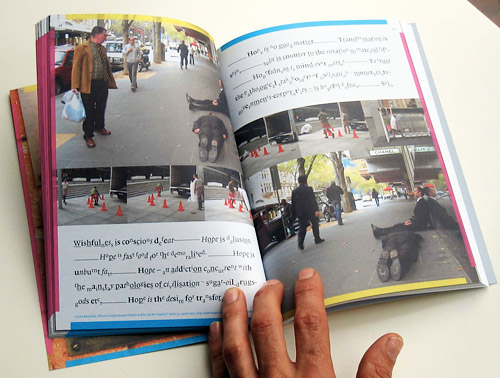
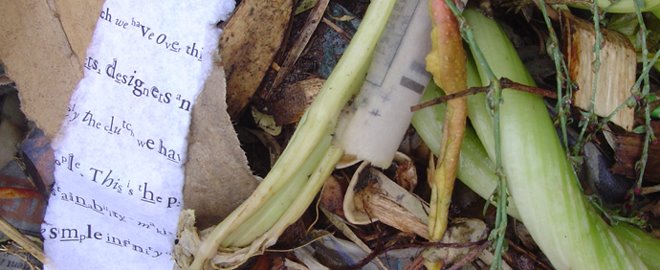
A number of years ago I was a participating artist at a land art event in Queensland. It was called The Floating Land 03. I installed three site-specific signs around Noosa. One along a bike path near to the regional gallery, one among the mangroves that you experienced by timber boardwalk, and one on Main beach.

The work on Main beach (pictured above and below) was gagged, or rather silenced for a short period during the event. Someone took offense and wrapped it up with fabric and gaffer tape. The reason I'm recalling this today is because I just read this quote by comedian Elayne Boosler:

"When women are depressed, they either eat or go shopping. Men invade another country".

The futility of this quote lies with the author's vision. She sees the two different responses to melancholy as being somehow unrelated. One is acceptable behaviour and one not. However the two responses are inextricably related. Man invades another country, justifies the destruction and theft of resources (by creating an enemy monster), makes more products with the resources to be consumed at home, which in turn fuels the illness of aggregate desire specific to modern capitalism. Both the consuming and the warring are acts of violence in modern life, only one is direct and one more mediated.

Unlike most of my friends I was sad to see John Howard go. Yes, I was. It meant an end to this horrible man's smug and mean spirited rule, but it also meant that we were heading back to the more indirect and veiled branch of the same party. As I expected, the Labor party has delivered almost the same government as Howard's, only with more fuzzy rhetoric and more sophisticated greenwash. Early in his office, after the Port Arthur massacre, Howard carried out his only good act as a politician, the disarmament of personal firearms. However, he made up for it later when he followed Bush's phony resource war to the Middle East. His logic: killing fellow Australians is inexcusable, however killing Muslims for fossil fuels is totally cool. Similarly, Rudd early in office, delivering his Sorry Day speech, brought us all to tears by 'fessing up to the brutality of white Australia; the genocides and repeated abuse of Aborigines by our very own colonising forces. The moral force of his words are still to this day just beautiful words, something educated people in positions of power are very good at displaying.

How many more years we have to wait for a politician to act morally is anyone's guess. Here, at the Garden of Self Defence, I generally don't dwell on what the Liberal-Labor party are up to. Many of the solutions to resource war, ecological destruction, male aggression, monotheistic colonisation, aggregate-growth capitalism, carbon emissions, genocide of indigenous cultures, pathologies of industrial agriculture, and abuse committed on non-human nature (by all of the above) can be found in community-based permaculture and heirloom seed gardening.


Photographs by Jonathan Sligh.