Showing posts with label gift-ecology. Show all posts

Friday, February 20, 2009

Gift ecology (or, towards a biophysical economics)


click for bigger.

Peddle, gather, cook, bottle (food activity alphabetised by return)

Our community has a local benefit concert and fundraiser for the survivors of the fires this coming Sunday and I spent the early part of the week thinking what I could contribute that didn't mean burning cash or burning carbon. We both have no work at present, which makes us time-rich and extremely productive in all manner of non-capitalist activity, while at the same time shitting ourselves with mounting bills.

I borrowed Meg's bike, which has a handy detachable front basket, and trawled the town for street fruit. I asked the local librarian, Janet, if I could harvest the rhubarb from the small community garden at the back of the library and she happily agreed, and I found some feral apples and pears ripe and delicious. I also noted other varieties of apples, nectarines and pears that would be ripe over the next few weeks and noted that many of the feral trees which had a substantial build up of humus at their base had disease-free apples. I cooked all the fruit together and added local honey.

I then peddled to O's to exchange some of our old glass jars for his larger, uniformed, black-lidded ones. I stayed for lunch, talked about brewing beer and gathered more apples and a branch of red-flowering eucalypt for my gal on the way home.

These small bottled gifts are for the organisers of the event – friends – folk who have worked hard over the past few weeks to organise the forthcoming day. As a child my folks had a successful cottage industry manufacturing jellies, mustards, chutneys and jams and this week I felt the spirit of that familial activity return.

Thursday, January 29, 2009

Hamish's second gift

A very low-fi song to go with your low-end art; I made it a few years ago when we were looking for a house in Northcote. 
Hamish Morgan

Tuesday, January 27, 2009

Possibilities (or, this is what an anarchist government might look like)


OK, we've just stepped into office. We got there because we asked everyday Aussies to donate five bucks to our campaign (Obama style). We raised truck loads and while campaigning hard we used the excess money to implement 78 community permaculture gardens Australia-wide. We have another 221 ear-marked to start up in the next six months. We don't owe business one dollar, and like George Monbiot we refuse to dine with industry. As you can imagine they are shitting themselves.

The first 7 changes in this first week in office will include:

1. In consultation with indigenous Australia demolish the states and reform local governments based on traditional aboriginal tribal lands - the natural food and water bowls of Australia. Our federal government will merely oversee and encourage localised initiatives, education and activities based on indigenous knowledge and ecologically-sound economics.

2. An education programme to slow breeding. Indigenous Australia have practiced a highly successful 'biophysical economics' (Herman Daly) for over 40,000 years. Aboriginal culture is based on breeding only to numbers that the land can support. Infanticide was a strategy of their permanent sustainability. We would adapt this to a voluntary extinction gift, or a non-baby bonus (PO) in the form of heirloom vegetable seeds, recycled costumes (MU), spices wind-sailed from Asia (JW), the latest in recycled computer technology and traditional musical instruments. Breeding today is not a noble and selfless act, especially in large numbers, it's a religio-capitalist ploy to boost productivity-profit and therefore violate the landbase (just ask Peter Costello, who we've sent to work in one of the Djadja wurrung compost fields). Capitalism, based on dangling eternal fantasies in front of the dutiful consumer-parent, so as the idea of more consumerables is even more pleasurable than the products themselves (David Graeber), feeds directly into the fantasy of the ever-expanding family and therefore into baby production. Australians will be educated and rewarded to only have one or two children at most, preferably none - the most noblest act of all.

3. All rights relinquished (IR). A community-specific programme for the abolition of copyright and the advancing of the arts as a fully de-capitalised social gift ecology. Artists, writers, poets, filmmakers and musicians will gift their work to the communities that they themselves participate in. In return the community will support them in terms of shared resources. Celebrities and other toxicultural figures will join Peter Costello in the compost fields. More on this here.

4. Non-compostable waste producing industries (including the arts) will be cast adrift with no government backing or future support. The government will insist that local governments only back industries that use a 'biophysical economics' model. All previously government-supported private industry will be axed and industries that can not adapt ecologically will be bought by the government. Privatisation of public commons will become a thing of history. All other industries will be put on notice to change their operations within 12 months.

5. Aboriginal land tax for the sale of all private property (PO). Each time a piece of land is sold or resold revenue will be taken from the sale and go directly to the establishment of a local indigenous centre, or the maintaining and further developing of existing ones. These centers will foster indigenous culture - art and food covers all areas of life - and foster indigenous sustainability knowledges, which would feed directly back into the wider community. Private property owners who plant and maintain permaculture gardens will be exempt from paying tax or rates on the land, and will be given a permacultural allowance to provide food ethically - 'within walking distance' (RP) - grown for their families and friends. Private property owners who employ indigenous land consultants will be given further incentives (to be advised by the local indigenous communities at a later date).

6. The removal of all religious indoctrination and packaged-processed foods from schools. This hardly needs justification, but if you require more information please leave a comment below. Similarly, secular ignorance of religion will not be tolerated. All schools will teach the history of religions, focussing on religion's involvement in the establishment of private property and the tendency for religious supremacy to create resource wars. Food gardening will replace all religious indoctrination lessons.

7. Art auction houses (such as Christies and Sothebys) will turn all of their artifacts over to public cultural centers. Those works deemed to be not interesting or amusing enough will be garage-sold to the public. Each household can choose up to three works only, collectors will also be delegated to the compost fields. The proceeds from the art sales will go to detoxifying the arts industry with education programmes aimed at educating artists about food and survival in a post-capitalist world. The film and music industry will become heavily digitised and everything freely available online. Film projects that produce as much as one empty Mt Franklin plastic bottle (or equivalent) will be shut down.

After such a good start we're all going to celebrate with some Astrid Lorange home brew. Over to you comenteers for our next week in office.

Sunday, January 25, 2009

Language warning

I've launched a new room to my creative caravan – Peej – which has revamped an old MySpace page I once used for spoken word, and turned it into a dumping ground for my musical amusements. 

My first track, Red Ecology, was written for Meg on her birthday - part of our developing gift ecology where no gift is produced that creates waste or uses new material. I made it into a film clip that I posted last week. The second, stein, is for Stein09, a year long celebration of Gertrude which is being organised by a number of poet friends around Australia. I'll blog about it in detail throughout the year. The third, 'ornylil'sexpot, is an attempt to marry ideas about cyclic and lineal time with a smutty dance jingo. Astrid Lorange and WB Yeats' provide the ideas, my life as a waiter when I first met Meg, the smut. The fourth, shutdafugup, is a return to my punk days. This track is for Nick Keys who left a smashing comment on my Fugs post, which inspired this piece of musical violence (against 'copy-righteousness' - NK). 

Most of the lyrics have come from posts and comments that have appeared on this blog. Be warned! Your comments might be next in line to be Peej'd.

NB I have made these tracks freely downloadable in the settings, however the antiquated beast that is MySpace doesn't seem to give you the option when you're on the homepage. If you want a copy of a particular track I can email you a MP3 - they're about 3MB each.

Friday, December 19, 2008

Cuba's eggs

Cuba, one of our chooks, went broody this week. There are two things you can do for a broody hen. Either give her some fertilised eggs to incubate over 21 days, or place her in a cage in full sunlight with plenty of air, clean water and food.

Wednesday, December 10, 2008

Marcel Duchamp's early success as a pedlar of art, namely Brancusi's sculpture, afforded him about thirty years of independent income, which in turn provided him the time to pursue his thought and art. Gertrude Stein's independent income was afforded to her by her father's success as an industrialist. Along with her own dedicated temerity (and Alice) this income provided her the opportunity to pursue forty years of thought and writing.

For years I have tried to foster a Duchamp-like canniness, or pathetically longed for a Stein-like stipend, but mostly I've made work on the hop, so to speak, my method is based on 'stealing time'. And when circumstances amalgamate so as not even theft is possible I tend to overheat, breathe far too thinly, self-loathe and spiral downwards, sometimes taking loved ones with me. 

The Garden of Self Defence – an experiment based on self-sufficiency – is my most ambitious attempt to live, not of independent income but independent of income, not outside of an ecology, but ecologically co-dependent. I've come to realise that 100% self-sufficiency is hard-core living, and I'm not sure I'm capable of it. However, I think 70-80% food, water and energy self-generation is possible, and I'm determined to find out whether this will provide a post-industrial income. 

Maintaining this life (a 'lifestyle' is a mediated perversion of capitalism), using permaculture and referring to indigenous intelligence, may result in permapoesis – a term I've developed to define a practice of sustainable meaning-making – but I'm not sure, so the GOSD remains an experiment of life founded on giving time, rather than stealing it.

Monday, December 1, 2008

On joking, avoidance and common substance

In David Graeber's book Possibilities: Essays on Hierarchy, Rebellion and Desire he redresses earlier anthropological social categories such as joking and avoidance relations.
The body in the domain of joking, one might say, is constituted mainly of substances – stuff flowing in or out. The same could hardly be true of the body in the domain of avoidance, which is set apart from the world... While joking bodies are necessarily apiece with the world (one is almost tempted to say "nature") and made up from the same sort of materials, the body in avoidance is constructed out of something completely different. It is constructed of property. p21.
Relations of 'common substance' are also recalled.
...where an entirely material idiom of bodily stuff and substances can be seen as the basis for bonds of caring and mutual responsibility between human beings. p23.
He goes on to talk about the possibility of sex between two people in terms of sharing food, not as one person consuming the other (as mentioned in an earlier post). Sharing, here, is experienced outside of an 'owning' relation (of avoidance). Graeber, like Hamish Morgan a few weeks ago in this garden, brings in Marcel Mauss.
Mauss has also argued that in giving a gift, one is giving a part of oneself. If a person is indeed made up of a collection of properties, this would certainly be true... Gift giving of the Maussian variety is never, to my knowledge, accompanied by the sort of behaviour typical of joking relations; but it often accompanies avoidance. p23.
A double white Australia line policy, an expression fixĂ© I have used in poems and other forms of thinking since 2001, is used to describe how colonialism (relations of avoidance) pierces and separates, disenfranchises and prepares Aboriginal land and resources for private use and sale. A double white Australia line is a policy of all governments since occupation. 

Colonialism also brought Christmas to the continent, imposing a gift-economy – guilt – on the people who had practiced (for 40,000 years) an extremely intelligent and sustainable gift-ecology.


Another's Brilliance (1' concrete), Patrick Jones, Meanjin, Poetics, 2/2001

Sunday, November 23, 2008

Hairy soil (for Peter O'Mara)


We had two truck loads of unwanted soil dumped by council workers who were moving earth in our street. Unwanted because of the weed factor. The soil was originally brought in by the council only 6 months ago to top dress the nature strip, it then became overgrown and complaints were made. I thought that it was better the soil stay in the area than be transported away again and asked Paul the truck driver, who used to run the Trentham hardware next door to my old bookshop, if he could bring it down.

Pete turned up and said 'what's with the hairy soil?'

We are beginning to go through it with the pitchfork, separating all the grass and thistle and other organic matter into a separate pile. We will then cook it in a compost to kill the seed. The filtered soil will be used to top dress the property before being mulched to improve the overall humus and grow more food.

A nice little self-serving exercise within this hairy ecology.

Thursday, November 20, 2008

Hamish's gift

Response to my Tagged post by Hamish Morgan. 

You talk about in your 'How to do Words with Things' about city based artists feeding off their own disconnection/abstraction in order to do their art (I would have to check up on that); their angst becomes generative of the work itself, and because everyone in the city has this disconnection there is a good market for this kind of work. Consumers buy the art in order to express their solidarity with disconnection and consumption. Your play in the city (along with an interest in graffiti, tagging, fonting!), to me, expresses a critique of those kind of artistic practices. That is, an art practice not built around consumption, one that is decapitalised. You propose an exchange, or gift-ecology. (The idea of a gift-economy began with Marcel Mauss, an anthropologist writing in the late 1920s after the destruction of Europe – through war and the industrial revolution – and wanting to rediscover a point of human connection without economic and industrial subterfuge. His book, 'The Gift', is a rather interesting critique of capitalism). I digress, back to my long-winded point. So you are interested in an art practice that generates responsibilities, obligations, debts, counter-gifts that keep a cycle of exchange going, that connects and keeps us in play with each other. (Another side point, the word for gift in German 'Gib' is the same word as poison - i.e. the gift is not 'free' but indebts us to give back, which is not necessarily a bad thing. The gift; antidote and poison! Also the English derivative of gift comes from the same word as 'take': the gift economy is one where we give and take; by giving we take something from the other - we take their sense of debt so that they give back!).

Perhaps all I want to say is that a truly decapitalised practice would have nothing to do with the city; would have no play with its structures, because this is what gives and takes our (creative) energy. I love a good ideas stoush; this shows my terrible reliance on critique (this is what the university teaches). I retreat from creativity through the self-defense of critique - now there is another provocation... PJ, I might add, I find your work terribly hopeful and evocative of a post-industrial future. Please keep sharing and indebting us all in a gift-ecology.
Wednesday, November 19, 2008

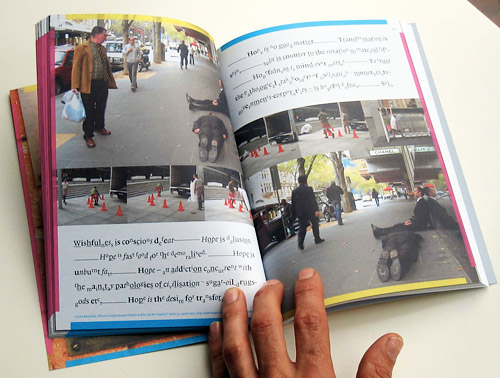
Tagged Post (a response to Hamish Morgan)

The following writing is in response to Hamish Morgan's comment on Tag yesterday.

I don’t think Tag is ‘against the city’; at least it is not a negation in total. It is difficult for play to be against something when it is caught up in the surprise and the joy of the new.

We have made similar work in the country, and of course the environment alters the work we make wherever it is. A rule of our practice, set out by John Cage, is ‘a work of art should include its environment’.

So, I see this new work not so much a critique, nor a logical attack, rather states of permanent play (permaplay) in everyday space and poesis (meaning-making) through activity before langauge. Making art without producing anything consumable is an obvious eco-politic that is 'against' the city (civis, civilisation, centre, transportation of resources, capitalisation, etc), but the work overall, I think, is more than this.

We specifically chose non-heroic, non-spectacular outer parts of Melbourne for no other reason than CBDs (toxicities) are so last century.

In relation to tagging itself I have a developing interest in the urban phenomenon of self-determining font making, graffitists who through the act of generating their own personalised fonts decentralise and demiltarise the alphabet in public space. This is important and exciting territory, and the body as tag is an extension of this line of graffic thought.

To make Tag we caught a train down to Melbourne, thus burning carbon, so this is a negation of our own making. A zero carbon footprint comes in small gradual steps over the next 6-7 years. Just in terms of carbon, we have a very small distance to go compared with, say, Fox Studios.

Additionally this film is part of a gift-ecology, a concept I'm developing so as my overall practice continues to contribute to the global movement of decapitalised art. I use gift-ecology instead of 'gift-economy' (a term developed by capitalists), because art should produce no waste – hence permanent culture (permaculture) as antidote to toxiculture.

Again, all this is transitional thought, on the way to a post-industrial, post-consumerist modality.

Thanks to all the commenteers – such generosity!