Showing posts with label Waste (non compostable). Show all posts

Saturday, January 31, 2009

Gifts of civilisation (or, how did we get here?)

In my Free-dragging Manifesto I talk about de-civilising activities aimed at mitigating civilisation's brutality. Composting plays a big part, as does the dispersal of cities (the word 'civilisation' comes from the Latin word civilis meaning centre or city). Derrick Jensen's massive two-volume tome Endgame: The Problem of Civilisation played a large role in the forming of my manifesto, especially his idea that any centre large enough to rely upon the importation of resources can never be sustainable. If you haven't got time to read Jensen's or my work then this little film, that I found today, is a micro-summary.


I close the screen and pick up David Graeber's book Possibilities, and the first thing I read is:
This leads to the interesting suggestion that, from the perspective of Medieval psychological theory, our entire civilization...is really a form of clinical depression. p67.

Tuesday, January 27, 2009

Possibilities (or, this is what an anarchist government might look like)


OK, we've just stepped into office. We got there because we asked everyday Aussies to donate five bucks to our campaign (Obama style). We raised truck loads and while campaigning hard we used the excess money to implement 78 community permaculture gardens Australia-wide. We have another 221 ear-marked to start up in the next six months. We don't owe business one dollar, and like George Monbiot we refuse to dine with industry. As you can imagine they are shitting themselves.

The first 7 changes in this first week in office will include:

1. In consultation with indigenous Australia demolish the states and reform local governments based on traditional aboriginal tribal lands - the natural food and water bowls of Australia. Our federal government will merely oversee and encourage localised initiatives, education and activities based on indigenous knowledge and ecologically-sound economics.

2. An education programme to slow breeding. Indigenous Australia have practiced a highly successful 'biophysical economics' (Herman Daly) for over 40,000 years. Aboriginal culture is based on breeding only to numbers that the land can support. Infanticide was a strategy of their permanent sustainability. We would adapt this to a voluntary extinction gift, or a non-baby bonus (PO) in the form of heirloom vegetable seeds, recycled costumes (MU), spices wind-sailed from Asia (JW), the latest in recycled computer technology and traditional musical instruments. Breeding today is not a noble and selfless act, especially in large numbers, it's a religio-capitalist ploy to boost productivity-profit and therefore violate the landbase (just ask Peter Costello, who we've sent to work in one of the Djadja wurrung compost fields). Capitalism, based on dangling eternal fantasies in front of the dutiful consumer-parent, so as the idea of more consumerables is even more pleasurable than the products themselves (David Graeber), feeds directly into the fantasy of the ever-expanding family and therefore into baby production. Australians will be educated and rewarded to only have one or two children at most, preferably none - the most noblest act of all.

3. All rights relinquished (IR). A community-specific programme for the abolition of copyright and the advancing of the arts as a fully de-capitalised social gift ecology. Artists, writers, poets, filmmakers and musicians will gift their work to the communities that they themselves participate in. In return the community will support them in terms of shared resources. Celebrities and other toxicultural figures will join Peter Costello in the compost fields. More on this here.

4. Non-compostable waste producing industries (including the arts) will be cast adrift with no government backing or future support. The government will insist that local governments only back industries that use a 'biophysical economics' model. All previously government-supported private industry will be axed and industries that can not adapt ecologically will be bought by the government. Privatisation of public commons will become a thing of history. All other industries will be put on notice to change their operations within 12 months.

5. Aboriginal land tax for the sale of all private property (PO). Each time a piece of land is sold or resold revenue will be taken from the sale and go directly to the establishment of a local indigenous centre, or the maintaining and further developing of existing ones. These centers will foster indigenous culture - art and food covers all areas of life - and foster indigenous sustainability knowledges, which would feed directly back into the wider community. Private property owners who plant and maintain permaculture gardens will be exempt from paying tax or rates on the land, and will be given a permacultural allowance to provide food ethically - 'within walking distance' (RP) - grown for their families and friends. Private property owners who employ indigenous land consultants will be given further incentives (to be advised by the local indigenous communities at a later date).

6. The removal of all religious indoctrination and packaged-processed foods from schools. This hardly needs justification, but if you require more information please leave a comment below. Similarly, secular ignorance of religion will not be tolerated. All schools will teach the history of religions, focussing on religion's involvement in the establishment of private property and the tendency for religious supremacy to create resource wars. Food gardening will replace all religious indoctrination lessons.

7. Art auction houses (such as Christies and Sothebys) will turn all of their artifacts over to public cultural centers. Those works deemed to be not interesting or amusing enough will be garage-sold to the public. Each household can choose up to three works only, collectors will also be delegated to the compost fields. The proceeds from the art sales will go to detoxifying the arts industry with education programmes aimed at educating artists about food and survival in a post-capitalist world. The film and music industry will become heavily digitised and everything freely available online. Film projects that produce as much as one empty Mt Franklin plastic bottle (or equivalent) will be shut down.

After such a good start we're all going to celebrate with some Astrid Lorange home brew. Over to you comenteers for our next week in office.
Wednesday, January 14, 2009

Consumption (or, it's Permablitzing time!)

So far I've been impressed with David Graeber's book, Possibilities. His first essay, "Manners, Deference, and Private Property: or Elements for a General theory of Hierarchy", has been used in various posts here over the past several weeks. His second essay concerns the very idea of consumption, and he naturally begins with some etymology.
The English "to consume" derives from the Latin verb consumere, meaning "to seize or take over completely," and hence, by extension, to "eat up, devour, waste, destroy, or spend". p.59
Graeber argues that if we were still speaking a fourteenth century dialectic a consumer society would mean 'a society of wastrels and destroyers'. 
...wasting diseases "consumed" their victims: a usage that according to the Oxford English Dictionary is already documented by 1395. This is why tuberculosis came to be known as "consumption". At first, the now-familiar sense of consumption as eating or drinking was very much a secondary meaning. Rather, when applied to material goods, consumption was almost always synonymous with waste: it meant destroying something that did not have to be (at least quite so thoroughly) destroyed. p59.
I fail to see how anything has changed since the fourteenth century. Waste and destruction have only intensified with population expansion placing greater and greater pressures on the Earth's ecologies. Graeber almost never writes using ecologic language, and I would guess he is an urban dweller who buys his food in from across the country and from overseas wrapped in plastic. However, his writing is nearly always suggesting an ecological revolution because he understands the toxic corollaries of twenty-first century capitalism, and where it has come from. Once we have a fair grasp of the pathologies of late-capitalism, it's time to turn to the solutions, as David Holmgren might say; it's time to permablitz the world.

Friday, January 9, 2009

The flux and detritus of the immutable

Every atheist must admit that God exists, because God exists in our minds, as an idea, a concept, a joke and as such God exists as an intellectual thing, a word made up of three letters.

I've been reading Why is there something rather than nothing, which is a kind of compendium of philosophical constructs from Socrates to Heidegger set out by Polish philosopher Leszek Kolakowski. His summary of St Augustine is alarming:
For Augustine there is only one historical process; here, contrary to the doctrines of some Greek philosophers, there are no cycles, regenerations or returns. And the things we consider to be the result of chance are all parts of the the wise plan of Providence, which is veiled from us. p.70
Wow! Judeo-Christian-capitalism is outlined in the 4th Century, which is essentially this: turn your back on ecology and chance by creating veils and mediations based on an idea of God; the desire for the immutable.

St Anselm, 600 years later, again summarised by Kolakowski, is similarly interesting:
...no experience is necessary to attain intellectual certainty of God's existence. p74
I wonder if no experience is necessary (of ecological life) to believe in the idea of cycles, regenerations or returns. On the way to the train and out of the city tonight we came across this Church of Returns; a Christian-based op shop had dumped its excess and some of us were skip-scabbing in celebration.

Sunday, January 4, 2009

What we build

There are children swimming in the ocean. Many are what health specialists would, no doubt, call unhealthily overweight. Their parents have seen to it that they are covered up with sunscreen and that they wear long shorts, hats and arm length body tops to keep the harmful radiation off their skin. While most of us become increasingly aware of the science, we continue to burn our wages preparing the sun for its increasing assault on our skin and our soil. Our bodies are also products of industrialised agriculture – we eat food that is overly-refined, sugar rich and highly processed, we pass this on to our children. 

The interrelation between intensifying radiation from the sun on our skin and increased levels of unburnt fat in our bodies is obvious enough – oil-based economics based on profit growth. What is less discussed is that our society is an impermanent culture, not possible of ever being sustainable. We have lived a deluded, perma-boom existence, and our high levels of skin cancer and diabetes are the physical corollaries of this Australian life.

We have taught our children how to protect themselves from the sun (from nature), and how to eat (from supermarkets), we have introduced them to a global culture of progress. We have told our children that transporting resources, investing in economic growth and producing immeasurable waste is progressive. We have not told them that progress is killing us. We'd prefer to veil our kids from the inevitable horrors that await us, and the horrors that we've allowed to endorse our way of life.

Why is this? It is easy for us to attack nature – the sun is enemy, and therefore we can defend ourselves against enemies. But how do we defend ourselves from ourselves? How do we cease to participate in the great global toxiculture our elders have built for us?

Tuesday, November 11, 2008

Excerpt (Garden as Collective Offensive)

In less than a generation we have used half the world’s oil supply and are rapidly depleting other fossil fuels. Cheap food and cheap energy are becoming things of the past. The machinations of growth-obsessed industrial civilisation result in the continual transfer of carbon from the ground, where it is good, to the atmosphere, in ever-increasing quantities that make it toxic. Despite all the evidence demonstrating this, the governing corporations remain committed to the growth model - acting as though the environment has an infinite capacity to absorb the relentless production of toxicological wastes.

Sunday, November 2, 2008

Mashup with Ian Robertson

From The Garden as Collective Offensive: 
Industrial civilisation functions in a broken cycle: product is separated from process, production and consumption are geographically dislocated, cause is distanced from eventual (deferred) effect. The production of waste is unavoidable in this modality. There is no ecology of commerce in place, nor is capitalism capable of implementing one.

Tuesday, October 28, 2008

Donovan Hohn does plastics

"Never mind that only 5 percent of plastics actually end up getting recycled. Never mind that the plastics industry stamps those little triangles of chasing arrows into plastics for which no viable recycling method exists. Never mind that plastics consume about 400 million tons of oil and gas every year and that oil and gas may very well run out in the not too distant future. Never mind that so-called green plastics made of biochemicals require fossil fuels to produce and release greenhouse gases when they break down. What’s most nefarious about plastic, however, is the way it invites fantasy, the way it pretends to deny the laws of matter, as if something—anything—could be made from nothing; the way it is intended to be thrown away but chemically engineered to last. By offering the false promise of disposability, of consumption without cost, it has helped create a culture of wasteful make-believe, an economy of forgetting."

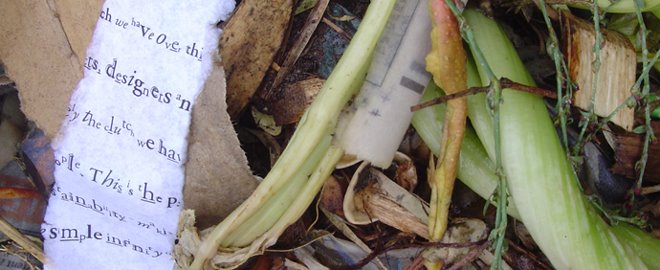
This thing on the other hand is 100% compostable, printed with vegetable based inks.

Monday, October 27, 2008

Zephyr carves up Swallow

A few years ago Zeph, Michael Farrell and I were walking from one room at the Ian Potter (NGV) – a gallery for non-compostable toxiculture specifically obsessed with Australian art – to another room where Ricky Swallow's dumb Vader object sat mutely on the floor. Zeph took one look at the dark ziggurat-like mask and launched himself at it, quickly mounting the top. At the time I expressed my delight to Micki Faz (as nicknamed by Nick Keys) that Zeph, at age 4, had out-done his dad in terms of cultural achievement. This little flick, taken a month or two ago, reminds me of that beautiful spirit at the Potty.

Saturday, October 25, 2008

Nipple (for Peter O'Mara)


Photography is the art of certainty that accepts as its limits the impartial something that can be captured of the everything that precedes the lens. 

Then there is photoshopping. A digital technique that confiscates the already memorialised before pushing it into the abject world of hyper-mediation. Not to be confused with collage or sampling.

Of course, the tiresome lineal premises of art's capitalisation (as discussed via skype with J this morning) is central to any critique of representation or object fetishised by the bourgeoisie, photographic or otherwise.

And, on another topic, it feels satisfyingly indulgent to be reading Spoerri's 'Mythological Travels..., given to me by my graphic friend Ian, and taken this afternoon by bike to the lake with Meg and her book of essays on plastics and ducks. But not indulgent in the same sense as the bourgeoisie's addiction to impure (non-compostable) consumption, because dipping into Spoerri's peculiar fetishised but unsentimental obsessions with macabre and other objects, crudely printed on the page like roneo copied black and white photos, (Something Else Press, Inc.) – the topographer of chance, the eternal infantile Spoerri – is go!