
Showing posts with label peter o'mara. Show all posts
Showing posts with label peter o'mara. Show all posts
Thursday, April 9, 2009


Friday, January 23, 2009

Friday, January 16, 2009
That which is possible
Several years ago Jason Workman and Esther Buder carried out a small food project in the Castlemaine district that filled their larder with bottled preserves and generated relations of sharing that continue today. The project was called That which is possible, and one of the gifts to come from it (that wasn't food-based) was a hand-made postcard series which contained pictures of claimed roadside food, recipes for preserving and a map of where the various plums, pears, apples, blackberries, and quince are and when, approximately, they bare fruit. The postcards were sent to friends but also to random strangers, not necessarily in the area, to promote a poetic of resourcefulness.

Today I had to go to Castlemaine to choose some stone for a small wall I'm building. I asked PO if he wanted to test Jason and Esther's 2005 map. Bingo! Early season cherry plums. We picked together a bag full for Meg's pancake breakfast on Sunday.

Saturday, January 10, 2009
Ockham's Razor (or, man on a) wire
What we know is based on direct experience, and the things we experience are twofold: the things we can see and touch, and our own mental activity... p.105
Leszek Kolakowski suggests Ockham's philosophy "opens up a deep rift, an unbridgeable chasm, between natural knowledge and faith"; the physical and the abstract, at least in the thirteenth century.
War generally is the result of unbridgeable chasms between the physical and the mental; of resource and land sovereingty and ideological or religious superiority. There is generally the oppressor (who's in expansion mode) and the oppressed (who's in resistance mode).
When wars are fought Ockham's Razor goes out the window, and therefore multiplicity is posited beyond necessity. I used the following Orwell quote in my last book to begin a chapter titled The problem of civilisation.
Actions are held to be good or bad, not on their own merits, but according to who does them, and there is almost no kind of moral outrage – torture, the use of hostages, forced labour, mass deportations, imprisonment without trial, forgery, assassination, the bombing of civilians – which does not change its moral colour when it is committed by "our" side. George Orwell, Notes on Nationalism, 1945Anthony Loewenstein's Zionism is a clear-eyed practice of Ockham's Razor; in other words, 'all other things being equal, the simplest solution is the best' – two states, no greed, permanent peace, checked superiority. Or, as my friends Peter O'Mara and Jeff Stewart have posited among the gum trees –

Thursday, December 11, 2008
Avoidance relations (a mesostic)
unfathomed fear is criPpling negation;
an immutable Agent for the simplistic and cruel.
if your heart is sweet-juiced, Thirsty and open,
your fear's reimburse 'a Human kind' (PO) –
unlike the cOld and made-up minds that poison;
the stupid are So dangerous, so blinkered and vain.
Sunday, November 23, 2008
Hairy soil (for Peter O'Mara)

We had two truck loads of unwanted soil dumped by council workers who were moving earth in our street. Unwanted because of the weed factor. The soil was originally brought in by the council only 6 months ago to top dress the nature strip, it then became overgrown and complaints were made. I thought that it was better the soil stay in the area than be transported away again and asked Paul the truck driver, who used to run the Trentham hardware next door to my old bookshop, if he could bring it down.
Pete turned up and said 'what's with the hairy soil?'
We are beginning to go through it with the pitchfork, separating all the grass and thistle and other organic matter into a separate pile. We will then cook it in a compost to kill the seed. The filtered soil will be used to top dress the property before being mulched to improve the overall humus and grow more food.
A nice little self-serving exercise within this hairy ecology.
Saturday, November 8, 2008
Best Sellers
The Centre for Collective Wealth is a project-based initiative founded by Jason Workman and Larisa Marossine in Brooklyn, NY. The centre facilitates online projects, discussions, events, public works and shows.For its inaugural project, the Center for Collective Wealth presents Best Sellers, a new video work by Patrick Jones.
Wednesday, November 5, 2008
Out of print
I've thought for a long time about how to make publishing books more a part of a closed-cycle ecology.
As the wireless reading device is still relatively non-existent, we really only have an industrial model of publishing: thousands of tonnes of books and draft manuscripts annually depopulating forests and by extension, releasing carbon into the atmosphere as greenhouse gas. It's a pretty fucked-up industry, like water bottled in plastic, that few seem to be critiquing.
Books I've published in the past use materials such as vegetable-based inks and recycled and chlorine-free pulp, however, production is still industrialised. Finsbury Green is the printery Ian and I generally use, and while they are leading the transition in cleaner technologies, I'm not convinced this will make all that much difference to the mammoth task we have of dismantling our toxiculture.
I think that change has to come from writers, who now have to decide their level of output, material use and distribution method – especially if we consider that transportation is an assault on the landbase that supports us. It helps when writers are also the publishers and distributors, like David Prater, a poet and early advocate of online publishing. He edits Cordite and knows first hand how much paper and ink has not passed through his office in the past ten years.
However, where the digital age has the potential to reduce pulp consumption on the planet, there's still the problem of digital hardware and the capitalisation (toxicology) of new technology – new equipment is upgraded while old equipment is offloaded as non-compostable waste.
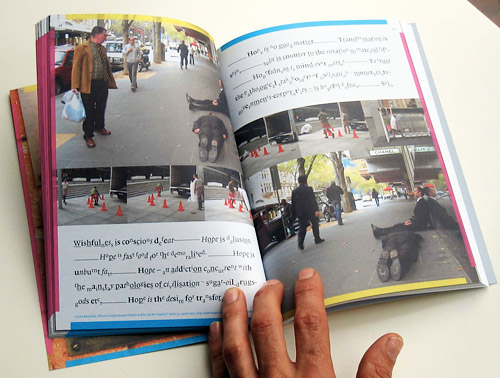
Then there's the materiality of books – their objecthoodness. Words and Things (2004) is an anthology of chance, concrete poetics and mutable literatures I edited, contributed to and co-produced with Ian Robertson. It includes Richard Tipping, Peter Tyndall, Peter O'Mara, Marie Sierra, Jeff Stewart, Aleks Danko, Alex Selenitsch and Geoffrey Baxter. It's now out of print and the 600 copies we manufactured are out in the world ready for some sort of decomposition.

As the wireless reading device is still relatively non-existent, we really only have an industrial model of publishing: thousands of tonnes of books and draft manuscripts annually depopulating forests and by extension, releasing carbon into the atmosphere as greenhouse gas. It's a pretty fucked-up industry, like water bottled in plastic, that few seem to be critiquing.
Books I've published in the past use materials such as vegetable-based inks and recycled and chlorine-free pulp, however, production is still industrialised. Finsbury Green is the printery Ian and I generally use, and while they are leading the transition in cleaner technologies, I'm not convinced this will make all that much difference to the mammoth task we have of dismantling our toxiculture.
I think that change has to come from writers, who now have to decide their level of output, material use and distribution method – especially if we consider that transportation is an assault on the landbase that supports us. It helps when writers are also the publishers and distributors, like David Prater, a poet and early advocate of online publishing. He edits Cordite and knows first hand how much paper and ink has not passed through his office in the past ten years.
However, where the digital age has the potential to reduce pulp consumption on the planet, there's still the problem of digital hardware and the capitalisation (toxicology) of new technology – new equipment is upgraded while old equipment is offloaded as non-compostable waste.
Then there's the materiality of books – their objecthoodness. Words and Things (2004) is an anthology of chance, concrete poetics and mutable literatures I edited, contributed to and co-produced with Ian Robertson. It includes Richard Tipping, Peter Tyndall, Peter O'Mara, Marie Sierra, Jeff Stewart, Aleks Danko, Alex Selenitsch and Geoffrey Baxter. It's now out of print and the 600 copies we manufactured are out in the world ready for some sort of decomposition.

Tuesday, October 28, 2008
Donovan Hohn does plastics
"Never mind that only 5 percent of plastics actually end up getting recycled. Never mind that the plastics industry stamps those little triangles of chasing arrows into plastics for which no viable recycling method exists. Never mind that plastics consume about 400 million tons of oil and gas every year and that oil and gas may very well run out in the not too distant future. Never mind that so-called green plastics made of biochemicals require fossil fuels to produce and release greenhouse gases when they break down. What’s most nefarious about plastic, however, is the way it invites fantasy, the way it pretends to deny the laws of matter, as if something—anything—could be made from nothing; the way it is intended to be thrown away but chemically engineered to last. By offering the false promise of disposability, of consumption without cost, it has helped create a culture of wasteful make-believe, an economy of forgetting."
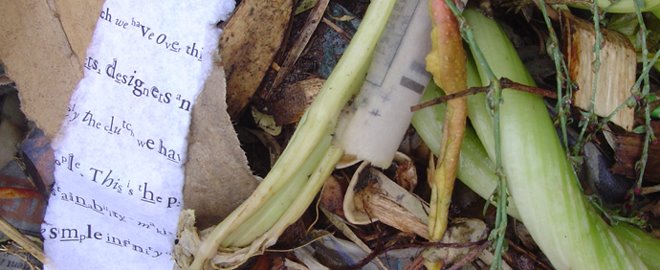
This thing on the other hand is 100% compostable, printed with vegetable based inks.

This thing on the other hand is 100% compostable, printed with vegetable based inks.

Saturday, October 25, 2008
Nipple (for Peter O'Mara)

Photography is the art of certainty that accepts as its limits the impartial something that can be captured of the everything that precedes the lens.
Then there is photoshopping. A digital technique that confiscates the already memorialised before pushing it into the abject world of hyper-mediation. Not to be confused with collage or sampling.
Of course, the tiresome lineal premises of art's capitalisation (as discussed via skype with J this morning) is central to any critique of representation or object fetishised by the bourgeoisie, photographic or otherwise.
And, on another topic, it feels satisfyingly indulgent to be reading Spoerri's 'Mythological Travels..., given to me by my graphic friend Ian, and taken this afternoon by bike to the lake with Meg and her book of essays on plastics and ducks. But not indulgent in the same sense as the bourgeoisie's addiction to impure (non-compostable) consumption, because dipping into Spoerri's peculiar fetishised but unsentimental obsessions with macabre and other objects, crudely printed on the page like roneo copied black and white photos, (Something Else Press, Inc.) – the topographer of chance, the eternal infantile Spoerri – is go!

Monday, October 13, 2008


Subscribe to:
Posts (Atom)