Showing posts with label poethics. Show all posts

Monday, February 9, 2009

Street food: some minor alternatives to capitalism

Peter Tyndall opened my first (awarded) public work, Poemscape: a physical anthology, with a considerable talk critiquing the use of the word 'scape' and its problematic mediation of the natural world. We all baked facing west to a hot afternoon sun, listening to Peter outside the public library. The 18 Fujis that I planted, across the road from the town's supermarket, clung pathetically to sturdy timber plinths, each capped with a poem etched into a brass plaque. One of these poems was Michel Deguys' O great apposition of the world. I used three local poems, six Australian (from other parts) and twelve from other countries, each based environmental themes. Nearly ten years on, with various re-plantings due to drought and social idiocy, the trees struggle on. Each year I prune, water and feed them, and this is the first year the apples have coddling moth, which I'll need to treat over a period of time. 


This afternoon Maria, our neighbour, dropped over a large bag of green apples, produced by her trees. "No good for eating", she said, "but, OK for stewing". So I harvested what little rhubarb we had left and made a combined stew. For breakfast in summer we usually have organic rolled oats, that we buy in bulk, with stewed fruit or currants and local apple juice. In winter we make porridge and add local honey. The only time we have to visit a supermarket is when we have been disorganised, and missed the small produce shops or the Sunday market. Each time I walk into a supermarket I feel ambushed, and the more I learn about industrial agriculture and the plastics industry the more difficult it is to actually buy anything from these centers of mediated and fluorescent violence. 


Many people are talking about post-capitalist strategies. Here's a few of mine: If you are in the city join or start a permablitzing community, if you're in a rural area grow your own food and buy, swap and glean from local growers. If you're into graffiti, plant fruit trees – think espaliered tags – where council workers might ignore or not see them until they are established. Official public art, such as my Poemscape, seems passé today, but all of this thought and activity is in transition from a broken cycle toxicology to a closed-cycle ecology. We need to get incrementally better at the latter in order to mitigate the former.

Wednesday, November 5, 2008

Out of print

I've thought for a long time about how to make publishing books more a part of a closed-cycle ecology.

As the wireless reading device is still relatively non-existent, we really only have an industrial model of publishing: thousands of tonnes of books and draft manuscripts annually depopulating forests and by extension, releasing carbon into the atmosphere as greenhouse gas. It's a pretty fucked-up industry, like water bottled in plastic, that few seem to be critiquing.

Books I've published in the past use materials such as vegetable-based inks and recycled and chlorine-free pulp, however, production is still industrialised. Finsbury Green is the printery Ian and I generally use, and while they are leading the transition in cleaner technologies, I'm not convinced this will make all that much difference to the mammoth task we have of dismantling our toxiculture.

I think that change has to come from writers, who now have to decide their level of output, material use and distribution method – especially if we consider that transportation is an assault on the landbase that supports us. It helps when writers are also the publishers and distributors, like David Prater, a poet and early advocate of online publishing. He edits Cordite and knows first hand how much paper and ink has not passed through his office in the past ten years.

However, where the digital age has the potential to reduce pulp consumption on the planet, there's still the problem of digital hardware and the capitalisation (toxicology) of new technology – new equipment is upgraded while old equipment is offloaded as non-compostable waste.

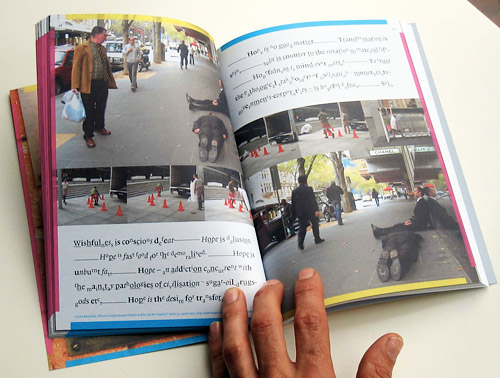
Then there's the materiality of books – their objecthoodness. Words and Things (2004) is an anthology of chance, concrete poetics and mutable literatures I edited, contributed to and co-produced with Ian Robertson. It includes Richard Tipping, Peter Tyndall, Peter O'Mara, Marie Sierra, Jeff Stewart, Aleks Danko, Alex Selenitsch and Geoffrey Baxter. It's now out of print and the 600 copies we manufactured are out in the world ready for some sort of decomposition.

Tuesday, October 14, 2008

Past Present Future


Today I continue to work on a text that has inspired this blog's beginnings, The Garden of Self Defence: a postscript to a Free-dragging Manifesto. 

In this piece I take one diagram, which was originally published 
by the Situationist International as a poster –

New Theatre of Operations for Culture, 1957


And add 51 years of 'everything' compostable and reusable to create my own diagram (in draft form); based upon a return to a closed-cycle ecology – NO TRANSPORTATION OF RESOURCES and NO WASTE! – except of course for experimental anomalies like free-dragging and a trillion other cultural mutations based on chance and experimental behaviour.

Atheatre of Operations for Permanent Culture, 2008


Monday, October 13, 2008