Showing posts with label industrial literature. Show all posts

Sunday, December 14, 2008

An angry post cheered up by a harvest of garlic, freshly washed

The one thing that everybody wants is to be free...not managed, threatened, directed, restrained, obliged, fearful, administered, they want none of these things they all want to feel free...they do not want to be afraid not more than is necessary in the ordinary business of living... Gertrude Stein, 1943
The daughter of the businessman, the income to write, the ordinary business of privilege; ever expanding post-war growth, ever expanding freedoms: cars, white-goods, confectionary, packaging, holidays; ever expanding art and art memorials; ever-expanding construction of culture well beyond the capacity of the landbase. Impermanent toxiculture; the mass market, the small secondary markets of the bourgeoisie: the snobs, the aspirants, the collectors, the publishers, the biography factory; ever-expanding obsessions of the civilised; utterly pre-tending to life.

"The world is round", Stein tells us, "and you can go on it round and round", she adds, as she did, as we do now, up and up, down and down, around and around, adding and expanding, unchecked and ill-managed, unbridled freedom, unlimited population, unleashed psychosis.

We have had 65 years of run-away capitalism, and here awaits us the blurred edge of run-away climate change: gas chambers lit for a new era holocaust by industry's furnaces and our desires.

Monday, November 24, 2008

Permapoesis

A well-composted soil fixes carbon in the earth where it’s needed most.

Permaculture bases its design principles on agro-ecology. A permaculturalist understands local ecology and applies this understanding to food production. This changes social, economic and cultural structures. If a poet’s food, which in part provides the material for poesis, is produced with her involvement, and within walking distance of her primary dwelling, her text is altered from one of capitalisation (reliance upon importation of resources) to one of ecology. The poet now participates actively within the environment that supports her, and the form and content of her life and work change accordingly.

The Readings Summer book catalogue arrived today which woke me from my slow text fantasy. I flicked through it in horror before heading back to my soil sifting. As I worked I imagined a publishing industry based on permaculture design and writers and poets stripped bare of their mediated existences; once dislocated, now active participants in the world that supports them.

Saturday, November 8, 2008

Best Sellers

The Centre for Collective Wealth is a project-based initiative founded by Jason Workman and Larisa Marossine in Brooklyn, NY. The centre facilitates online projects, discussions, events, public works and shows.

For its inaugural project, the Center for Collective Wealth presents Best Sellers, a new video work by Patrick Jones. 

Wednesday, November 5, 2008

Out of print

I've thought for a long time about how to make publishing books more a part of a closed-cycle ecology.

As the wireless reading device is still relatively non-existent, we really only have an industrial model of publishing: thousands of tonnes of books and draft manuscripts annually depopulating forests and by extension, releasing carbon into the atmosphere as greenhouse gas. It's a pretty fucked-up industry, like water bottled in plastic, that few seem to be critiquing.

Books I've published in the past use materials such as vegetable-based inks and recycled and chlorine-free pulp, however, production is still industrialised. Finsbury Green is the printery Ian and I generally use, and while they are leading the transition in cleaner technologies, I'm not convinced this will make all that much difference to the mammoth task we have of dismantling our toxiculture.

I think that change has to come from writers, who now have to decide their level of output, material use and distribution method – especially if we consider that transportation is an assault on the landbase that supports us. It helps when writers are also the publishers and distributors, like David Prater, a poet and early advocate of online publishing. He edits Cordite and knows first hand how much paper and ink has not passed through his office in the past ten years.

However, where the digital age has the potential to reduce pulp consumption on the planet, there's still the problem of digital hardware and the capitalisation (toxicology) of new technology – new equipment is upgraded while old equipment is offloaded as non-compostable waste.

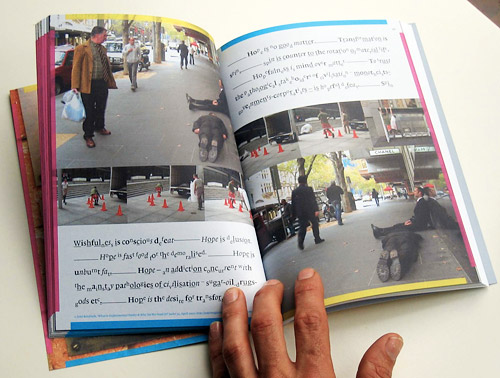
Then there's the materiality of books – their objecthoodness. Words and Things (2004) is an anthology of chance, concrete poetics and mutable literatures I edited, contributed to and co-produced with Ian Robertson. It includes Richard Tipping, Peter Tyndall, Peter O'Mara, Marie Sierra, Jeff Stewart, Aleks Danko, Alex Selenitsch and Geoffrey Baxter. It's now out of print and the 600 copies we manufactured are out in the world ready for some sort of decomposition.

Saturday, October 25, 2008

Nipple (for Peter O'Mara)


Photography is the art of certainty that accepts as its limits the impartial something that can be captured of the everything that precedes the lens. 

Then there is photoshopping. A digital technique that confiscates the already memorialised before pushing it into the abject world of hyper-mediation. Not to be confused with collage or sampling.

Of course, the tiresome lineal premises of art's capitalisation (as discussed via skype with J this morning) is central to any critique of representation or object fetishised by the bourgeoisie, photographic or otherwise.

And, on another topic, it feels satisfyingly indulgent to be reading Spoerri's 'Mythological Travels..., given to me by my graphic friend Ian, and taken this afternoon by bike to the lake with Meg and her book of essays on plastics and ducks. But not indulgent in the same sense as the bourgeoisie's addiction to impure (non-compostable) consumption, because dipping into Spoerri's peculiar fetishised but unsentimental obsessions with macabre and other objects, crudely printed on the page like roneo copied black and white photos, (Something Else Press, Inc.) – the topographer of chance, the eternal infantile Spoerri – is go!