Showing posts with label post-industrial. Show all posts

Monday, January 5, 2009

We breed the pathologies

Today I stumbled across a small booklet published in 1945 called We breed the Platypus written by local naturalist David Fleay. The introduction was written by Alec H Chisholm, F.R.Z.S., who refers to Fleay as the 'god-father' to the first platypus born in captivity.

The language of Chisholm is what is most interesting about this introduction. Chisholm obsesses with Fleay's noteriety as he does with a shy Australian mammal's global image.
Fame, of course, usually selects her subjects in more or less orthodox fashion, but occassionally she indulges a whimsy and makes her choice on novel lines.
Chisholm introduces to us the platypus in terms of her gradual shift from monist indigenous being, to invader's hoax, to spectacular zoological curiosity and worthy of civilised scholary investigation. 
Aborigines had stated that the animal actually burrowed into the ground for breeding purposes and laid soft-shelled eggs, and a number of white men had made the same claim. But no definitive evidence on the point was forth-coming until as late as 1884.
Chisholm notes that English zoologist, W H Caldwell's "...hard work in the bush" to make the discovery that the platypus actually lays eggs "...caused a major scientific sensation". Then he gets to the crux of what this post is about:
As the years rolled on the platypus continued with persistence worthy of a film star, to keep itself in the news.
In 1927 the first book about the platypus was written by actor turned naturalist Harry Burrell. Earlier Burrell took five 'water-moles' to America, and for the one that survived the voyage, for a mere forty-nine days in the New York Zoo, the authorities declared that the $1400 it cost and the interest it aroused was "fully justified".

Chisholm's invader's voice speaks for itself. A voice we have inherited without acknowledging the subtext. Today academics speak of post-industrialism and post-colonialism but the attitudes that exploit and colonise go on unchecked, as if celebrity culture has delivered us from the cult of the aristocrat.

I can't get out of my mind the poet's words: "Our elders are sick". It seems to say everything about how white Australia has, for the most part, ignored Aboriginal eldership and replaced it with abstraction and mediation.

Thursday, November 27, 2008

Reaping that which is possible


Today's harvest: broad beans and snow peas.

When growing food ceases to become a lifestyle choice (a mediation), but a life conscious act – or, rather a collective act for community health and defiance against governments who support industrialised agriculture – our society will begin its slow walk away from a culture of abuse to one of sustainability; one that fixes carbon, not one which burns it; one that produces no waste because everything is used and re-used in a closed-cycle ecology. Until that time government proclamations about the environment are empty and off the mark.

The food needs to be walking distance (relocalisation) and human brutality direct and seen for what it is, not disguised on the shelves of supermarkets. Our council tips need to move from methane producing toxic dumps to aerobic compost heaps and community gardens.

All of this is possible if enough of us stop waiting for governments to act or watch them lead us in the opposite direction (John Brumby). Which leads me to my current read (a gift from Jason), which I highly recommend:


David Graeber, p23 –
Sexual relations, after all, need not be represented as a matter of one partner consuming the other; they can also be imagined as two people sharing food.
More on Possibilities later.

Thursday, November 20, 2008

Hamish's gift

Response to my Tagged post by Hamish Morgan. 

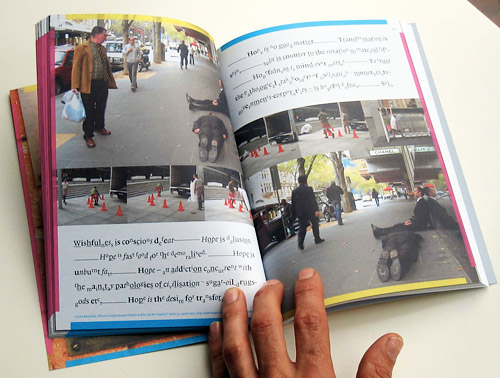
You talk about in your 'How to do Words with Things' about city based artists feeding off their own disconnection/abstraction in order to do their art (I would have to check up on that); their angst becomes generative of the work itself, and because everyone in the city has this disconnection there is a good market for this kind of work. Consumers buy the art in order to express their solidarity with disconnection and consumption. Your play in the city (along with an interest in graffiti, tagging, fonting!), to me, expresses a critique of those kind of artistic practices. That is, an art practice not built around consumption, one that is decapitalised. You propose an exchange, or gift-ecology. (The idea of a gift-economy began with Marcel Mauss, an anthropologist writing in the late 1920s after the destruction of Europe – through war and the industrial revolution – and wanting to rediscover a point of human connection without economic and industrial subterfuge. His book, 'The Gift', is a rather interesting critique of capitalism). I digress, back to my long-winded point. So you are interested in an art practice that generates responsibilities, obligations, debts, counter-gifts that keep a cycle of exchange going, that connects and keeps us in play with each other. (Another side point, the word for gift in German 'Gib' is the same word as poison - i.e. the gift is not 'free' but indebts us to give back, which is not necessarily a bad thing. The gift; antidote and poison! Also the English derivative of gift comes from the same word as 'take': the gift economy is one where we give and take; by giving we take something from the other - we take their sense of debt so that they give back!).

Perhaps all I want to say is that a truly decapitalised practice would have nothing to do with the city; would have no play with its structures, because this is what gives and takes our (creative) energy. I love a good ideas stoush; this shows my terrible reliance on critique (this is what the university teaches). I retreat from creativity through the self-defense of critique - now there is another provocation... PJ, I might add, I find your work terribly hopeful and evocative of a post-industrial future. Please keep sharing and indebting us all in a gift-ecology.

Wednesday, November 12, 2008

Compost & Cos


Today I killed Bill. She wasn't getting better with the garlic water and we couldn't justify the expense of a vet, nor the fantasy of industrial pharmaceuticals. I killed her as part of redressing the compost area, which looked like this at about 5pm. 


At 4.30pm I brought the black and white bins, full of kitchen scraps, back from Ben's cafe, laid Billy to rest at the base of the right-hand bay, tore up several cardboard boxes and placed them over her. I then wet down this elegiac layer and heaped on Ben's scraps, straw from the coup and Meg's day's weeding material, before covering up both bays to cook the compost.


The bay on the left (above), that I last turned here for Hamish Morgan – who today sent more reference humus: Katherine Gibson's 'The End of Capitalism' – is almost ready for use on the garden.


I picked our finest cos lettuce (above right) and returned Ben's bins, proudly presenting the first exchange of our casual gift-ecology.

Thursday, October 23, 2008

Tuesday, October 14, 2008

Past Present Future


Today I continue to work on a text that has inspired this blog's beginnings, The Garden of Self Defence: a postscript to a Free-dragging Manifesto

In this piece I take one diagram, which was originally published 
by the Situationist International as a poster –

New Theatre of Operations for Culture, 1957


And add 51 years of 'everything' compostable and reusable to create my own diagram (in draft form); based upon a return to a closed-cycle ecology – NO TRANSPORTATION OF RESOURCES and NO WASTE! – except of course for experimental anomalies like free-dragging and a trillion other cultural mutations based on chance and experimental behaviour.

Atheatre of Operations for Permanent Culture, 2008