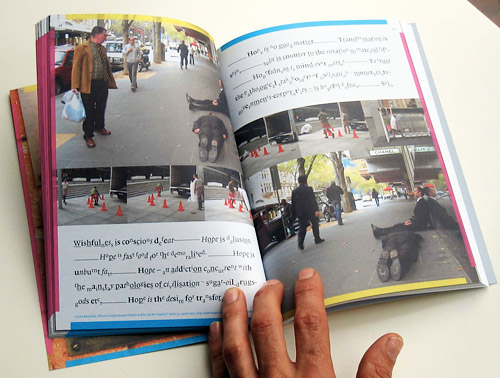
Reviewed in The Age by Robert Nelson.
Wednesday, June 3, 2009
Tuesday, June 2, 2009
The rage against permanency
Arm people with organic methods of self-sufficiency and see the rapid decline of factory farms, obesity, self-harm, ADHD, tooth decay, factory slaves, dioxins, wage-slaves, drug addiction, non-compostable waste, poisoned soil, carbon pollution, and on and on and on it goes.
Thursday, May 7, 2009
Sunday, April 26, 2009
Lucky dip and scratch (or, carbon fixed/carbon smoked)
In the meantime the garden has been neglected and the frost season has begun, which makes looking at the garden a tad depressing. Every day I have been scheming and planning new raised beds, future composts, fruit and nut tree plantings, canopies over raised bed structures in order to mitigate birds and frost damage, mulch and humus for further water and carbon conservation and more indigenous plantings to encourage greater biodiversity.
Surprisingly we've found that these heirloom toms (Riesentraube) are extremely frost hardy, for tomatoes at least. Because we live in a cold climate (though increasingly less so) toms generally come into abundance just as the first frosts start rolling in. Therefore these hardy toms are ideal in this climate. We've had 2 frosts already and the plants keep producing and ripening fruit.
In my absence the chooks have been guarding the compost. Over the Summer and until the first frost the European wasps had colonised the heap, now the chooks have reclaimed it as their very own lucky dip and scratch zone.
Working to pay bills and planning to fly to the US are obvious hypocrisies in light of what we're aiming to achieve in the garden over the next five years: 90% water self-sufficiency, 70% energy self-sufficiency, 70% food self-sufficiency. I suppose by agreeing to go to the US I participate in what I represent: a privileged late-capitalist citizen who still partakes in the short-term fantasy world of oil-based technologies.
As WorkmanJones' practice involves both disembodiment and re-embodiment, displacement and re-placement these ethical dilemmas are just part and parcel of a cold and rainy 2009 Sunday afternoon milieu.
Tuesday, April 21, 2009
Roaming Graffiti Wall
Background
It's March 2006 and it's the height of two disparate cultures in Australia – Howardism and stencilism. The City of Melbourne is hosting the Commonwealth Games and the authorities of the city have taken it upon themselves to enforce a zero-tolerance policy towards graffiti. This was our response.
Roaming Graffiti Wall from Patrick Jones on Vimeo.
A WorkmanJones action, 2006. Film and music by Patrick Jones (Peej), 2009. Roaming camera by Ivor Bowen. Wall roamers and supporters*: Jeff Stewart, Cath Davies, Pete O'Mara, Tim O'Sullivan, Jasmine Salomon, Patrick Jones, Laura (the RMIT student we roped in off the street), Tara Gilbee, Jason Workman, Cath Ryan, Ruark Lewis, Petra Beuskans, Peter Tyndall, Adrian Kosky and Nikki Blanch.
Friday, April 17, 2009
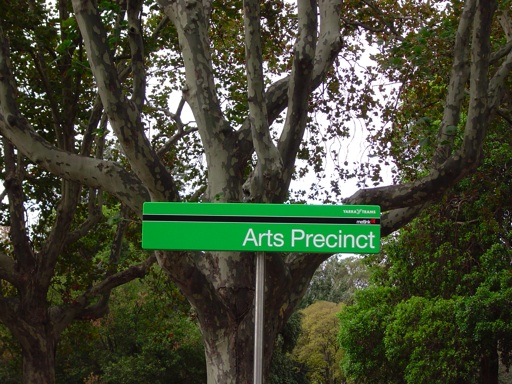
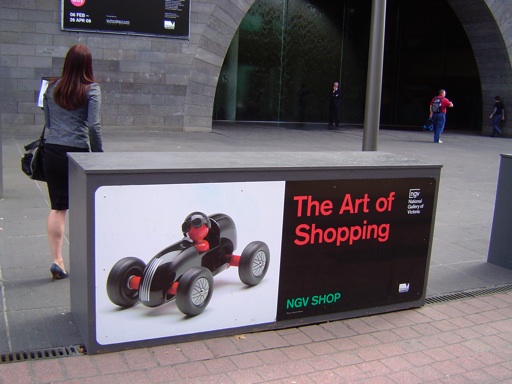
Melbourne cultural carbon factories (Art Precincts)

When will the art world pull its weight when it comes to carbon emissions and toxic waste?

Does this picture need any more explanation?
STUFF! We're overcrowded with TOO MUCH stuff, and apparently we need more. And, that's my segue in to an exhibition that opens tomorrow at MUMA called Too Much of Me: 7 Paths Through the Absurd (with Detour). Jason and I have two of our films in it as WorkmanJones. The "detour" is a collaborative film by Buster Keaton and Samuel Beckett. Working with another certainly begins a de-centering process. The self has to consider the other and become something else, something less controlling.
The self, as artist, as consumer, or as religious identity is disembodied in modern capitalist culture. The other (nature) is veiled and abstracted as if the material parameters that govern the universe will immaterialise via technological rationalism or religious fervor. Both manifest as monological illogic. There is too much of everything because the self is all consuming. Art is implicit in this picture, a bourgeois obsession. I'm not sure if WorkmanJones is an anti-art anymore. I often call our practice transitional in the way we attempt to ground our carbon in a practice that is of the body, but perhaps it's more aptly post-art.
Regardless, farming food bio-dynamically and living by permacultural methods is the priority now. Art has to re-embed itself in nature, it has to work on its own humus composition.
Incidentally the below pic is from the patron's honour board at ACCA. A cry out to all the Anonymous dudes online. You're legends!
Thursday, March 26, 2009
Free-dragging, slow text and permapoesis: towards a biophysical poetry (an excerpt)
Little by little the things that were once free and uncapitalised are increasingly legislated against, privatised or both – seed, birth, milk, school, water, art, death, etc. While free-dragging on road signs in country Victoria a few years ago Jason Workman and I were booked for “abstracting traffic”, and after challenging the police officer as to why we were being booked he told us “people have concerns when they see people doing things”. The fine was manageable at $120, however it was 100% of the budget for our day of practice. I managed to record the whole conversation I had with him, and have played it back many times to hear those words: “abstracting traffic”. But we were neither abstracting nor obstructing, which is no doubt what the country cop meant to say. Free-dragging developed for both Workman and I out of our own imprisonments. Free-dragging is thus a response to feeling enslaved. Free-dragging is a biophysics for self-liberty, a poetry form synonymous with composting where abstractions do not dominate but rather play their part in a material world. In coming out of these self-imposed sentences we began to understand that to hope was to project something abstract and unreachable upon the future and this caused considerable anxiety. We quickly came to reacquaint ourselves with joy and post-utopian play – non-deluded – our blood oxygenated with the liberty of hopelessness; endorphins as air in an aerobic compost. By becoming unstuck and uprooted we took greater refuge in ourselves as contiguous beings with everything else. Therefore our poetry/graffiti had to become public and participate in social space. We pulled down our garrets and with the materials reclaimed from an age of isolation and anxiety built raised beds for vegetables, chook houses, compost bays and are planning future alehouses based on steady state economics. Food sovereignty has become central to our work, which has developed as part of a broader permaculture community, a community of intensifying "poeverty" (post H D Thoreau and D T Suzuki), and through the development of a personal permapoesis. Thanks to Ian, Meg, Kate F, Jeff, Hamish, Jason and Pete O for your help with this work.The title of the panel came from this drawing I did a few years ago and was first published in Going Down Swinging No.26 last year.
Click for bigger.
Monday, March 16, 2009
Apple workshop
Today I gave a workshop to design students at RMIT. Before heading to Melbourne Meg, Z and I picked apples at the local library, where nearly ten years ago I planted 18 Fujis as part of a public work (which included public food and poetry). I introduced the students to the methods of WorkmanJones' practice and how we use chance and one prop, word or idea to propel our work on a given day. At the end of the workshop, after introducing the gleaned Fujis to corporatised public space – materially, architectually and as disruption – the students ceremoniously destroyed the remaining apples by throwing them at a wall. After a day in the city the destruction of such precious and nutritious life was somehow apt.
Thursday, January 22, 2009
On-off
Saturday, January 3, 2009
Mashed (elegy for the city)
Our elders are sick. Written on the wall of a child's tree-house by a Scottish poet.Since Plato we have been conscious of the ill-logic of our cities but struggled to do away with them. Now for the first time in human history there are more people in cities than in rural areas. It is no wonder, therefore, that human existence is at its most abstract, most violent, most 'civil', most veiled, most mediated, most toxic, most insane.
Wednesday, December 17, 2008
Cities
After I posted the most recent WorkmanJones film, Tag, a friend of mine, Hamish Morgan, challenged me on why we chose to use the city as a site for our work. There are so many ways to think about and address this question. I initially gave some reasons in response, but having thought more about it lately, about impermanent culture (impermaculture), I thought I'd share some of this thinking.
Firstly, cities exist. Modern cities are toxicities, they rely on resources from elsewhere, they waste waste, they can (probably) never be sustainable, more people live in them than in rural areas (a recent global phenomenon), and cities are places of social invention and mutation. For all these reasons, critiquing, participating in and understanding the city is to understand the dominant psyche of modern humans and why centralised capitalism is killing us, and many other species, very rapidly and very cruelly.
Recently, I voluntarily endured a paper given by a PhD candidate that cross-pollinated Situationist thought with her own desire to continue shopping. It was a seemingly clever paper using fashionable dérive poetics with individualist urbane desire. Michael Farrell brilliantly called it 'romantic shopping'. It simply repulsed me. She was a post-graduate student in sustainability and architecture.
Her intellectual abstractions represented her mediated blindness. She told us that she drove her car into the city to carry out her shopping 'experiments', and that she had to consume things in order for her experiment to work. When I challenged her, pretty clumsily regrettably, on her work as capitalist embellishing, she exclaimed, "But what other system have we got?"
What was so offensive about this paper was that an architect working in the area of sustainability was not looking at urban permaculture in Havana as a model or focus point for her research, or any other transitional city. Havana is a living example that excitingly challenges my Jensenian belief that cities can never be sustainable (based on a reliance upon the importation of resources). Instead it was her own desire and its place in the world that was being indulgently understood. The other area this paper failed to investigate, regarding the question of future sustainability and urban psychogeography, was indigenous intelligence.
Photo: Kathryn McCool
Monday, December 15, 2008
Property relations
Photo: Kathryn McCool
If property is so closely related to avoidance, and if these two principals of identification and exclusion really are so consistently at play (and I think they are), then is it really so daring to suggest that the person, in the domain of avoidance, is constructed out of property? David Graeber, Possibilities, p22.
Wednesday, November 19, 2008
Tagged Post (a response to Hamish Morgan)
I don’t think Tag is ‘against the city’; at least it is not a negation in total. It is difficult for play to be against something when it is caught up in the surprise and the joy of the new.
We have made similar work in the country, and of course the environment alters the work we make wherever it is. A rule of our practice, set out by John Cage, is ‘a work of art should include its environment’.
So, I see this new work not so much a critique, nor a logical attack, rather states of permanent play (permaplay) in everyday space and poesis (meaning-making) through activity before langauge. Making art without producing anything consumable is an obvious eco-politic that is 'against' the city (civis, civilisation, centre, transportation of resources, capitalisation, etc), but the work overall, I think, is more than this.
We specifically chose non-heroic, non-spectacular outer parts of Melbourne for no other reason than CBDs (toxicities) are so last century.
In relation to tagging itself I have a developing interest in the urban phenomenon of self-determining font making, graffitists who through the act of generating their own personalised fonts decentralise and demiltarise the alphabet in public space. This is important and exciting territory, and the body as tag is an extension of this line of graffic thought.
To make Tag we caught a train down to Melbourne, thus burning carbon, so this is a negation of our own making. A zero carbon footprint comes in small gradual steps over the next 6-7 years. Just in terms of carbon, we have a very small distance to go compared with, say, Fox Studios.
Additionally this film is part of a gift-ecology, a concept I'm developing so as my overall practice continues to contribute to the global movement of decapitalised art. I use gift-ecology instead of 'gift-economy' (a term developed by capitalists), because art should produce no waste – hence permanent culture (permaculture) as antidote to toxiculture.
Monday, November 17, 2008
Tag
Jason and I had a day making new work in Melbourne last Friday. On Saturday we put together this collage.