Showing posts with label Public Space. Show all posts

Saturday, February 7, 2009

Possessions of the sun

We're at the local lake. Dogs, ducks, yabbies, redfin, swans, swamp hens, flies, wasps, bees, mosquitos, jumping jacks, bull-ants, foxes, snakes, swamp wallabies, children and adult human beings share the water. I swim, cool down, then sit on the bank and continue my slow read of David Graeber's Possibilities: Essays on Hierarchy, Rebellion, and Desire.
The ultimate proof that one has sovereign power over another human being is one's ability to have them executed. In a similar fashion, one might argue, the ultimate proof of possession, of one's personal dominium over a thing, is one's ability to destroy it – and indeed this remains one of the key legal ways of defining dominium, as a property right, to this day. p73
Zeph gets out of the water and comes over to us, his towel wraps his shivering body, "You are under a rest Dad!" Which is true, so I reply "Yes, I'm under a tree, resting". "No Dad! You're under arrest!" he shouts. 

Until this Summer the highest recorded local temperature was 39 degrees celsius. This area of south-east Australia is known for its high rainfall and cool highland climate. Things are rapidly changing. Today is the fourth day of 41 degrees this past fortnight, and it is the most brutal, wind-charged and apocalyptic of all of the 4928 days that I've been living here. We're all on a high fire alert.
When you eat something, you do indeed destroy it (as an autonomous entity), but at the same time, it remains "included in" you in the most material of senses. Eating food, then, became the perfect idiom for talking about desire and gratification in a world in which everything, all human relations, were being re-imagined as questions of property. p74
After today "sovereignty" over something in terms of social relations, say between parents and children, masters and slaves, private property and public lakes (to name a few) has changed. Today the unsinkable Murdoch media empire crumbles, while the sun takes up the heirarchical slack, as if the financial crash and the nature crunch are wholly linked organisms. Of course they are. We are standing on the bank looking out over a body of cool water. Nearby, Ballarat's majestic Lake Wendouree is barren. Runaway climate change is just over the horizon, and our politicians and our own comfortable incontestability have sentenced us to nature's complete rule and wrath.

David Holmgren, at a recent meeting in our town hall (with climatologist Rob Gell), stated that growing your own food by permaculture methods uses between a fifth and a tenth less water than supermarket food. Additionally, Gell stated that by 2013, according to the most recent science, the Arctic ice will be gone, and that the southern part of Australia will burn and the northern part will become much wetter.

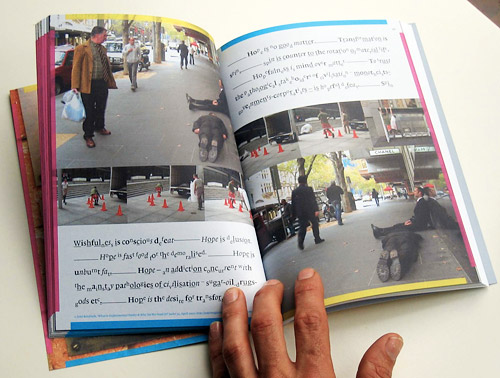
So I return to all I know: making useless art, embracing hopelessness, growing what food is possible, living intensely and actively with few expectations and sharing what's possible to share. Astrid Lorange, in her review of my book, writes it this way –
By decentring the kind of symbolism we might attach to an artistic manifesto for a sustainable future–that is, that hope will manifest as change–Jones sets up a far more mobilising set of propositions. Rather than hope and desire, we need to practise free-dragging, where non-delusional play and civil disobedience are the productive ferment of critical and creative hopelessness.
Others call it excrement.

Saturday, January 3, 2009

Mashed (elegy for the city)

Our elders are sick. Written on the wall of a child's tree-house by a Scottish poet.
Since Plato we have been conscious of the ill-logic of our cities but struggled to do away with them. Now for the first time in human history there are more people in cities than in rural areas. It is no wonder, therefore, that human existence is at its most abstract, most violent, most 'civil', most veiled, most mediated, most toxic, most insane.

Jason Workman gave me permission to do a mashup of WorkmanJones city interventions between 2006 and 2008, which I've just finished. The main track is by Esmerine, who I think are a Canadian band that don members of godspeed you! black emperor.


Wednesday, October 22, 2008

How to Do Things With Friends (2005)

Several years ago, inspired by reading John Cage, I asked Michael Farrell and Toby Sime to join me in a day's adventure with big dice in Melbourne. I made the dice with off-cuts of plywood and painted them with fast drying acrylic – my work tends to be compulsive; no rehearsal, little planning, loads of opportunity for de-authorisation. I asked a filmmaker friend, Ivor Bowen, to document the day as a surveiller, or as a jaw-agape tourist. Michael, Toby and I just hung around the city inventing games, sitting around, talking to people, walking aimlessly and throwing the dice. A few years later another friend of mine's band, The Haints of Dean Hall, put out an album and I choose the following, completely unrelated country soundtrack to accompany the activities we had previously invented in the city, and spun the two together into the following flick.

In short, Cage's writings on chance and the Situationists' manifesta on 'experimental behaviour' and 'drifting' cumulate into three poets fucking around the city writing poems with big die.

Thursday, October 16, 2008

To what end?


"The economic crisis is petty by comparison to the nature crunch. But they have the same cause... As we goggle at the fluttering financial figures, a different set of numbers passes us by. On Friday, Pavan Sukhdev, the Deutsche Bank economist leading a European study on ecosystems, reported that we are losing natural capital worth between $2 trillion and $5 trillion every year, as a result of deforestation alone(1). The losses incurred so far by the financial sector amount to between $1 trillion and $1.5 trillion. Sukhdev arrived at his figure by estimating the value of the services - such as locking up carbon and providing freshwater - that forests perform, and calculating the cost of either replacing them or living without them. The credit crunch is petty when compared to the nature crunch." Read more Monbiot here.