Saturday, May 2, 2009
On death, sex and compost
Thursday, April 16, 2009
I think therefore I comment, I comment therefore I think
Delight yourself in the Lord, and he will give you the desires of your heart.
Delight yourself in the soil and it will give you unrelenting honesty about your Christian-capitalist carbon footprint.But why is a C-c carbon footprint necessarily larger than my own? I'd like to get it measured to be sure, so I'm taking an educated guess that those who invest in desire, hope, fantasy and heaven aren't really thinking about microbial life, and therefore about carbon fixing. If only cops would breathalise us for greenhouse gas and humus depletion and leave drink driving to real chance encounters.
It says (in a slow text):
Christ is the only Christian, become your own Ian.I have a friend called Ian whom I love to call Ianian, and he is the greatest Ianian of them all.
Wednesday, April 1, 2009
Father and son free-dragging
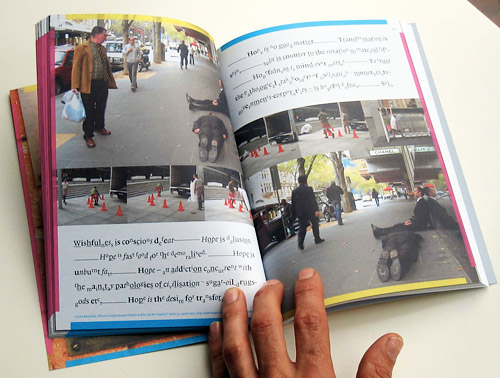
Laugh Club not working for you? Then wreck yourself in a crash course in Free-dragging. The course tutor is one of the co-originators of this mutant form of Parkour (sometimes carried out in drag). Learn the poetry of hopelessness and the art of physical graffiti from a master free-dragger. Come with your own liability insurance and self-liberty assurance. Guaranteed to make you sore.
Wednesday, February 18, 2009
3g
- gathering
- gleaning
- growing
Sunday, February 15, 2009
Saturday, February 7, 2009
Possessions of the sun
The ultimate proof that one has sovereign power over another human being is one's ability to have them executed. In a similar fashion, one might argue, the ultimate proof of possession, of one's personal dominium over a thing, is one's ability to destroy it – and indeed this remains one of the key legal ways of defining dominium, as a property right, to this day. p73Zeph gets out of the water and comes over to us, his towel wraps his shivering body, "You are under a rest Dad!" Which is true, so I reply "Yes, I'm under a tree, resting". "No Dad! You're under arrest!" he shouts.
When you eat something, you do indeed destroy it (as an autonomous entity), but at the same time, it remains "included in" you in the most material of senses. Eating food, then, became the perfect idiom for talking about desire and gratification in a world in which everything, all human relations, were being re-imagined as questions of property. p74
By decentring the kind of symbolism we might attach to an artistic manifesto for a sustainable future–that is, that hope will manifest as change–Jones sets up a far more mobilising set of propositions. Rather than hope and desire, we need to practise free-dragging, where non-delusional play and civil disobedience are the productive ferment of critical and creative hopelessness.Others call it excrement.
Saturday, January 17, 2009
Stateless Gestures
Tuesday, January 6, 2009
Beyond judgement, towards criticality
...avoidance became generalized: in the sense that principals of behaviour which once applied mainly to relations of formal deference gradually came to set the terms for all social relations, until they became so thoroughly internalized they ended up transforming people's most basic relations with the world around them. David Graeber, p31.
Saturday, January 3, 2009
The great unwashed
Supermarkets represent society's woeful handling of death. Like the city, the supermarket is a petroleum-based assualt on the earth by the Great Washed – the civilised; the centralised. When all our vegetables once again look like these dirty irregular carrots (top right), grown locally, we will have given up the dependance upon credit, veils, abstractions and mediations that constitute a woeful and disconnected relation to death.
For a more succinct and inspirational version of this rant check out Alastair McIntosh's Do Lecture.
Thursday, January 1, 2009
Sunday, December 21, 2008
A de-civilising process
At this point, I can turn to Norbert Elias' argument about the civilizing process in Europe...essentially it came down to the attempt, largely on the part of middle class religious authorities, to improve the manners of those below: most of all by eliminating all traces of the carnivalesque from popular life. David Graeber, Possibilities, p31-32.
Photo: Peter O'Mara (as you can see he won't make Best Australian Photography, 2008, but he is included in this year's Best Australian Poems, UQP).
Friday, December 19, 2008
Immutable fashion – notes on small talk
The Dancers Inherit the partyWhen I have talked for an hour I feel lousy –Not so when I have danced for an hour:The dancers inherit the partyWhile the talkers wear themselves out andsit in corners alone, and glower.
On middle class povertyThe poet's teeth are rotten.The poet doesn't drive.The poet has an empire in the mind.The poet writes the god.The poet is assassinated.The poet's unAustralian.Patrick Jones (listen to this poem here)
Wednesday, December 17, 2008
Cities
After I posted the most recent WorkmanJones film, Tag, a friend of mine, Hamish Morgan, challenged me on why we chose to use the city as a site for our work. There are so many ways to think about and address this question. I initially gave some reasons in response, but having thought more about it lately, about impermanent culture (impermaculture), I thought I'd share some of this thinking.
Firstly, cities exist. Modern cities are toxicities, they rely on resources from elsewhere, they waste waste, they can (probably) never be sustainable, more people live in them than in rural areas (a recent global phenomenon), and cities are places of social invention and mutation. For all these reasons, critiquing, participating in and understanding the city is to understand the dominant psyche of modern humans and why centralised capitalism is killing us, and many other species, very rapidly and very cruelly.
Recently, I voluntarily endured a paper given by a PhD candidate that cross-pollinated Situationist thought with her own desire to continue shopping. It was a seemingly clever paper using fashionable dérive poetics with individualist urbane desire. Michael Farrell brilliantly called it 'romantic shopping'. It simply repulsed me. She was a post-graduate student in sustainability and architecture.
Her intellectual abstractions represented her mediated blindness. She told us that she drove her car into the city to carry out her shopping 'experiments', and that she had to consume things in order for her experiment to work. When I challenged her, pretty clumsily regrettably, on her work as capitalist embellishing, she exclaimed, "But what other system have we got?"
What was so offensive about this paper was that an architect working in the area of sustainability was not looking at urban permaculture in Havana as a model or focus point for her research, or any other transitional city. Havana is a living example that excitingly challenges my Jensenian belief that cities can never be sustainable (based on a reliance upon the importation of resources). Instead it was her own desire and its place in the world that was being indulgently understood. The other area this paper failed to investigate, regarding the question of future sustainability and urban psychogeography, was indigenous intelligence.
Photo: Kathryn McCool
Monday, December 15, 2008
Property relations
Photo: Kathryn McCool
If property is so closely related to avoidance, and if these two principals of identification and exclusion really are so consistently at play (and I think they are), then is it really so daring to suggest that the person, in the domain of avoidance, is constructed out of property? David Graeber, Possibilities, p22.
Saturday, December 13, 2008
Ashes and boxes (some notes on death)
The one thing that everybody wants is to be free...not managed, threatened, directed, restrained, obliged, fearful, administered, they want none of these things they all want to feel free...they do not want to be afraid not more than is necessary in the ordinary business of living... Gertrude Stein, 1943
Friday, December 5, 2008
Shredding, gleaning, piling and heaping
Wednesday, December 3, 2008
The crow and the chook
Aborigines saw man as sharing a common life-principal with animals, birds and plants. They embraced all these in human social and religious life by establishing totemic relationships between them and people. (A P Elkin, 1967, from The Loddon Aborigines, Edgar Morrison, p.17., private press booklet, 1971, from articles published in the Daylesford Advocate newspaper 1963-1971).The Loddon Aborigines, as anthropologists like David Graeber might suggest, had relations of 'common substance' with the land – a closed-cycle, single-broken-line homeostasis, where the body (as tribe) is contiguous with everything else. Here, the closed-cycle represents the tribal land, a clearly delineated food and water bowl where nothing is wasted, and the single-broken-line represents the necessity for other relations outside of this land.
Within these clearly defined boundaries their hunting rights were ordinarily respected by their neighbours with whom they normally enjoyed friendly relations and a measure of collaboration and inter-marriage. (The Loddon Aborigines, Edgar Morrison, p16., private press booklet, 1971, from articles published in the Daylesford Advocate newspaper 1963-1971).This kind of collaboration can occur because the line is permanently broken. By contrast, the gated-existence model of industrial civilisation – the privatisation, capitalisation and transportation of resources – is represented as a solid double=white=line; a line of brutally imposed impermanent or throwaway culture.
Last night at a meeting at the Daylesford Town Hall, David Holmgren, co-originator of Permaculture, spoke with climatologist Rob Gell, in relation to the funding of a community-owned wind farm, Hepburn Wind. After their presentations, I asked them whether 6-7 years was a realistic timeframe to make the transition from industrial civilisation to a zero emission, water, energy and food relocalisation system, such as what we are attempting, with permaculture principals, in the Garden of Self Defence. Gell said effectively that yes, 5-10 years is the timeframe for radical change and that runaway climate change will result if we don’t all act significantly within this period. Holmgren went on to add that those who make the transition earlier, especially from oil dependancy, will find it easier than others to adapt because in a culture of high waste there is still so much to glean and reuse when only a few are doing it. When he opened his address, Gell said that he had just met with Penny Wong, Minister for Climate Change and Water, which confirmed for him that those who place their trust in governments (to make the necessary changes) delude themselves.
Government, effectively, is in a war of contradictions with itself. The war goes something like this: good intentions plus millions of dollars of consultancy fees equates to greenwash, while old world industries pressure bureaucrats to retain business as usual in terms of consumption and waste. Last night’s sentiment and permaculture’s general call to arms since the early 1970s suggests that governments are sluggish beasts who cannot act as quickly as we can at a local level.
If we require a system to replace neoliberal capitalism, and I believe we do, then it is indeed Permaculture. Cuba has demonstrated this, albeit an easier task within a socialist country where there is little unburnt fat to start with. Which brings me to an issue that has been bugging me for a number of months, playing out in our garden as I write. Permaculture of course includes chooks as central to any design. Our two chooks are called Dirt and Cuba. Chooks give manure, eggs and companionship while we provide food, protection and a warm bed of straw reciprocally. A family of crows have come to enjoy the pleasures of gleaning the chook food and competing with them for local resources. Our natural inclination has been to frighten them off and protect our chooks' feed. Sound familiar?
In order to understand the possibilities for our own localised, closed-cycle, single-broken-line ecological existence, we have come to realise we have to remain open to and not bully-away these potent black birds, whose environment we occupy. Indeed everything of our previous existence must be challenged, especially our double=white=line – the supermarket and the transportation of resources, and the interrelationship with the global market, conversion monotheism, profit-growth capitalism, our militarised and specialised education system, to name but a few of the most destructive hegemonies.
An ecological intelligence or permapoesis depends upon our sensitivity to indigenous intelligence. When our economists are equally our ecologists and our systems and resources are again shared, we will have reclaimed some of the intelligence for a permanent culture that the local mob fully possessed.
Monday, December 1, 2008
On joking, avoidance and common substance
The body in the domain of joking, one might say, is constituted mainly of substances – stuff flowing in or out. The same could hardly be true of the body in the domain of avoidance, which is set apart from the world... While joking bodies are necessarily apiece with the world (one is almost tempted to say "nature") and made up from the same sort of materials, the body in avoidance is constructed out of something completely different. It is constructed of property. p21.Relations of 'common substance' are also recalled.
...where an entirely material idiom of bodily stuff and substances can be seen as the basis for bonds of caring and mutual responsibility between human beings. p23.He goes on to talk about the possibility of sex between two people in terms of sharing food, not as one person consuming the other (as mentioned in an earlier post). Sharing, here, is experienced outside of an 'owning' relation (of avoidance). Graeber, like Hamish Morgan a few weeks ago in this garden, brings in Marcel Mauss.
Mauss has also argued that in giving a gift, one is giving a part of oneself. If a person is indeed made up of a collection of properties, this would certainly be true... Gift giving of the Maussian variety is never, to my knowledge, accompanied by the sort of behaviour typical of joking relations; but it often accompanies avoidance. p23.A double white Australia line policy, an expression fixé I have used in poems and other forms of thinking since 2001, is used to describe how colonialism (relations of avoidance) pierces and separates, disenfranchises and prepares Aboriginal land and resources for private use and sale. A double white Australia line is a policy of all governments since occupation.