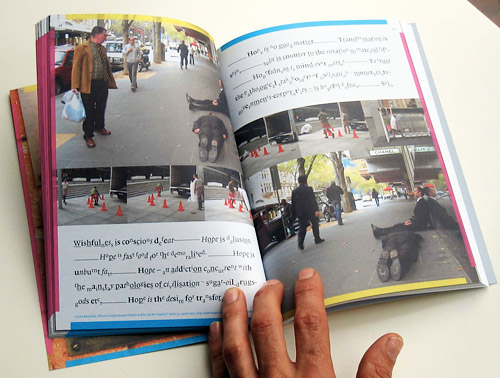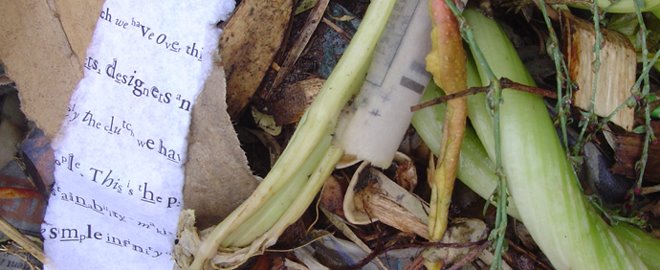
And from public fruit (yesterday's post) to another form of self-pollination – Jason Workman and Ian Gamble in North Carolina.
Showing posts with label Non-capitalised Art. Show all posts
Showing posts with label Non-capitalised Art. Show all posts
Saturday, January 17, 2009


Saturday, January 3, 2009
Mashed (elegy for the city)
Our elders are sick. Written on the wall of a child's tree-house by a Scottish poet.Since Plato we have been conscious of the ill-logic of our cities but struggled to do away with them. Now for the first time in human history there are more people in cities than in rural areas. It is no wonder, therefore, that human existence is at its most abstract, most violent, most 'civil', most veiled, most mediated, most toxic, most insane.
Jason Workman gave me permission to do a mashup of WorkmanJones city interventions between 2006 and 2008, which I've just finished. The main track is by Esmerine, who I think are a Canadian band that don members of godspeed you! black emperor.
Wednesday, December 17, 2008
Cities

After I posted the most recent WorkmanJones film, Tag, a friend of mine, Hamish Morgan, challenged me on why we chose to use the city as a site for our work. There are so many ways to think about and address this question. I initially gave some reasons in response, but having thought more about it lately, about impermanent culture (impermaculture), I thought I'd share some of this thinking.
Firstly, cities exist. Modern cities are toxicities, they rely on resources from elsewhere, they waste waste, they can (probably) never be sustainable, more people live in them than in rural areas (a recent global phenomenon), and cities are places of social invention and mutation. For all these reasons, critiquing, participating in and understanding the city is to understand the dominant psyche of modern humans and why centralised capitalism is killing us, and many other species, very rapidly and very cruelly.
Recently, I voluntarily endured a paper given by a PhD candidate that cross-pollinated Situationist thought with her own desire to continue shopping. It was a seemingly clever paper using fashionable dérive poetics with individualist urbane desire. Michael Farrell brilliantly called it 'romantic shopping'. It simply repulsed me. She was a post-graduate student in sustainability and architecture.
Her intellectual abstractions represented her mediated blindness. She told us that she drove her car into the city to carry out her shopping 'experiments', and that she had to consume things in order for her experiment to work. When I challenged her, pretty clumsily regrettably, on her work as capitalist embellishing, she exclaimed, "But what other system have we got?"
What was so offensive about this paper was that an architect working in the area of sustainability was not looking at urban permaculture in Havana as a model or focus point for her research, or any other transitional city. Havana is a living example that excitingly challenges my Jensenian belief that cities can never be sustainable (based on a reliance upon the importation of resources). Instead it was her own desire and its place in the world that was being indulgently understood. The other area this paper failed to investigate, regarding the question of future sustainability and urban psychogeography, was indigenous intelligence.

Photo: Kathryn McCool
Wednesday, November 19, 2008
Tagged Post (a response to Hamish Morgan)
The following writing is in response to Hamish Morgan's comment on Tag yesterday.
I don’t think Tag is ‘against the city’; at least it is not a negation in total. It is difficult for play to be against something when it is caught up in the surprise and the joy of the new.
We have made similar work in the country, and of course the environment alters the work we make wherever it is. A rule of our practice, set out by John Cage, is ‘a work of art should include its environment’.
So, I see this new work not so much a critique, nor a logical attack, rather states of permanent play (permaplay) in everyday space and poesis (meaning-making) through activity before langauge. Making art without producing anything consumable is an obvious eco-politic that is 'against' the city (civis, civilisation, centre, transportation of resources, capitalisation, etc), but the work overall, I think, is more than this.
We specifically chose non-heroic, non-spectacular outer parts of Melbourne for no other reason than CBDs (toxicities) are so last century.
In relation to tagging itself I have a developing interest in the urban phenomenon of self-determining font making, graffitists who through the act of generating their own personalised fonts decentralise and demiltarise the alphabet in public space. This is important and exciting territory, and the body as tag is an extension of this line of graffic thought.
To make Tag we caught a train down to Melbourne, thus burning carbon, so this is a negation of our own making. A zero carbon footprint comes in small gradual steps over the next 6-7 years. Just in terms of carbon, we have a very small distance to go compared with, say, Fox Studios.
Additionally this film is part of a gift-ecology, a concept I'm developing so as my overall practice continues to contribute to the global movement of decapitalised art. I use gift-ecology instead of 'gift-economy' (a term developed by capitalists), because art should produce no waste – hence permanent culture (permaculture) as antidote to toxiculture.
I don’t think Tag is ‘against the city’; at least it is not a negation in total. It is difficult for play to be against something when it is caught up in the surprise and the joy of the new.
We have made similar work in the country, and of course the environment alters the work we make wherever it is. A rule of our practice, set out by John Cage, is ‘a work of art should include its environment’.
So, I see this new work not so much a critique, nor a logical attack, rather states of permanent play (permaplay) in everyday space and poesis (meaning-making) through activity before langauge. Making art without producing anything consumable is an obvious eco-politic that is 'against' the city (civis, civilisation, centre, transportation of resources, capitalisation, etc), but the work overall, I think, is more than this.
We specifically chose non-heroic, non-spectacular outer parts of Melbourne for no other reason than CBDs (toxicities) are so last century.
In relation to tagging itself I have a developing interest in the urban phenomenon of self-determining font making, graffitists who through the act of generating their own personalised fonts decentralise and demiltarise the alphabet in public space. This is important and exciting territory, and the body as tag is an extension of this line of graffic thought.
To make Tag we caught a train down to Melbourne, thus burning carbon, so this is a negation of our own making. A zero carbon footprint comes in small gradual steps over the next 6-7 years. Just in terms of carbon, we have a very small distance to go compared with, say, Fox Studios.
Additionally this film is part of a gift-ecology, a concept I'm developing so as my overall practice continues to contribute to the global movement of decapitalised art. I use gift-ecology instead of 'gift-economy' (a term developed by capitalists), because art should produce no waste – hence permanent culture (permaculture) as antidote to toxiculture.
Again, all this is transitional thought, on the way to a post-industrial, post-consumerist modality.
Thanks to all the commenteers – such generosity!
Sunday, November 16, 2008

Friday, October 31, 2008
On the shelf of books
On the shelf sit three unpublished manuscripts including two illustrated children's books. Every now and then they get an airing. Here's a page from my 2003-2006 poetry manuscript.

Monday, October 13, 2008

Subscribe to:
Posts (Atom)