After I posted the most recent WorkmanJones film, Tag, a friend of mine, Hamish Morgan, challenged me on why we chose to use the city as a site for our work. There are so many ways to think about and address this question. I initially gave some reasons in response, but having thought more about it lately, about impermanent culture (impermaculture), I thought I'd share some of this thinking.
Firstly, cities exist. Modern cities are toxicities, they rely on resources from elsewhere, they waste waste, they can (probably) never be sustainable, more people live in them than in rural areas (a recent global phenomenon), and cities are places of social invention and mutation. For all these reasons, critiquing, participating in and understanding the city is to understand the dominant psyche of modern humans and why centralised capitalism is killing us, and many other species, very rapidly and very cruelly.
Hamish has spent a few years living with an aboriginal community in remote WA, and I have spent the majority of my life living in occupied regional areas of Australia, namely the Wingecarribee district, Wagga Wagga and Djadjawurrung country for the past 13 years. Both Hamish and I have been educated in urban universities, where few questions are ever asked concerning urban impermaculture.
Recently, I voluntarily endured a paper given by a PhD candidate that cross-pollinated Situationist thought with her own desire to continue shopping. It was a seemingly clever paper using fashionable dérive poetics with individualist urbane desire. Michael Farrell brilliantly called it 'romantic shopping'. It simply repulsed me. She was a post-graduate student in sustainability and architecture.
Her intellectual abstractions represented her mediated blindness. She told us that she drove her car into the city to carry out her shopping 'experiments', and that she had to consume things in order for her experiment to work. When I challenged her, pretty clumsily regrettably, on her work as capitalist embellishing, she exclaimed, "But what other system have we got?"
What was so offensive about this paper was that an architect working in the area of sustainability was not looking at urban permaculture in Havana as a model or focus point for her research, or any other transitional city. Havana is a living example that excitingly challenges my Jensenian belief that cities can never be sustainable (based on a reliance upon the importation of resources). Instead it was her own desire and its place in the world that was being indulgently understood. The other area this paper failed to investigate, regarding the question of future sustainability and urban psychogeography, was indigenous intelligence.
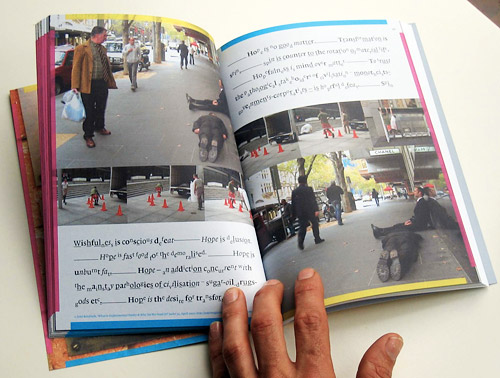
Our urban film, Tag, was never meant as a critique of the city, rather an example of using an impermacultural domain as a site for post-consumer play. A critique of the city occurs in other parts of my practice, as it does here. It was also made to demonstrate the body as common substance, devoid of shame and embarrassment, and directly influenced by the abstract and toxic environment in which we were courting chance behaviours.
 Photo: Kathryn McCool