
 A portrait of the artist as superscript type.
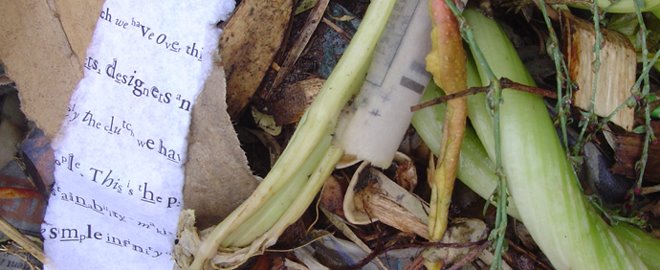 A portrait of the artist as superscript type.
The Internet and globalisation have created a virtual compression of time-space; networks of interrelation have spread across any possible boundary creating diverse points of connection. The net is expanding from one site of intensity to another, creating webs of interrelation upon which economic, environmental and social survival depends. The extension we want to make in this paper is that this modern digital experience is one that shares its model, at least at a ‘systems’ or epistemological level, with both traditional and contemporary cultural practices from the Central and Western Deserts in Australia.
Far from being ‘primitive’ or ‘no longer possible’ the Aboriginal model is the future. It is a map or blueprint for future social, economic and ecological relations that are taking place now, as they have for thousands of years. The modernisation of Australia can be seen as beginning from the desert out.
European modernisation in Australia is predominantly ecologically disembodied, and in recent times we have experienced further ramifications of this dominant cultural intervention, especially in terms of social and environmental disquietude. In Australia’s urban centres increases in self-harm, mood disorders, chronic illness, violence and obesity proliferate among young people, while their social network systems have never been more advanced. The concentration of populations in cities, and the reliance upon the importation of resources, has placed an unprecedented strain upon the landbase. The generation of heavily processed and synthetic food, derived from a developing culture of “super-farms”, coincide with a digital ecology model for social health and diversity; where the former (industrial agricultures) negates the latter (digital ecologies).
In this paper we will develop these theses and show which models already exist for a future beyond a disembodied aggregate-growth society. We will discuss Aboriginal social networking modalities in light of online community making; discuss Aboriginal rotational agricultural practices and compare them to modern permacultural practices; and discuss how the disembodied urban experience can be re-embedded into socio-ecological systems.


Perhaps why we know so much less about the trillions of microbes in the soil below our feet than we do about the stars and solar systems above our heads is because the civilised world is obsessed with transcendence, grandeur, spectacle and escape. Art and literature are often specifically implicated in this skywards obsession, which also concerns the cult of celebrity – a culture of anxiety and hypermediation directly related to food disorders and substance abuse. From Free-dragging, Slow Text and Permapoesis: towards a biophysical poetry, Patrick Jones, 2009.
Industrial civilisation functions in a broken cycle: product is separated from process, production and consumption are geographically dislocated, cause is distanced from eventual (deferred) effect. The production of waste is unavoidable in this modality. There is no ecology of commerce in place, nor is capitalism capable of implementing one.
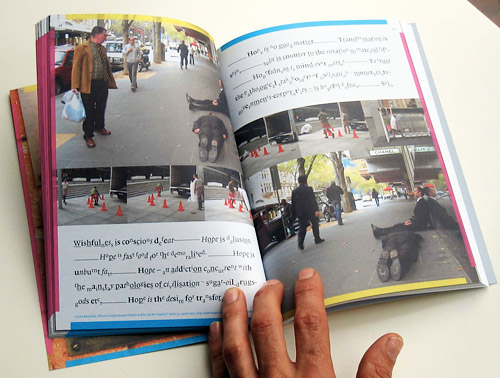 (Made from vegetable based inks printed on chlorine-free pulp - fully compostable!)


